We have decided to stay put today rather than packing everything up to go exploring. It is vacation after all. We can find enough to do here for a day.
Consequently, we have been very lazy this morning. It makes a huge difference when you can get outside early enough for coffee, followed by a late breakfast (fried eggs and homemade bagels) followed by a second coffee.

One of the things we added to the van this year is a small expresso machine. We don’t drink filtered coffee. Even at home we only drink lattes. We have been able to create room for the machine, the milk frother AND the coffee pods. Although I am not sure how we would carry enough pods for a longer trip. I do not miss cleaning out the previous coffee maker and the coffee grounds. It makes everything so much cleaner. How coffee grounds end up in the cutlery drawer has always been a mystery to me.
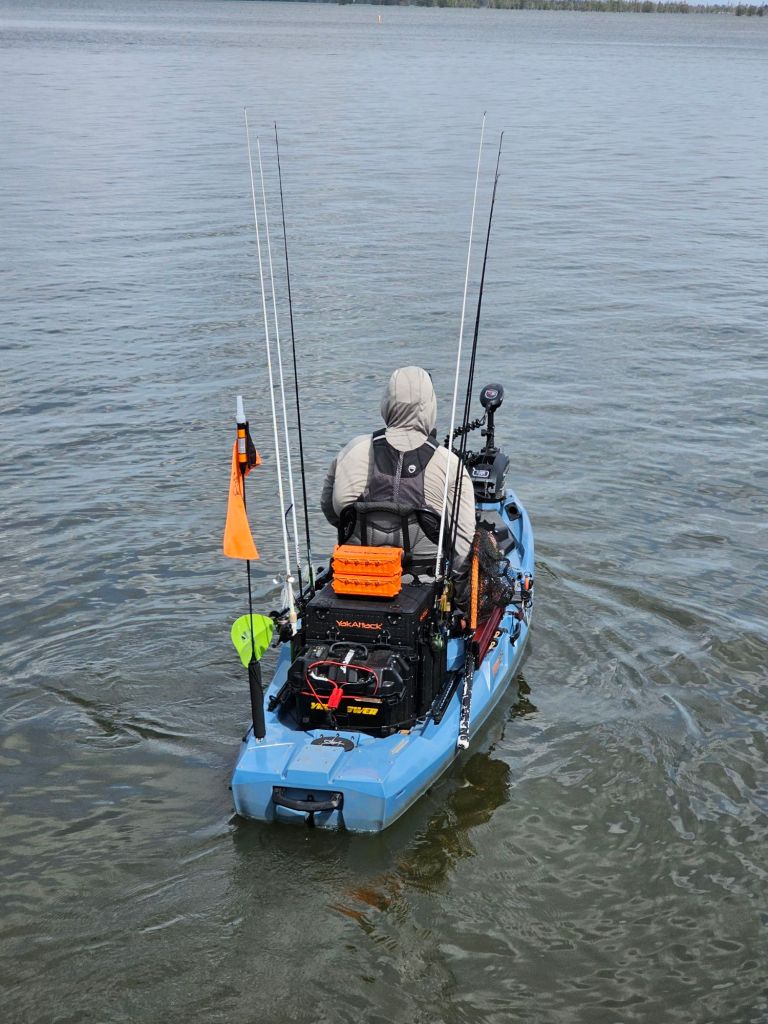
Most of the campsites here are occupied by people who are here to fish. There is some serious fishing gear in this campground along with a variety of small boats and strange tent contraptions.
History of Lake Marion, South Carolina
Lake Marion is the largest lake in South Carolina, spanning approximately 110,000 acres. It was created between 1939 and 1942 as part of the Santee-Cooper Hydroelectric and Navigation Project, a New Deal initiative designed to provide hydroelectric power, improve navigation, and boost economic development in the region.
The Creation of Lake Marion
The project was led by the South Carolina Public Service Authority (commonly known as Santee Cooper). The goal was to harness the Santee and Cooper Rivers for electricity production. To achieve this, engineers constructed a dam at Pinopolis and diverted water through a canal system, flooding thousands of acres of farmland, forests, and swamplands.
The creation of the lake displaced many residents, including farmers and landowners, and submerged small towns and historical sites. Despite this, the project provided much-needed jobs during the Great Depression and brought electricity to rural areas.
World War II temporarily halted aspects of the project, but the lake was still completed in 1942. The hydroelectric power generated by the project played a key role in supporting wartime production.
Today, Lake Marion is a popular destination for fishing, boating, and outdoor recreation. It is home to diverse wildlife and is known for its submerged forests, remnants of the land that was flooded decades ago. The lake also plays an essential role in South Carolina’s water supply and environmental conservation efforts.
The Huguenots at Santee, South Carolina, were French Protestant refugees who settled in the area during the late 17th and early 18th centuries to escape religious persecution in France. They were part of a larger wave of Huguenot migration to the American colonies, particularly to South Carolina, which welcomed Protestant settlers.
The Huguenots established their community along the Santee River, primarily in present-day Berkeley County. Many of them settled in and around what is now known as the French Santee region. They founded St. James Santee Parish, one of the earliest Anglican parishes in the colony, though many maintained their French Reformed traditions.
The American Revolutionary War
Fort Watson was a British stronghold during the American Revolutionary War, located on the Santee River in present-day Clarendon County, South Carolina. It was built on an ancient Native American mound, giving British forces a strategic advantage over the surrounding terrain. In April 1781, the fort became a key target for Patriot forces under General Francis Marion, known as the “Swamp Fox” and Lieutenant Colonel Henry “Light-Horse Harry” Lee. Lacking artillery to breach the fort’s defenses, the Patriots devised a unique strategy by constructing a wooden tower that allowed them to fire directly into the fort. This innovative tactic forced the British to surrender on April 23, 1781, marking an important victory in the Southern Campaign. The fall of Fort Watson disrupted British supply lines and helped pave the way for further Patriot successes in South Carolina.
The Santee Indian Mound, located on the shores of Lake Marion in present-day Clarendon County, South Carolina, is an ancient earthen structure built by the indigenous Santee people, a part of the larger Mississippian culture. Believed to date back over 1,000 years, the mound served as a ceremonial and burial site, reflecting the sophisticated societal and religious practices of the Santee tribe. During the American Revolutionary War, the British recognized its strategic value and built Fort Watson on top of the mound, using its elevation to control the surrounding area.
The Battle of Eutaw Springs, fought on September 8, 1781, was one of the last major battles of the American Revolutionary War in the Southern theater. It took place near present-day Eutawville, South Carolina, between American forces led by General Nathanael Greene and British troops under Colonel Alexander Stewart. The battle began with an intense American attack that initially pushed the British back. However, after looting the enemy camp, the Patriot troops lost their momentum, allowing the British to regroup and counterattack. Though technically a British tactical victory, the battle weakened their forces significantly, forcing them to retreat to Charleston. This engagement played a crucial role in the overall Patriot campaign, contributing to the eventual British surrender at Yorktown a month later. Today, the site is preserved as Eutaw Springs Battlefield Park, honoring those who fought in this pivotal clash.

We enjoyed a lovely day in camp. We walked down to the fishing piers and the interpretive center which proved to be very informative.
On our way here, we passed several large cement factories. Why are they here? It turns out there is a lot of limestone in this state, particularly along this coast. We also learned more history and local involvement in the Revolutionary War.
Next question… is why are there so many historic buildings built with red brick? Where does the brick come from? And the answer is quite lengthy as it turns out.
These little esoteric details interest me.
The brick industry in South Carolina has a long and significant history, dating back to the colonial period. In the 17th century, European settlers began producing bricks to meet construction demands, particularly in the Lowcountry, where high-quality clay deposits were abundant along the Ashley and Cooper Rivers. Charleston quickly became a hub for brick production, with enslaved labor playing a crucial role in manufacturing bricks for homes, churches, and public buildings. Many of the city’s historic structures, such as St. Michael’s Church and the Old Exchange Building, were built using locally made bricks.
After the Civil War, the decline of plantation-based brickmaking led to the rise of industrial brick companies. Mechanized production methods were introduced, increasing efficiency and allowing companies like the Southern Clay Manufacturing Company to modernize the industry. By the early 20th century, South Carolina’s brick industry thrived, supplying materials for construction projects throughout the Southeast. The demand surged during World War II and the post-war urbanization boom, leading to advancements in kiln technology and production techniques. However, the introduction of concrete and other alternative materials reduced the dominance of brick in construction.
The historical significance of the industry is still visible in Charleston’s well-preserved colonial architecture and ongoing restoration projects, reflecting the lasting impact of South Carolina’s brickmaking legacy.
Question answered!
I made some oatmeal raisin muffins which will do us to the end of the trip. Two fresh out of the oven muffins, chicken salad from chicken leftovers and fresh grapes made lunch. What was left of the afternoon was spent relaxing. We have been getting in a lot of walking. Both of us are averaging 11,000+ steps per day. Not bad for a couple of old folks!
Dinner tonight is meatballs and meat sauce over the leftovers mashed potatoes, raw cauliflower (my personal favorite) and mandarins and brownies for dessert.
We have to pack up later because we move camp tomorrow. We’ve had the awning out for the coast two days. It’s covered in stuff from the trees that we need to clean off.
We are sitting here with our pre-dinner drinks and nice music watching the kids in the campground from various campsites and all ages male and female coalesce into a group. They all have various forms of transportation, scooters and bikes of various sizes. Watching them ‘Negotiate’ their usage is interesting. At least one of them has a walkie talkie back to his mother and is off with the pack (they are in the campsite opposite us. I was talking to mom earlier). It’s amazing how kids who don’t know each other can socialize at the drop of a hat.
A short walk after dinner then the pre-move tidy up: awning cleaned off and retracted, chairs and tables stored away followed by TV streaming and bed.
 Louise and Brian McLeod Travel Blog
Interesting stuff—-creative cooks——flexible campers with gourmet coffee!
Sent from the all new AOL app for iOS
LikeLike