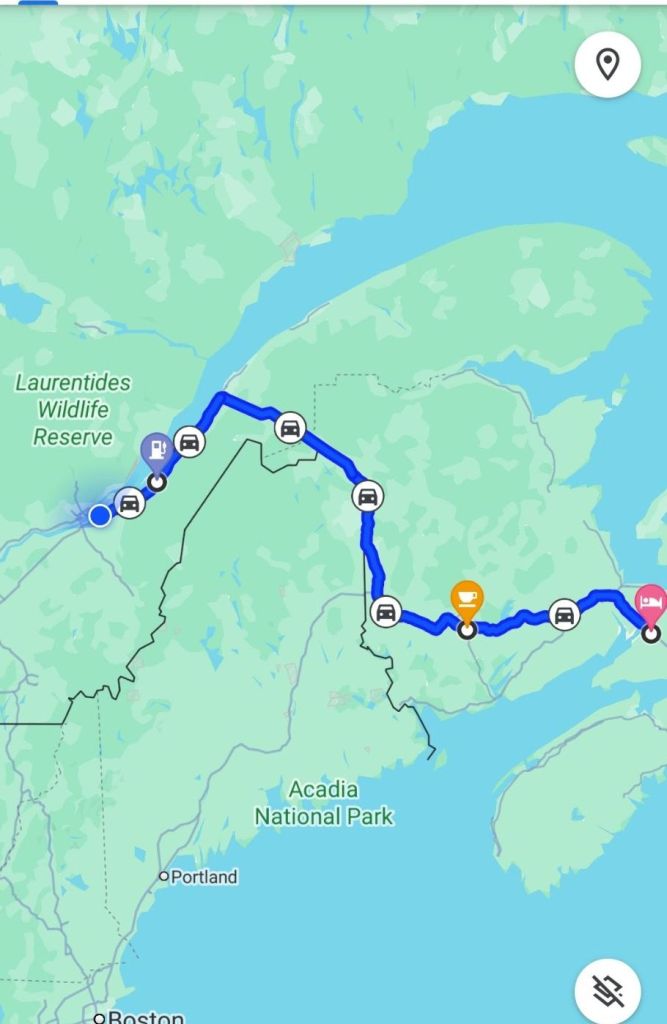
Another gorgeous morning. We have a long day on the road today, mainly through New Brunswick. After a quick breakfast, we were packed up and out of camp by 8 am. We gassed up yesterday afternoon. Today is a 3 province day, NS, NB, QC. Only in Atlantic Canada is this possible by car, including ferries.
Even though we are not stopping to sightsee today, I’ll pick out a few interesting things along the way that we have done on previous trips.
New Brunswick is a picturesque province, known for its stunning natural beauty, rich cultural heritage, and vibrant communities. Its diverse landscape encompasses lush forests, pristine rivers, rugged coastlines, and rolling hills. New Brunswick is bordered by Quebec to the north, Nova Scotia to the east, the Gulf of Saint Lawrence to the northeast, the Bay of Fundy to the southeast, and the U.S. state of Maine to the west
New Brunswick is the only officially bilingual province in Canada, with both English and French being recognized as official languages. The population is two thirds English to one third French. The French spoken is Acadian French with 7 regional dialects.
New Brunswick has a strong Acadian heritage, with many communities in the province tracing their roots back to the early French settlers who arrived in the region in the 17th century. The Acadian culture is celebrated throughout the province through festivals, traditional music, and delicious cuisine, including dishes like poutine râpée and fricot.
A large portion of the economy is controlled by the Irving Group of Companies, which consists of the holdings of the family of K. C. Irving. The companies have significant holdings in agriculture, forestry, food processing, freight transport (including railways and trucking), media, oil, and shipbuilding. The Irving family controls so much of the province’s economy that it is sometimes referred to as economic feudalism.
McCain Foods is one of the world’s largest manufacturers of frozen potato products. Other products include apples, cranberries, maple syrup, and is the biggest producer of wild blueberries in Canada.
The provincial capital is Fredericton.
First stop, Moncton
Moncton, is situated in the Petitcodiac River Valley at the geographic centre of the Maritime Provinces. The city has earned the nickname “Hub City” because of its central inland location in the region and its history as a railway and land transportation hub for the Maritimes. Moncton was officially founded in 1766 with the arrival of Pennsylvania German immigrants from Philadelphia as an agricultural settlement.
It is most famous for its Magnetic Hill and the Tidal Bore. Unsurprisingly, the “bore” was a very popular early tourist attraction for the city, but when the Petitcodiac causeway was built in the 1960s, the river channel quickly silted in and reduced the bore. Typical human interference with nature.
The Magnetic Hill is a Canadian gravity hill, a type of optical illusion created by rising and descending terrain. A gravity hill is a place where a slight downhill slope appears to be an uphill slope due to the layout of the surrounding land, creating the optical illusion that water flows uphill or that a car left out of gear will roll uphill. Many of these sites have no specific name and are often called just “Gravity Hill”, “Magnetic Hill”, “Magic Road” or something similar.
We tried it once years ago just for fun when we still drove a stick shift vehicle.
We spent several hours driving through NB, stopping every 2 hours to switch drivers. Lunch was Tim Hortons. It was inevitable on a trip this long.
Once we arrived in Quebec (a home province for us for 25 years and where we raised our family) we moved back into the eastern time zone and gained an hour. The roads have improved significantly since we last drove through here although they are still working on finishing a new highway up to Riviere du Loup (Wolf River) on the St. Lawrence River.
One of my favorite town names that we pass on this route is Saint-Louis-du-Ha! Ha. We used to drive through it, now we go around it.
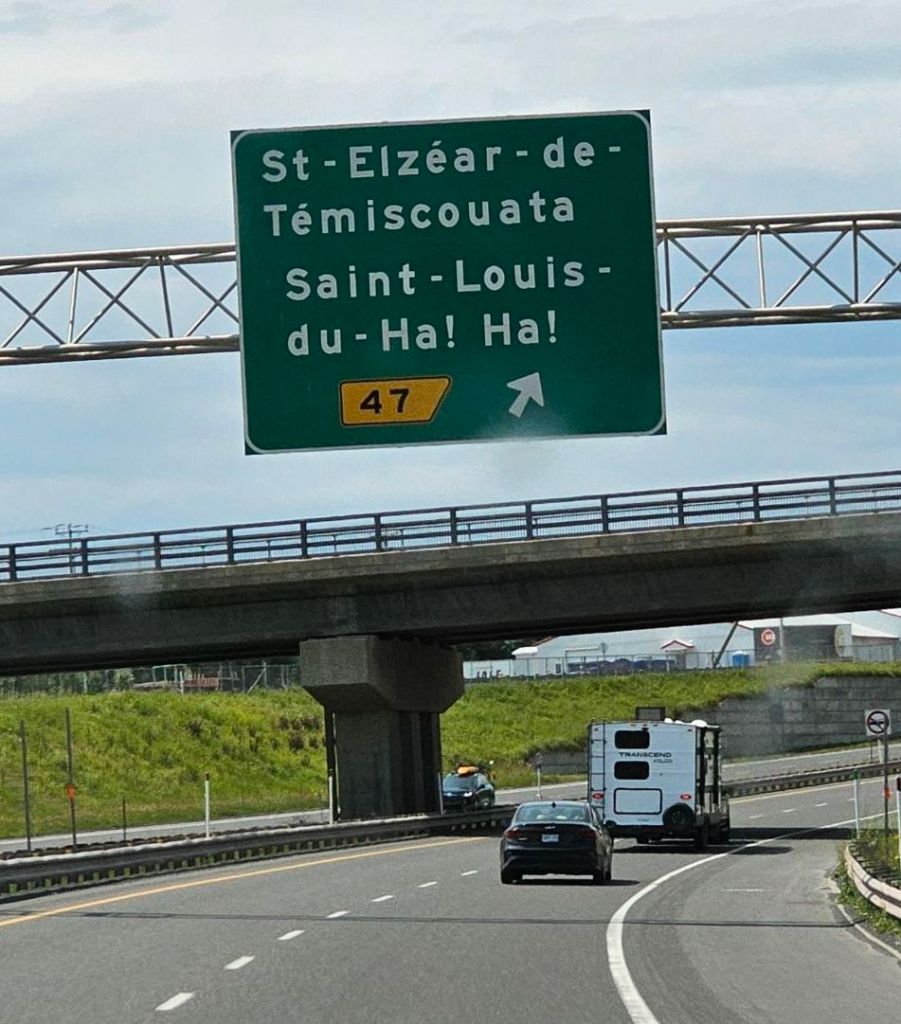
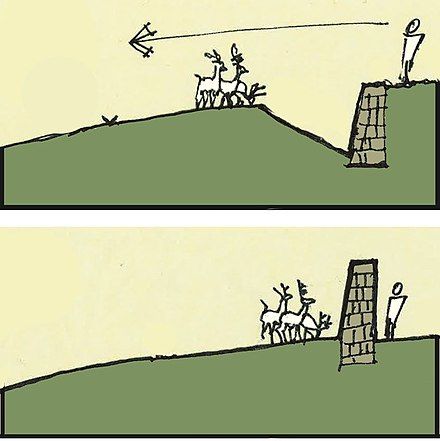
Saint-Louis-du-Ha! Ha! is the only town in the world with two exclamation points in its name, and shares the distinction of having an exclamation point in its name with Westward Ho!, a village in Devon, in south-west England. Ha! Ha! Is derived from an old French word haha meaning impasse. ha-ha also known as a sunk fence, blind fence, ditch and fence, deer wall, or foss, is a recessed landscape design element that creates a vertical barrier (particularly on one side) while preserving an uninterrupted view of the landscape beyond from the other side. The name comes from viewers’ surprise when seeing the construction. In this case it might refer to nearby Lake Temiscouata with its stunning view from the surrounding hills.
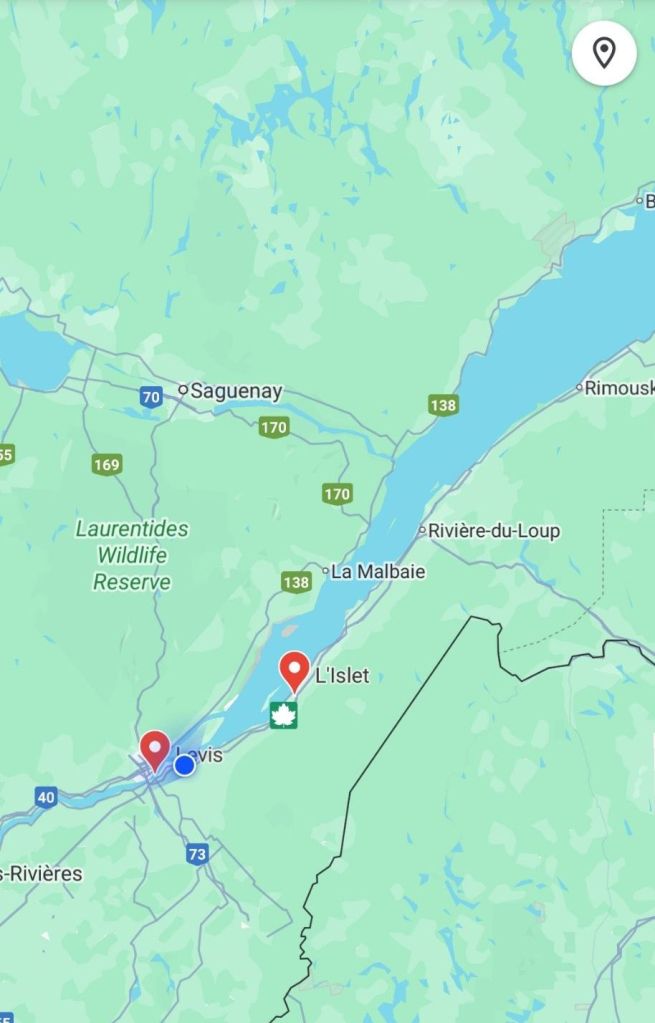
At Riviere du Loup we headed west on Hwy 20 along the south shore of the St. Lawrence River, otherwise known as the Lower St. Lawrence. This is prime agricultural land and very beautiful. The land distribution is based on the original Seigneuries of Quebec that have existed from 1627 until the British conquest of New France in 1763 and continued in the British colony of the Province of Quebec (1763–1791), then in Lower Canada (1840) and in the Province of Canada until 1854. The land was divided into strips such that each Seigneurie had access to the river. It still looks the same today, long strips of farmland parallel to each other and ending at the river.
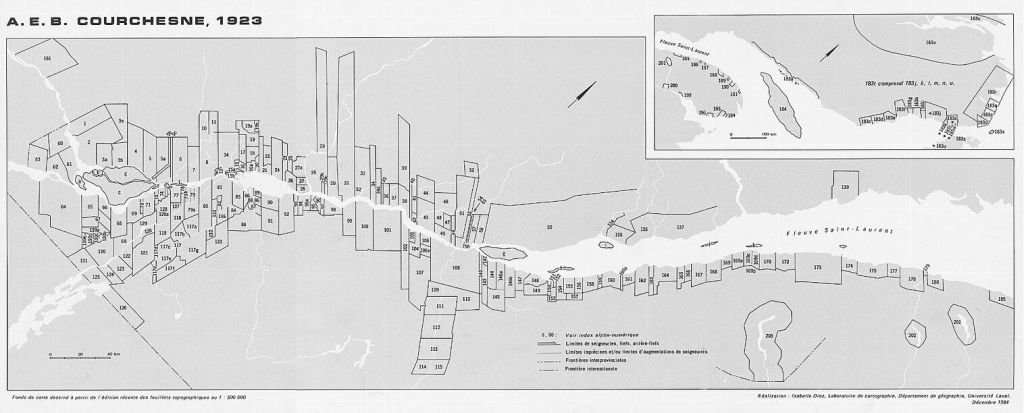
The seigneurial system was also a land distribution system aimed at populating the colony and regulating society. The territory to be developed was divided into seigneuries, which were granted to figures (seigneurs) who had provided service to the king. Economic historians have attributed the wealth gap between Quebec and other parts of Canada in the 19th and early 20th century to the persistent adverse impact of the seigneurial system. King Louis XIV instituted a condition on the land, stating that it could be forfeited unless it was cleared within a certain period of time. This condition kept the land from being sold by the seigneur, leading instead to its being sub-granted to peasant farmers, the habitants. When a habitant was granted the title deed to a lot, he had to agree to accept a variety of annual charges and restrictions. Rent was the most important of these and could be set in money, produce or labour. Once this rent was set, it could not be altered, neither due to inflation nor time. A habitant was essentially free to develop his land as he wished, with only a few obligations to his seigneur. Likewise, a seigneur did not have many responsibilities towards his habitants. The seigneur was obligated to build a gristmill for his tenants, and they in turn were required to grind their grain there and provide the seigneur with one sack of flour out of every 14. The seigneur also had the right to a specific number of days of forced labour by the habitants and could claim rights over fishing, timber and common pastures. The seigneur–habitant relationship was one where both parties were owners of the land, who split the attributes of ownership between them. The manorial system was formally abolished through the passage of the Feudal Abolition Act 1854 by the Parliament of the Province of Canada.
Quebec City is situated at the narrowing of the St. Lawrence River and the most eastern place for a bridge. We are not going to visit Quebec City and there is too much history for me to write about it here.
Our campsite for tonight is situated in Levis, across the river from Quebec City. Besides the bridge, there is also a ferry into Quebec City’s lower town. The campsite offers a free shuttle to the ferry, making it an ideal location for campers wanting to visit. We’ll cross the Pierre LaPorte Bridge tomorrow and continue our trip on the north shore.
Pierre Laporte (25 February 1921 – 17 October 1970) was a Canadian lawyer, journalist, and politician. He was deputy premier of the province of Quebec when he was kidnapped and murdered by members of the Front de libération du Québec (FLQ) during the October Crisis. Prime Minister Pierre Trudeau invoked Canada’s War Measures Act which allowed mass raids and arrests to take place in order to find the group who had kidnapped Laporte and Cross.
After a beautiful day of sunshine, it is now pouring with rain.
I will stop my blog here. Tomorrow, we have a 5 hour drive to a daughter who is northwest of Montreal. We will visit with her for a few days before moving on to two daughters in Ontario and a family party next weekend.
It has been a fabulous trip despite the rescheduling. I will have to visit it all again before pronouncing a favorite activity.
We are always improving how we do things. Major improvements this time were: moving water and electrical connections from the back to the side; eliminating a storage box I no longer had to keep moving around; keeping a stool handy in the back so I can reach things without standing on the seats; the addition of the Starlink with hardwiring on the outside and permanent mounting of the router and power supply.
Thank you all for following along with us on another adventure.
 Louise and Brian McLeod Travel Blog
You must be logged in to post a comment.