Today is just a run of about 4 1/2 hours down to Port Aux Basques for our midnight ferry back to Nova Scotia. The weather is warm but cloudy with on and off rain. We stopped for lunch in a diner along the way. The scenery though was spectacular as usual in this province.
We arrived in Port aux Basques around 2:30. Now what are we going to do for 8 hours or so? We ended up at the Newfoundland Railway Heritage Museum and spent the afternoon napping and reading in the parking lot.
I haven’t talked about the now defunct Newfoundland Railroad, and this is as good a time as any.
The Newfoundland Railway was a narrow-gauge railway that operated on the island of Newfoundland from 1898 to 1988. With a total track length of 906 miles (1,458 km), it was the longest 3 ft 6 in (1,067 mm) narrow-gauge system in North America.
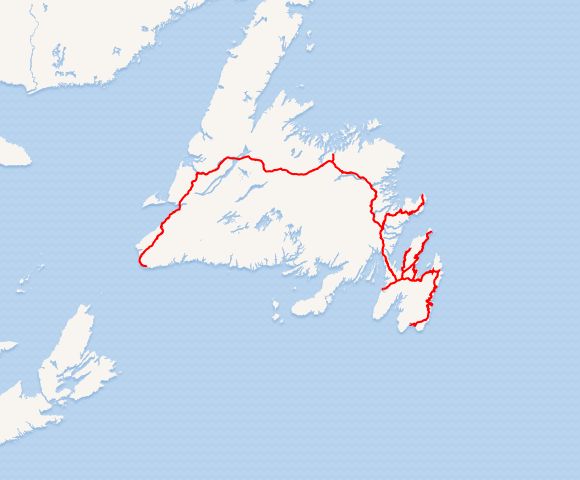
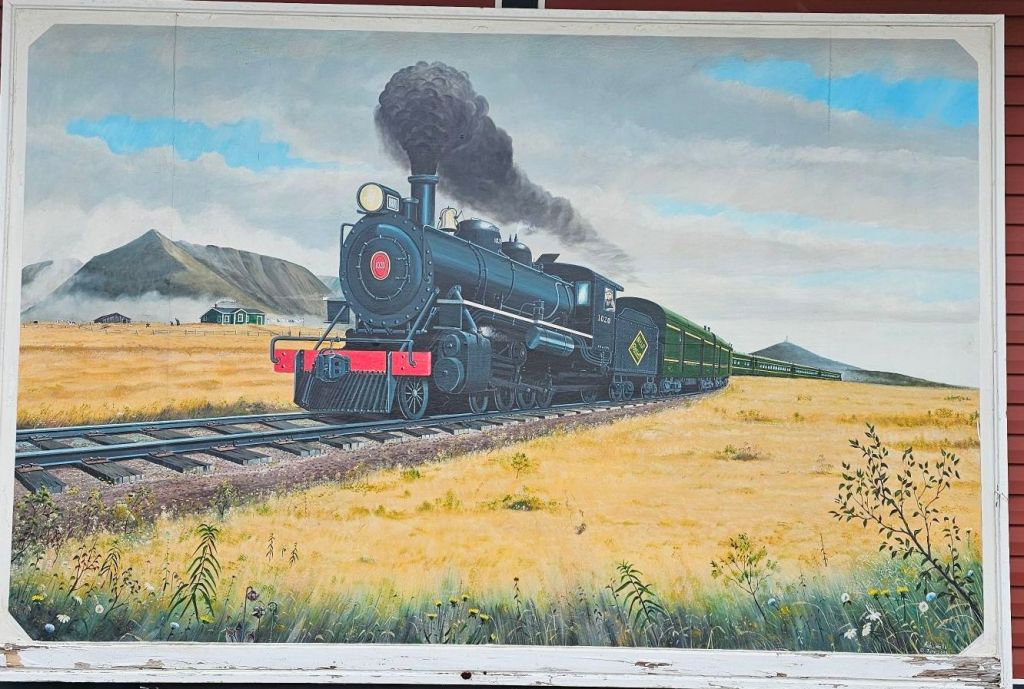
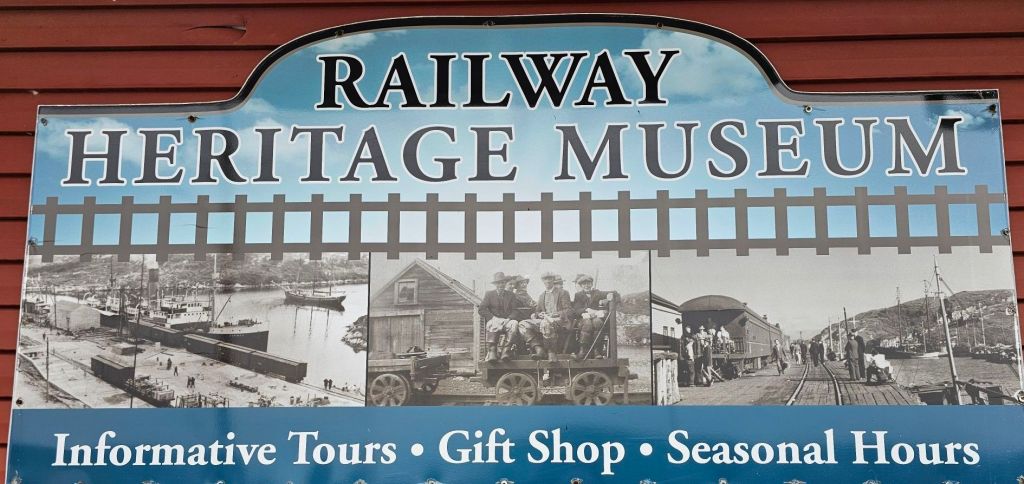
The railway was initially called the Newfoundland Government Railway but was soon shortened to the Newfoundland Railway in 1926. It remained the property of the dominion government until Confederation on March 31, 1949, when it was transferred to the federal government’s Canadian National Railway.
Although the railway saw an increase in traffic during the First World War, it was extensive military-related construction in the late 1930s and early 1940s which proved the worth of the Newfoundland Railway as a strategic asset. An air force base was developed adjacent to the main line in Gander, and major American military bases were constructed in Stephenville (Ernest Harmon AFB), Argentia (NS Argentia) and St. John’s (Pepperrell AFB), in addition to Canadian and British defence facilities in St. John’s. Given the lack of roads and all-weather highways in Newfoundland during the 1940s, and the U-boat threat in the waters off-shore, the Newfoundland Railway became a vital, yet very obscure, supply link in the defence of the Northeast Atlantic and the Allied convoy system.
When Winston Churchill met Franklin D. Roosevelt in Placentia Bay in 1941 to sign the Atlantic Charter, Churchill sent for Lord Beaverbrook, Minister of Aircraft Production. Beaverbrook flew into Gander and then travelled by rail to Placentia in the caboose of a freight train to save waiting for a passenger train. The Second World War also saw the Newfoundland Railway experience its most tragic loss, when the ferry Caribou was torpedoed and sunk 40 km (25 miles) off Port aux Basques by the German submarine U-69 on October 14, 1942. 137 passengers died and 104 people survived the sinking.
The railway was officially abandoned on October 1, 1988.
The waters all around Newfoundland from the Sea of Labrador, the Straits of Belle Isle, the Gulf of Saint Lawrence and the St. Lawrence River were strategically critical during WW2.
Did you know? The Battle of the St. Lawrence during World War II was a series of naval engagements between German U-boats and Canadian and British naval and air forces in the waters of the Gulf of St. Lawrence and the St. Lawrence River. The battle took place from 1942 to 1944 and was a crucial part of the larger Battle of the Atlantic, which aimed to protect the Allied supply lines and prevent the Germans from cutting off vital shipping routes.
The St. Lawrence River, with its strategic location and important ports, was a key transit route for supplies and troops heading from North America to Europe. The German U-boats targeted this area in an attempt to disrupt Allied shipping and weaken their war effort. The U-boats used the cover of darkness and the vast expanse of the St. Lawrence to launch surprise attacks on convoys and merchant ships.
The Canadian and British forces responded by increasing their naval and air patrols in the area, as well as improving anti-submarine tactics and technologies. They also established coastal defences and implemented convoy systems to protect the shipping routes. Despite these efforts, the Germans managed to sink several ships and disrupt the flow of supplies through the St. Lawrence.
The Battle of the St. Lawrence was a challenging and costly campaign for both sides. The harsh weather conditions, rough terrain, and vast expanses of water made it difficult to detect and combat the U-boats. However, the Allied forces ultimately prevailed, thanks to their perseverance, improved tactics, and the crucial intelligence provided by codebreakers.
Overall, the Battle of the St. Lawrence was a significant chapter in the larger Battle of the Atlantic, demonstrating the strategic importance of the St. Lawrence River in the Allied war effort and the challenges of protecting vital supply lines in the face of determined enemy opposition.
Okay, no more history.
We had our last dinner in Newfoundland at Alma’s Family restaurant and our last meal of cod. And what a meal it was! Best fish and chips yet. I am soooo going to miss the decadent French fries in this part of the world. I could use a decent glass of wine, though.
So far, our ferry is delayed…. going to be a long night. Will keep you posted.
 Louise and Brian McLeod Travel Blog
You must be logged in to post a comment.