Gander, Newfoundland, has a rich and diverse history that is closely tied to its strategic location and significance in aviation. The town of Gander was established in the early 1930s as a key stopover for transatlantic flights. Its central location in Newfoundland made it an ideal refueling point for aircraft traveling between North America and Europe.
During World War II, Gander became a critical military base for the Allies, playing a key role in the transportation of troops and supplies. The airport expanded significantly during this time to accommodate the increased traffic, becoming one of the busiest airports in the world.
After the war, Gander continued to thrive as a hub for international aviation. In the 1950s and 1960s, the airport was used for high-profile flights, including the first non-stop transatlantic flight by a jet aircraft.
Gander and 9/11
One notable event in Gander’s history is the role it played in the aftermath of the 9/11 attacks.
On September 11, 2001, the tragic terrorist attacks took place in the United States, leading to the grounding of all civilian flights in American airspace. In response to this crisis, numerous international flights were diverted to Canadian airports, including Gander (38 planes carrying 6600 passengers to Gander alone). The small town of Gander and its residents rose to the occasion, opening their homes, schools, and community centers to stranded passengers and flight crews.
The people of Gander demonstrated immense kindness, compassion, and solidarity during this crisis, providing shelter, food, and support to the thousands of stranded travelers. The events that unfolded in Gander showcased the true spirit of humanity and unity in the face of adversity.
The story of Gander’s response to the 9/11 attacks has been widely celebrated and has even inspired a Broadway musical “Come from Away” that highlights the extraordinary actions of the people of Gander during a time of need, emphasizing the importance of kindness, compassion, and community in times of crisis.
The Silent Witness Memorial in Gander, Newfoundland is a poignant tribute to the 256 victims of the Arrow Air Flight 1285 crash that occurred on December 12, 1985. The memorial, consisting of 256 silhouettes representing each victim, stands as a solemn reminder of the tragedy that unfolded that day.
The Arrow Air Flight 1285 crash remains one of the deadliest aviation disasters in Canadian history. The plane, carrying American troops returning home from a peacekeeping mission in the Middle East, crashed shortly after takeoff from Gander International Airport. The cause of the crash was never definitively determined.
After stocking up on food again in Gander, we found a quilt shop on our way out of town. This was the most unusual one yet. The lady who owns it runs it out of a trailer in her driveway. It was fully stocked. What a great business model. She said she is not beholden to the typical immovable brick and mortar location. When she needs to go to trade shows, she just takes the whole thing with her. Clever!


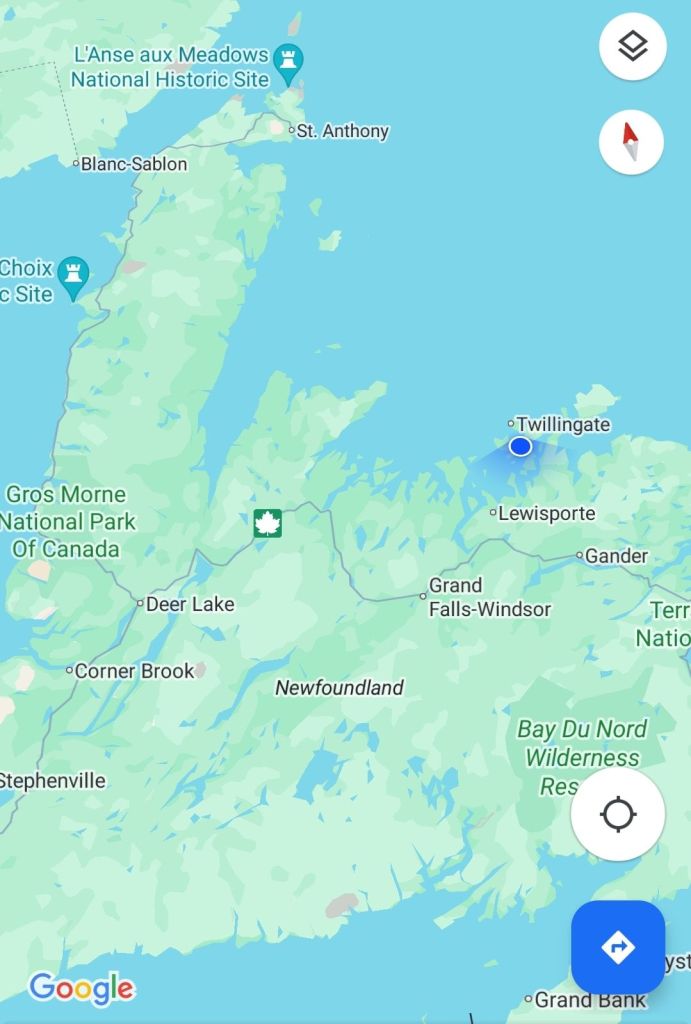
Our goal today is Twillingate. The drive between Gander and Twillingate is lovely. Windy roads and lots of little causeways linking a multitude of little islands.
We stopped off at our campground first to get registered. Change of routine today as we have plans in Twillingate tonight and will be back late. Our campground tonight is a pretty little Provincial Park on the water with the interesting name of Dildo Run. We stopped long enough to put everything that was wet from the rain the day before out on the picnic table to dry, including the tablecloth. After a quick picnic lunch, we headed up to Twillingate.
Twillingate is actually a series of small islands. It was first settled by the French. The name Twillingate is an anglicization of the original French name Toulinquet. It is one of the oldest ports on the island.
The earliest known people to inhabit the area were the Maritime Archaic, who occupied the area 3,500 years ago in roughly 1500 BC. The Maritime Archaic people were later supplanted by the Beothuk, and possibly the Dorset Inuit, who occupied the area until the arrival of European settlers.
The French had been fishing in the area possibly as early as 1500, but the first European settlers did not arrive until the 17th century. The settlers were mostly made up of fishermen. The native Beothuk managed to survive until the early 19th century in small numbers near Twillingate and the mouth of the Exploits River.
Because of the cod moratorium in 1992, fishing is not practised as much in the area, though some fishermen still catch crab, lobster and other aquatic species. The seal hunt is practised in Twillingate.
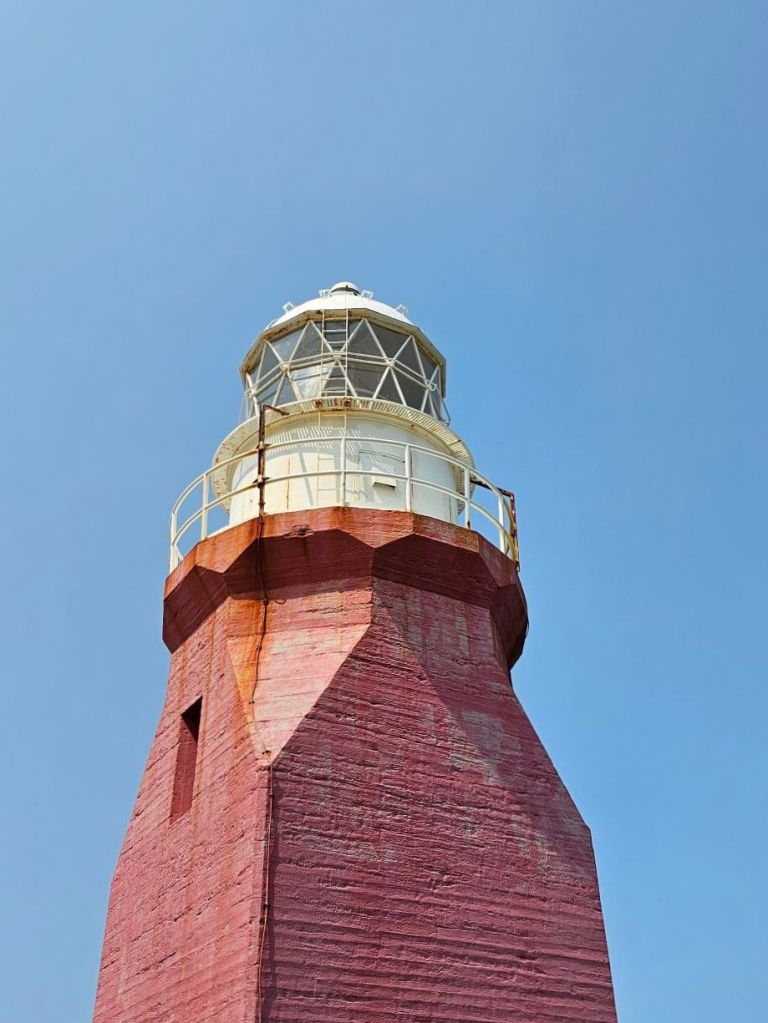
The Twillingate lighthouse has a most unusual architectural style. Built out of concrete, it is octagonal towards the top ressembling a baby bottle. It’s quite distinctive.
For fun, we visited the Auk Islands Winery. Yes a winery. However this one is different. The fermentation is from wild picked berries native to the area, blueberries, lingonberry ( Partridgeberry), cloud berry (bakeapple), rhubarb and another blue berry whose name I’ve forgotten and native only to here. They also have very raunchy names. Someone has a good sense of humor. We came away with a Cloudberry Iceberg wine made with 10 000 year old iceberg water. Iceberg water is a thing here and iceberg water harvesting/processing is a business.

While we are on the subject of icebergs. Twillingate is where we expected to see them however, only one came through this year and it was early April. Trivia fact: apparently the icebergs seen here are 3 years old by the time they calf off the coast of Greenland and float down to Newfoundland.
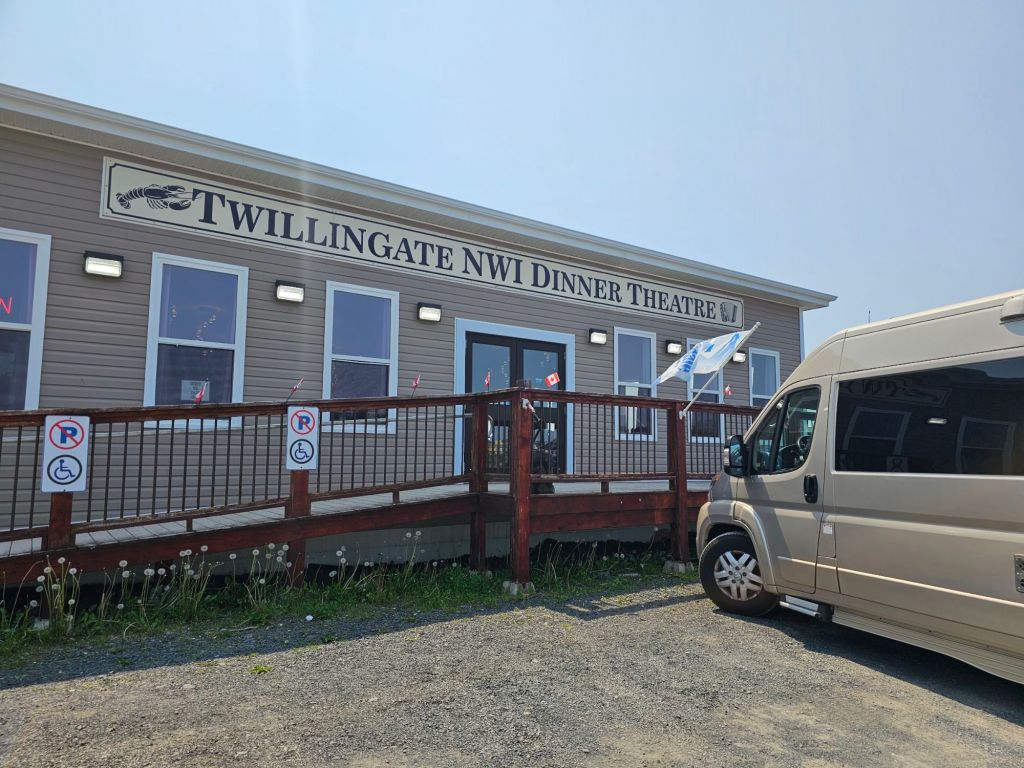
And last night we had a lot of fun. We had a wonderful lobster dinner at the Twillingate Dinner Theater followed by 2 hours of great local entertainment. We sat at community tables and had great conversation over dinner. Our dinner companions were from Florida, Nova Scotia (with Newfoundland roots), Ontario. All of us were Canadians birthwise or naturalized
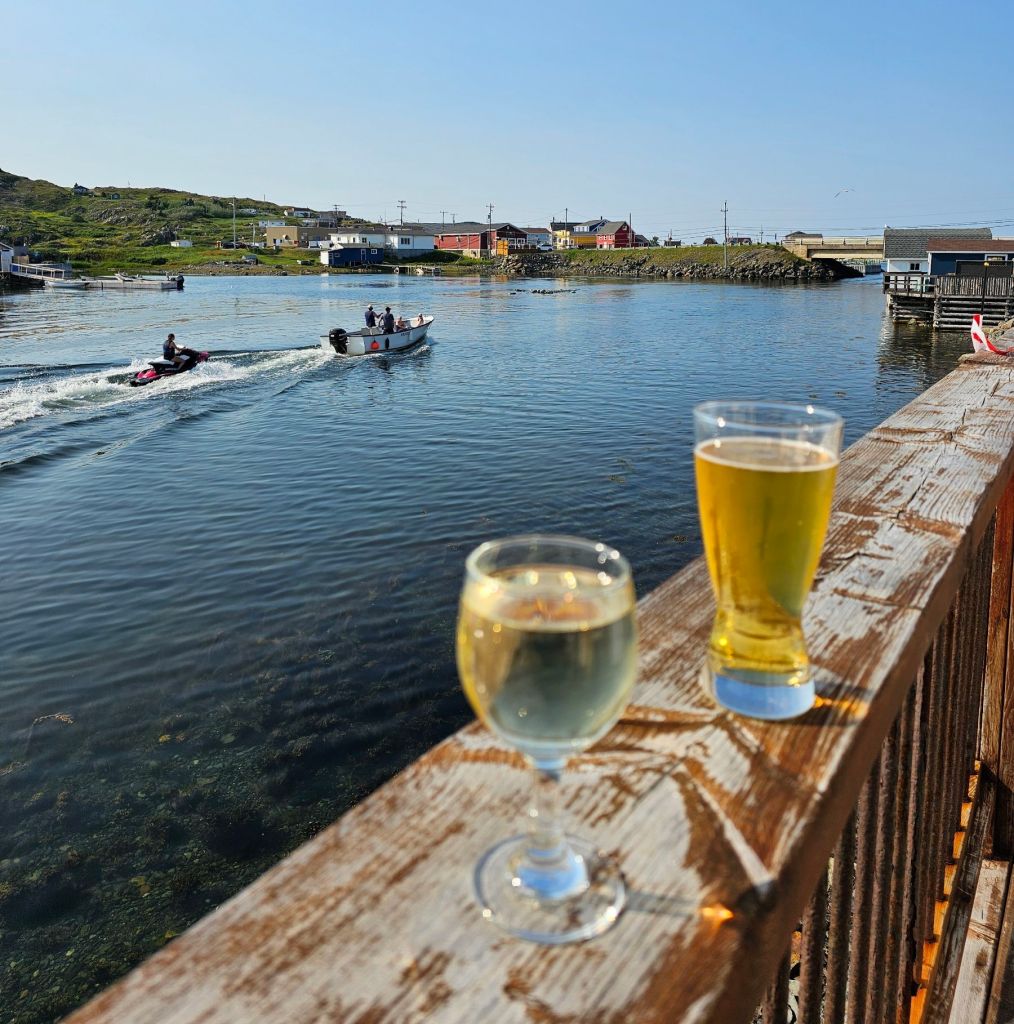
Before dinner we met a gentleman over drinks on the dock who was sailing his boat from Lewisporte to St.Johns to visit children. He and his wife would be on their boat for 4 months.

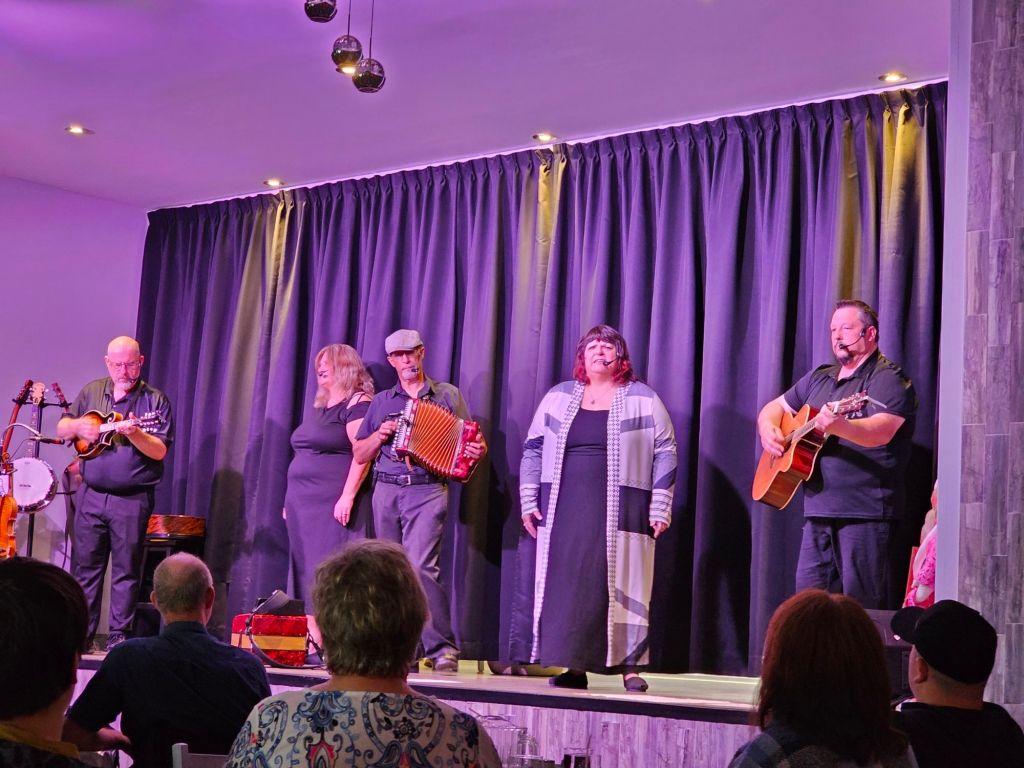
All in all it was a great day, warm and sunny and companionable. Something we don’t always get on a day to day basis. The entertainment was excellent with music, Newfy jokes, skits and tributes to Newfoundland songwriters and artists. Lots of fiddle playing, accordion and the ‘ugly stick’. In outports and remote villages, social gatherings such as concerts, “times,” mummering, and kitchen parties were an important part of the rural culture. The principal melody instruments were accordions and fiddles. Starting in the 20th century, rhythmic accompaniment came from the ugly stick.
The ugly stick is a Newfoundland musical instrument fashioned out of household and tool shed items, typically a mop handle with bottle caps, tin cans, small bells and other noise makers. Often an old rubber boot is attached to the bottom. The instrument is played with a drum stick or notched stick and has a distinctive sound.
The evening started off with a hearty rendition of “I’z the b’y”. We also heard this on Canada Day in Terra Nova.
I’se The B’y (also I’s The Bye) is a traditional Newfoundland folk song/ballad. “I’s the B’y” is in the Newfoundland English dialect, and translates to standard English as “I’m the Boy” or “I’m the Guy”. The Canadian Songwriters Hall of Fame decided to honour the song in 2005, officially accepting it as part of the Canadian Song Hall of Fame.
I’s the b’y that builds the boat
And I’s the b’y that sails her
I’s the b’y that catches the fish
And brings them home to Liza. (or Lizer)
Chorus: Hip yer partner, Sally Thibault
Hip yer partner, Sally Brown
Fogo, Twillingate, Moreton’s Harbour
All around the circle!
Sods and rinds to cover your flake
Cake and tea for supper
Codfish caught in the spring o’ the year
Fried in maggoty butter.
Chorus:
I don’t want your maggoty fish
They’re no good for winter
I could buy as good as that
Down in Bonavista.
Chorus:
I took Liza to a dance
As fast as she could travel
And every step that she did take
Was up to her knees in gravel.
Chorus:
Susan White, she’s out of sight
Her petticoat wants a border
Old Sam Oliver in the dark
He kissed her in the corner.
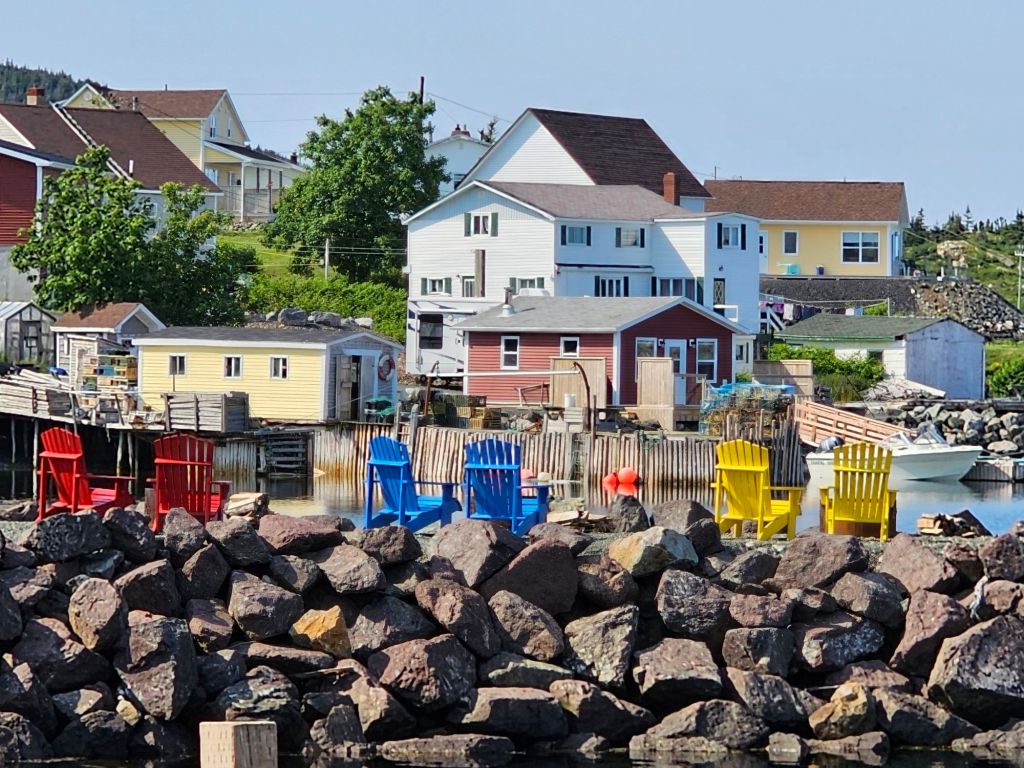
Photos of the afternoon and evening in Twillingate.



 Louise and Brian McLeod Travel Blog
You must be logged in to post a comment.