Lovely warm morning having been rocked n the van all night by the wind. It’s so nice to be able to have breakfast by the ocean. The van serves as a windbreak.

Note: ‘The Sea for Breakfast’ was one of my favorite books in my earlier days, written by Lillian Beckwith, a UK school teacher who moved to an island in the Hebrides for health reasons. She talks about the island, the sea and her colorful neighbors. It’s a charming book. I thought of it as soon as I brought our breakfasts out.
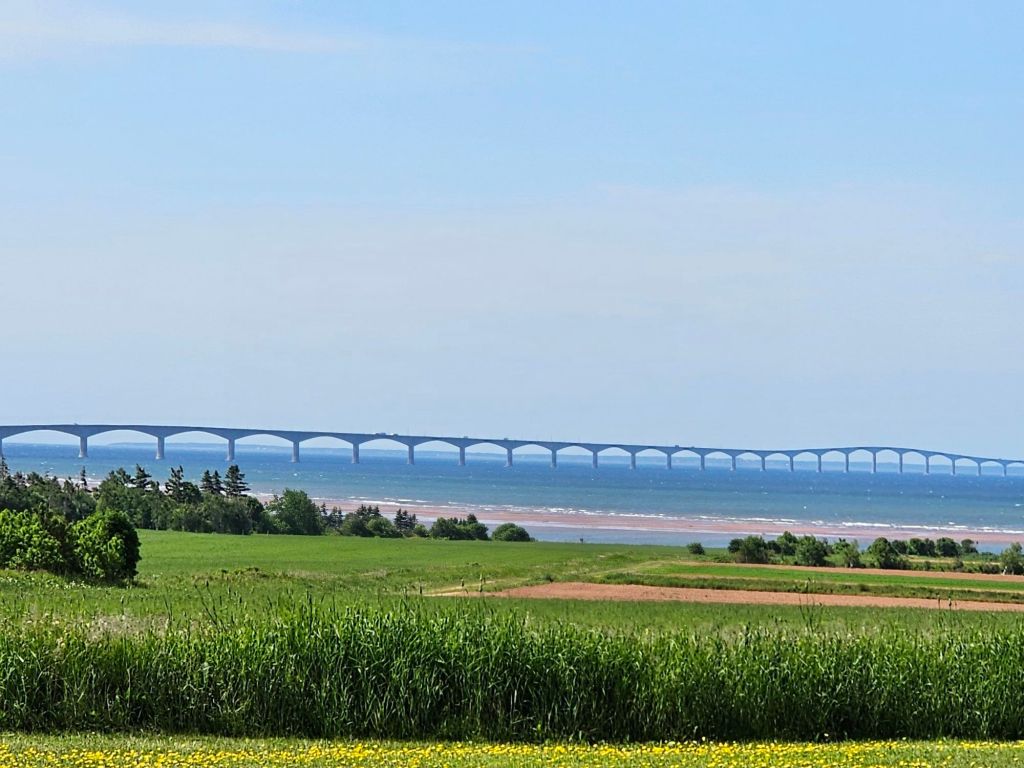
Today we take the causeway over to Prince Edward Island, Canada’s smallest Province and home to it’s best beaches.
The Confederation Bridge, also known as the PEI Causeway, is a bridge that spans the Abegweit Passage of the Northumberland Strait, linking Prince Edward Island with the mainland of New Brunswick, Canada. It is 12.9 kilometers (8 miles) long, making it the longest bridge in the world over ice-covered waters. The bridge opened on May 31, 1997, and has since become an iconic landmark and a vital transportation link for residents and visitors to Prince Edward Island.
The last time we visited PEI, when our children were young, we had to take a ferry. We are taking the ferry when we leave PEI in Friday as its closer to where we need to be in Nova Scotia, the Cabot Trail.
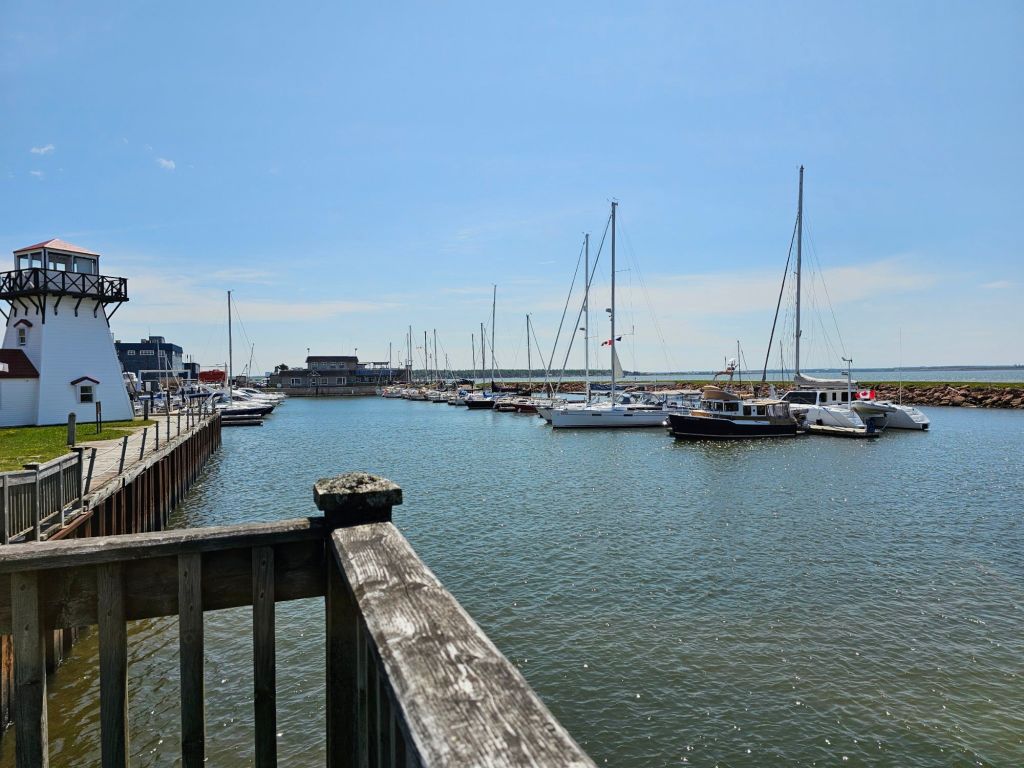
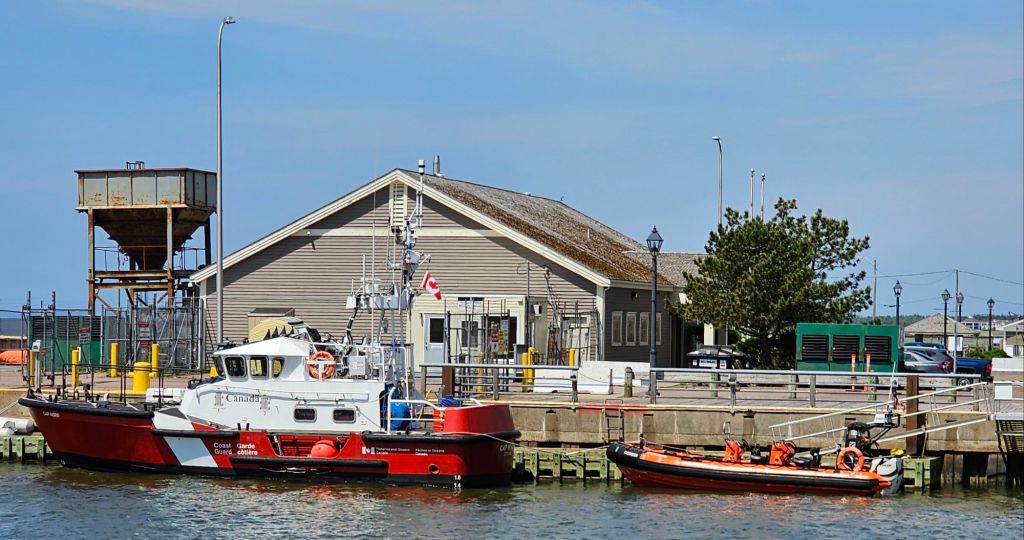
We stopped in Summerside for a bit of a walk. Summerside is home to a Canadian coastguard unit noted for its Search and Rescue (SAR).
Summerside, PEI
Summerside, originally known as Green’s Shore, was renamed Summerside in 1877. One of the significant events in Summerside’s history is the arrival of the first European settlers in the late 1700s. Summerside quickly became a hub for agriculture, fishing, and shipbuilding due to its prime location along the coast. Summerside played a vital role in the shipping industry during the 19th century, with its port becoming a key point for trade and commerce. In the 20th century, the city saw further growth and modernization, with the establishment of industries such as aerospace, manufacturing, and technology.


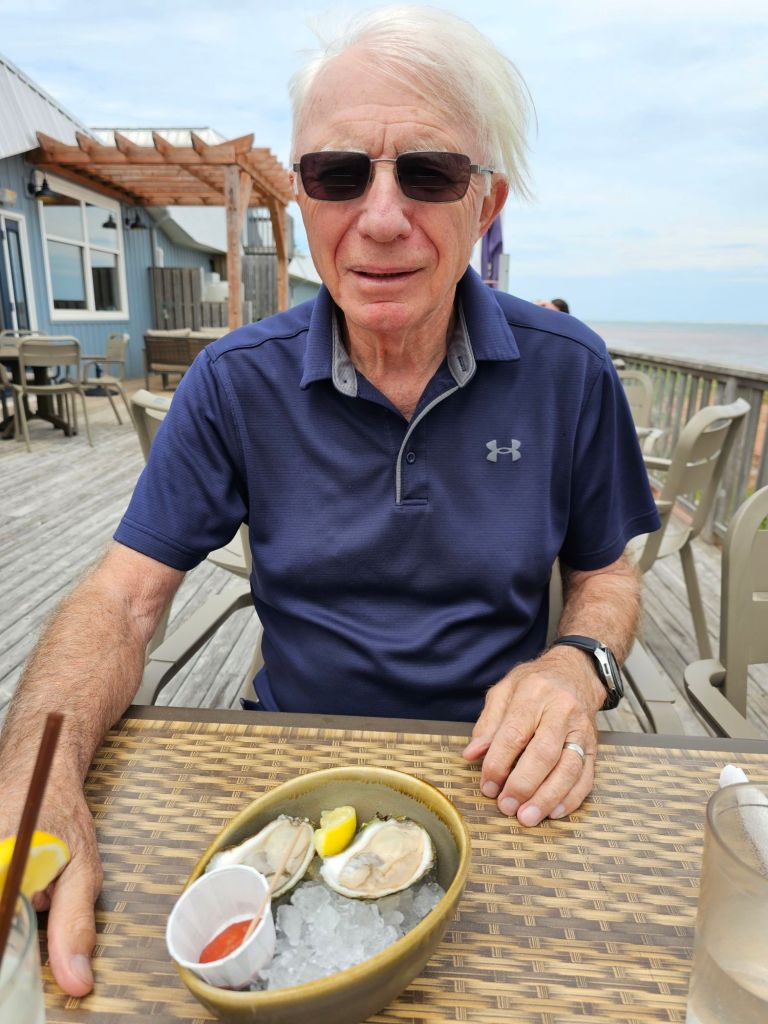
Moving on from scallops and lobster in Nova Scotia and New Brunswick to mussels and oysters in PEI, we drove over to Malpeque Bay after leaving Summerside, home of the Malpeque oyster.
Malpeque Oysters
Malpeque oysters are PEI’s most famous oyster, grown wild in Malpeque Bay and harvested by hand-tonging out of small skiffs. Malpeques come in two grades: Choice and Standard. Choice have well-shaped, deep-cupped shells; standards are more curved and shallow. They are known for their distinctive taste and are often described as having a balanced flavor profile with a slightly salty and sweet taste. The name Malpeque comes from the Mi’kmaq word magpeg, which means “the bay which swells” with the tides. In the late 1700s and early 1800s, Acadians who settled in Malpeque Bay had no market for oysters, so they used them as fertilizer and burned their shells for lime. In 1900, Malpeque oysters were judged the world’s tastiest at the Paris World Fair, which brought the region’s oysters to international attention.


For Mussel lovers, PEI mussels are farmed. TheY finish growing in the mesh bags called ‘socks’ that you buy them in. We passed several bays today with buoys in rows that were obviously mussel farms.
PEI Mussels
PEI Mussels are grown in 19 shallow bays and inlets on PEI ranging from estuaries on the east side of the Island to barrier beach lagoons on the north shore.
The PEI Mussel farming industry uses the longline system. Mussels are held in suspension in socks (mesh sleeves) tied to anchored or moored buoy rope.
In the spring when the water temperature reaches around 15 degrees centigrade, PEI Mussels spawn which means they release their eggs and sperm. There is a swimming stage called mussel larva, and at just the right time the mussel farmer puts out seed collectors; usually frayed pieces of rope or strips of plastic mesh attached to a long line. The collector serves as a settlement surface for the billions of mussel larva swimming in the water. After they attach, they form a hard shell and are called spat. Once a spat is around one inch long (usually around the first of October) they are hand stripped from the ropes and taken ashore. The mussel seeds are then declumped and graded into uniform size classes before being placed into plastic mesh sleeves/tubes called socks. Within hours the mussel socks are taken back out to the farm and hand tied onto the long lines.
So.. now you know where Mussels come from!

On our way to our lunch spot, we passed the birthplace of Lucy Maud Montgomery, famous for writing the series of books she is most noted for, Anne of Green Gables.
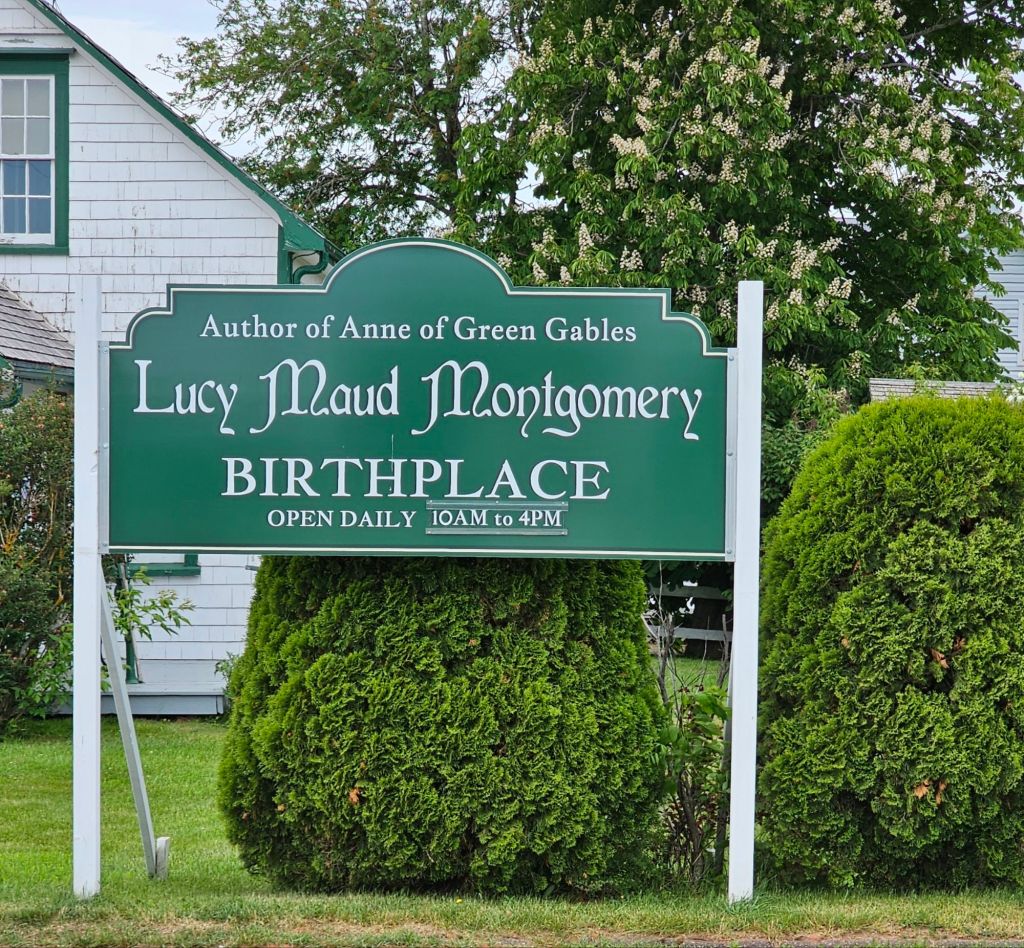

Lucy Maud Montogomery
Lucy Maud Montgomery (1874-1942) was a Canadian author best known for her novel series about Anne Shirley, an imaginative and outspoken young girl who is adopted by an elderly brother and sister. Montgomery’s most famous work is “Anne of Green Gables,” which has become a beloved classic of children’s literature. Montgomery drew on her own experiences growing up in Prince Edward Island, Canada, to create the character of Anne and the picturesque setting of Avonlea. Montgomery’s writing is known for its strong sense of place, vivid descriptions, and memorable characters. In addition to the Anne series, Montgomery wrote numerous other novels, short stories, and poems during her prolific literary career.
“Anne of Green Gables” explores themes of friendship, family, community, and the power of imagination. It has become a beloved classic and has been adapted into numerous films, television series, and stage productions. Anne Shirley’s character is known for her spunky and independent spirit, as well as her iconic catchphrase, “Dear old world, you are very lovely, and I am glad to be alive in you.”
This is the warmest weather so far. Is it because of the heat dome further west? Temperatures are in the 80s and our campsite on the beach has no shade. We tried putting the awning out for a bit, but the wind is too gusty. We are now tucked in behind the van between the back doors that are open.
I spent a bit of time this afternoon doing an odd chore. I have clothing with me, including a fleece zippered jacket that have no loops for hanging on hooks! Who makes clothing these days that usually end up hanging on hooks without loops? I put loops on 4 (!) Pieces of clothing and one towel… the towel loop I placed midway along the long side so it can up in a shower or our bathroom without dragging on the floor.
We are camping at Cavendish Beach National Park. We camped here 47 years ago with our young girls. We had bikes in those days to ride to and from the beach. No bikes or children this time. It looks as though there was a fire through here in recent years as there is no mature growth and what trees remain show damage.
Note: it turns out the tree damage was caused by Hurricane Fiona in 2022 that brought significant damage to the coastland and forests.
We bought seafood chowder from our lunch spot that will be dinner tonight along with the biscuit that came with it, left over ribs from father’s day, raw vegetables and hummus. Dessert is strawberries and icecream.
We are really enjoying the rhythm of our days. A nice leisurely breakfast, morning chores and leave camp at some point, drive and sightsee until about 1:30 or whenever we find a good place to eat, head to our campsite around 3:30 – 4 pm. Afternoon chores if there are any, laundry, showers, sewing, reading, gaming, email, a walk and always my blog. Dinner any time after 7, sometimes another walk, some TV, bed.
Since leaving St. John, NB, we have been averaging around 100 miles / day at 40 miles/hour. Not exactly taxing. This is vacation too!

A gorgeous end to the day with a walk along the beach after dinner clean up. The sun doesn’t set until 9:15 or so.


 Louise and Brian McLeod Travel Blog
You must be logged in to post a comment.