Sun was shining in all its glory after having a day off yesterday. It’s father’s day.
We decided to do things in Halifax we haven’t done before: the Canadian Museum of Immigration and the cemetary where the Titanic victims are buried.
Halifax. NS
Halifax is the capital city of the Canadian province of Nova Scotia. It has a rich history dating back to the early 18th century. Originally inhabited by the Mi’kmaq indigenous people, the area became a strategic military outpost for the British in the mid-18th century.
One of the most significant events in Halifax’s history was the Halifax Explosion of 1917, when a French cargo ship carrying explosives collided with another vessel in the harbor, resulting in a catastrophic explosion that killed over 2,000 people and devastated large parts of the city. The resulting explosion was the largest man-made blast before the development of nuclear weapons, causing widespread devastation, loss of life, and injuries in the city.
During World War I, Halifax played a crucial role in supporting the war effort. The city’s strategic location made it a hub for military operations, troop movements, and supply shipments to Europe. Halifax was also a significant naval base and a key player in convoy operations to protect merchant ships from German U-boats.
During World War II, Halifax served as a major naval and military base for the Allies. The strategic location of Halifax made it an essential port for ships delivering supplies, troops, and equipment to Europe. The city also played a crucial role in the Battle of the Atlantic, as convoys departed from Halifax to provide crucial support to the war effort. Additionally, Halifax was the hometown of the Royal Canadian Navy’s Atlantic fleet, making it a key player in the Allied naval operations.
Halifax has also played a significant role in Canadian immigration history, serving as a major port of entry for European immigrants in the late 19th and early 20th centuries.
Canadian Museum of Immigration
The Canadian Museum of Immigration at Pier 21, located in Halifax, is dedicated to telling the stories of immigrants to Canada. It was an immigration facility that operated from 1928 to 1971 and is now a National Museum of Immigration. It showcases exhibits and artifacts that explore the immigration experience and its impact on Canadian society. It is a significant site in Canada’s immigration history and a place where many immigrants first arrived in the country.

I hasn’t thought about it until we visited the museum here this morning, but I had an aunt who would have come through Pier 21 in Halifax with my 4 year old cousin as a war bride from the UK. I was able to find the birth record of my cousin at the genealogy library in the museum. Nice family connection. I was assured by the museum staff that she would have come here with other war brides as they all came through this facility, and then taken a train directly from the immigration center to Hamilton, ON.
History of immigration to Canada
Here is a brief overview of the history of immigration in Canada:
- Indigenous Peoples: The first inhabitants of Canada were Indigenous peoples, who have lived on the land for thousands of years before the arrival of European settlers.
- European Colonization: The first major wave of immigration to Canada occurred during the period of European colonization in the 16th century. French and British colonizers established settlements in what is now Canada, bringing with them settlers and traders from Europe.
- British and French Immigration: Throughout the 18th and 19th centuries, British and French immigrants continued to arrive in Canada, particularly in the eastern provinces of Quebec and the Maritime provinces.
- Immigration Policy: In the late 19th and early 20th centuries, Canada implemented various immigration policies to encourage settlement in the country, including the construction of the Canadian Pacific Railway, which brought thousands of immigrants to the western provinces.
- Post-World War II Immigration: Following World War II, Canada experienced a significant increase in immigration, welcoming refugees, displaced persons, and skilled workers from war-torn Europe.
- Multiculturalism Policy: In 1971, Canada became the first country in the world to adopt an official policy of multiculturalism, recognizing and supporting the cultural diversity of its population.
- Recent Immigration Trends: In recent decades, Canada has continued to attract immigrants from around the world, with a focus on skilled workers, students, and refugees. The country’s immigration policy is based on principles of diversity, inclusion, and economic growth.
We had a quick light lunch in the Farmers Market at Pier 22 (which isn’t an actual market, just a craft fair) of soup and east Indian rolls.
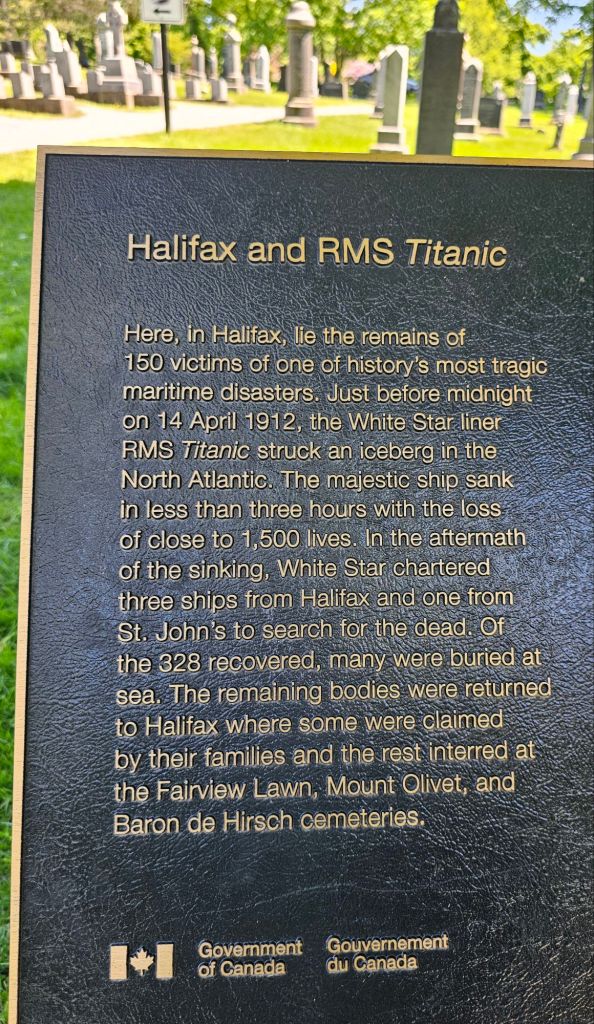
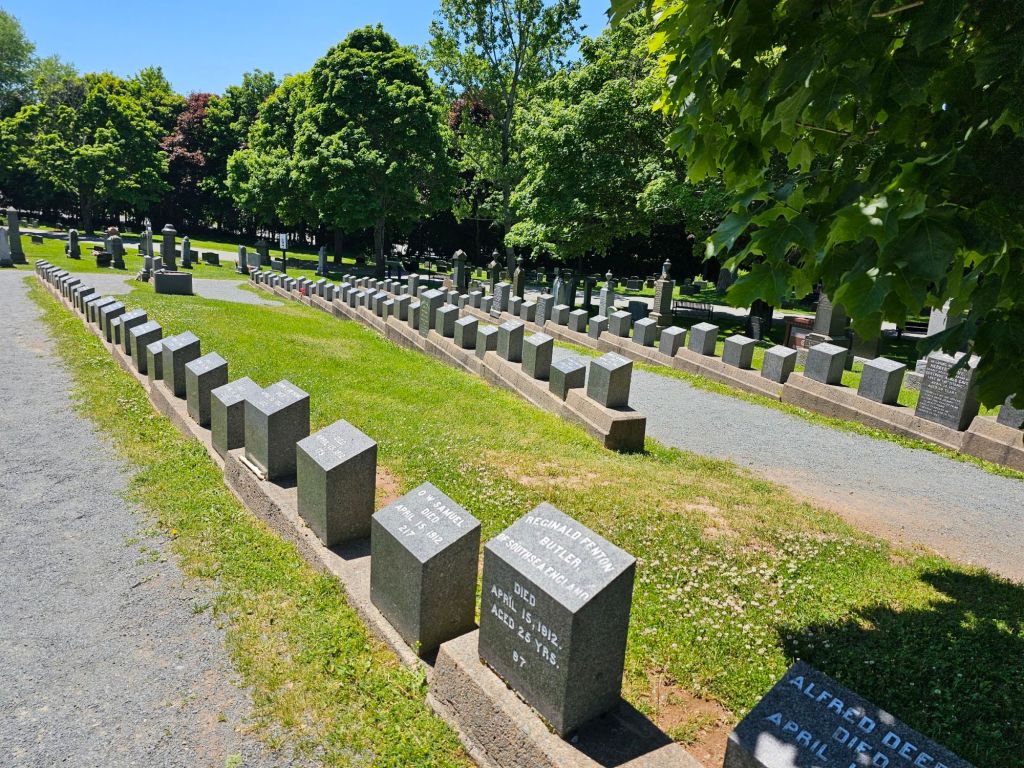
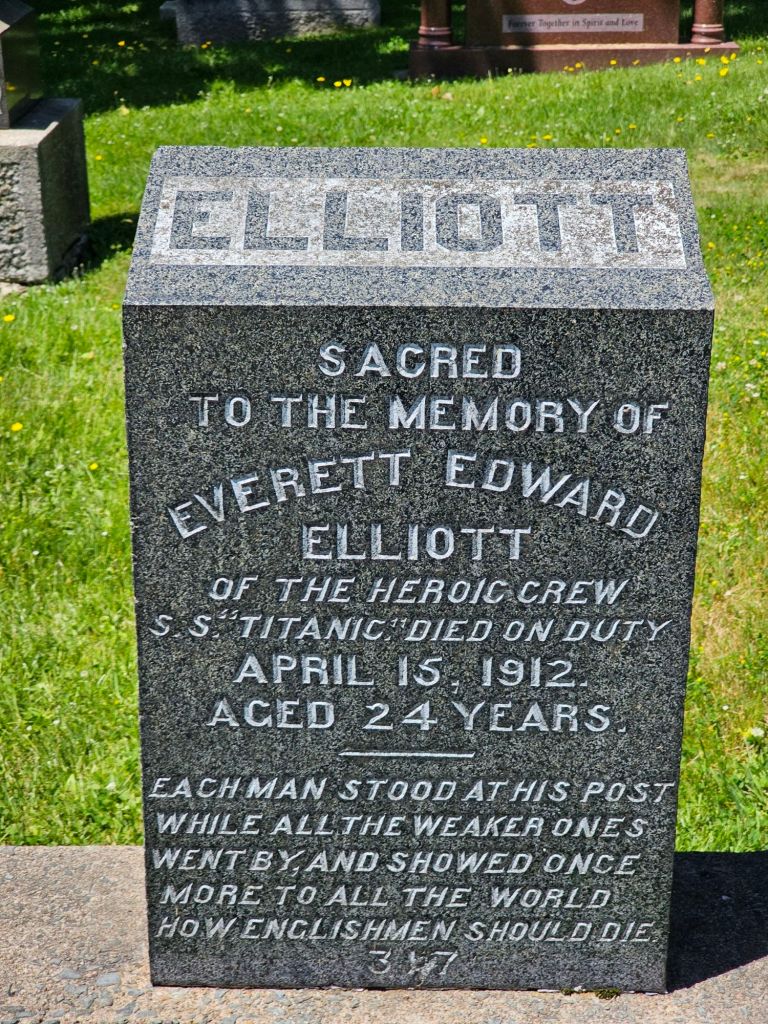
We pushed on to the Fairview Lawn cemetary, which proved to be fascinating. I didn’t know that victims of the sinking of the Titanic were buried in Halifax.
The Victims of the Titanic
Of the 337 bodies recovered, 119 were buried at sea. 209 were brought back to Halifax. 59 were claimed by relatives and shipped to their home communities. The victims buried at sea were third class passengers. Lack of preservation materials for all the recovered bodies did not allow them to be brought to Halifax. Following the sinking of the Titanic in 1912, the city of Halifax played a significant role in recovery efforts.
There are three cemeteries in Halifax where victims of the Titanic are buried:
- Fairview Lawn Cemetery: This cemetery is the final resting place for the majority of Titanic victims. There are 121 graves in total, with many of the headstones simply engraved with the ship’s name and the date of the sinking.
- Mount Olivet Cemetery: Some Titanic victims, primarily those who were of the Catholic faith, are buried in this cemetery. Their graves are marked with Celtic crosses.
- Baron de Hirsch Cemetery: This Jewish cemetery is the burial site for several Titanic victims who were Jewish. Their graves are marked with traditional Jewish symbols and inscriptions.
These cemeteries serve as a solemn reminder of the tragic loss of life that occurred during the sinking of the Titanic.
There was also a marker to the unknown victims of the 1917 harbor explosion.

It’s a gorgeous day. Perfect temperatures for travelling and relaxing in our campsite for the rest of the afternoon.
We stopped to replenish food supplies and picked up dinner tonight… ribs on the BBQ, fresh local asparagus with rice to go with it. Dessert is fresh local strawberries and home made brownies.
We have a father’s day call with some of our family later this afternoon and friends at home tonight.


 Louise and Brian McLeod Travel Blog
You must be logged in to post a comment.