It’s raining and we are in no hurry to get out of bed. We don’t have a long drive today and we have seen what there is to see in Lunenburg.
A little shopping was needed before leaving Lunenburg. Given the weather, we decided to stop at Peggy’s Cove on the way. We’ve been here before.
Peggy’s Cove
Peggy’s Cove is a small rural community located on the eastern shore of St. Margaret’s Bay in Nova Scotia, Canada. The area is known for its picturesque fishing village, iconic lighthouse, and rocky coastline.
The history of Peggy’s Cove can be traced back to the early 19th century when the site was originally inhabited by the Mi’kmaq indigenous people. The name “Peggy’s Cove” is believed to have originated from the sole survivor of a shipwreck in the area, a woman named Margret or Peggy, who settled in the village and married a local resident.
The lighthouse at Peggy’s Cove was built in 1915 to help guide ships safely through the treacherous waters of St. Margaret’s Bay.

Roads and several homes were badly damaged at Peggy’s Cove in 2003 by the extensive flooding that accompanied Hurricane Juan, which also damaged the cove’s breakwater. The breakwater was further washed away by Hurricane Bill in 2009, allowing waves to seriously damage a home and gift shop, and washed away one of the cove’s characteristic wooden fish sheds.
Everyone who visits Nova Scotia visits Peggy’s Cove and today is no exception. Even though it’s raining, there are tour buses and people climbing all over the rocks.
We’ve chosen the non-bus designated restaurant for lunch. We are sharing lobster Mac and cheese and fresh haddock.

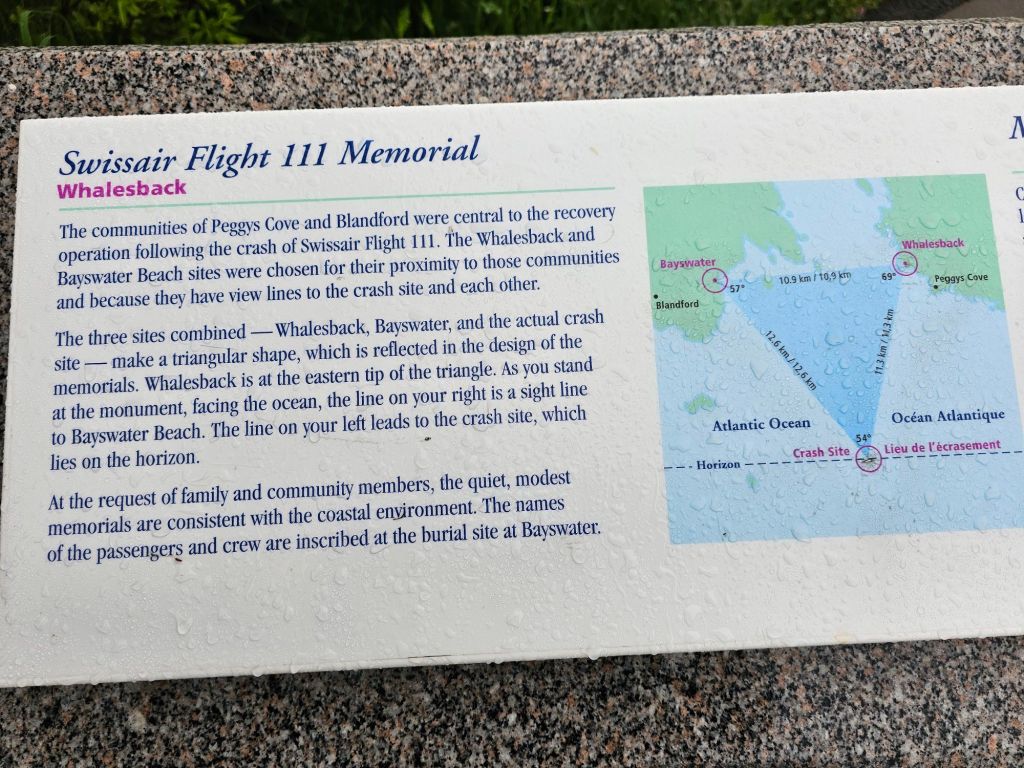
On September 2, 1998, Swissair Flight 111 crashed into St. Margaret’s Bay approximately eight kilometres (five miles) southwest of Peggy’s Cove with the loss of all 229 aboard. The cove became one of the staging areas for first responders that were involved in the search-and-rescue response, crash recovery operation, and investigation of the crash. Many of the volunteers that were first to approach the crash site were privately owned fishing boats that were operating out of Peggy’s Cove and surrounding harbours.

I have been wanting to know more about the Black community in Nova Scotia. All I’ve known previously is that there was an influx of Africans from the US after the revolutionary war so I’ve been doing some research particularly about the community in Halifax.
Black Cummunity in Nova Scotia
The Black community in Nova Scotia, Canada has a rich history that dates back to the 17th century. Many Black Nova Scotians are descendants of African Americans who arrived in the region during the American Revolutionary War. These individuals were promised freedom and land in Nova Scotia by the British government in exchange for their loyalty during the war.
Africville, Halifax
Africville was a historic African-Nova Scotian community located on the outskirts of Halifax, Nova Scotia, Canada. Established in the early 1800s, the community was home to mostly Black residents, many of whom were former slaves and descendants of Loyalists who resettled in Nova Scotia after the American Revolutionary War.
Over the years, Afrikville grew into a vibrant and close-knit community with its own church, schools, businesses, and a strong cultural identity. However, despite its strong sense of community and resilience, Afrikville faced significant challenges including poverty, racism, and inadequate infrastructure.
Despite paying municipal taxes and years of petition, residents lived without the services taken for granted by others, including water, sewage, paved roads, police, ambulance and fire truck service. Facilities unwanted by other communities such as a prison, a slaughterhouse, and an infectious disease hospital were located in and around Africville. While other parts of the city received investments to modernize and renew, the isolated community of Africville was left to ruin.
In the 1960s, the City of Halifax decided to redevelop the area where Afrikville was located, citing concerns about health and sanitation. In 1964, the residents of Afrikville were forcibly removed from their homes and the entire community was demolished. This act of displacement and destruction had a lasting impact on the former residents of Afrikville, many of whom lost their homes, businesses, and connections to their community.
In the years since the demolition of Africville, there have been efforts to recognize and preserve the memory of the community. The Africville Genealogy Society, established in the 1980s, works to document the history of Afrikville and preserve its legacy. In 2011, the Government of Nova Scotia issued a formal apology for the destruction of Africville and established a compensation package for the former residents and their descendants.
Today, Africville remains an important symbol of the strength and resilience of the African-Nova Scotian community and serves as a reminder of the long history of racism and discrimination faced by Black Canadians.
Rain
The wet weather is here for the day. After a lovely fish and seafood lunch at Bubba Magoos, we decided to pack it in for the day. It was raining too hard to photograph in Peggy’s Cove. We headed to our campsite about an hour away where we can just tuck in and be comfortable. We can do Halifax tomorrow. It’s not our first visit there.
Took us a lot longer to get into camp than anticipated. We already knew that the major bridge through Halifax to Dartmouth was closed for repairs over the weekend. Didn’t anticipate the amount of traffic now being routed across the secondary bridge which added at least 30 minutes to the trip. Decision tomorrow.. go back into Halifax and that traffick or keep on going?
Stay tuned.
We spent what was left of the afternoon getting caught up on email, reading, sewing (kantha quilting) and watching YouTube. Dinner is soup and salad.

 Louise and Brian McLeod Travel Blog
You must be logged in to post a comment.