Wow. This morning is superb! The sun is shining on our campsite and the wind has gone down. Breakfast and coffee outside for the first time since we left home. We also had dinner outside last night. I love our new weather station. Now I can see what the outside temperature is before getting out of bed. The solar panels are soaking up energy.
We have no services in this campsite and if we didn’t have our satellite dish, no cell network. However, with the satellite dish, we were able to have a family zoom call last night and our cell phone service allows wifi calling. Success on the satellite investment.

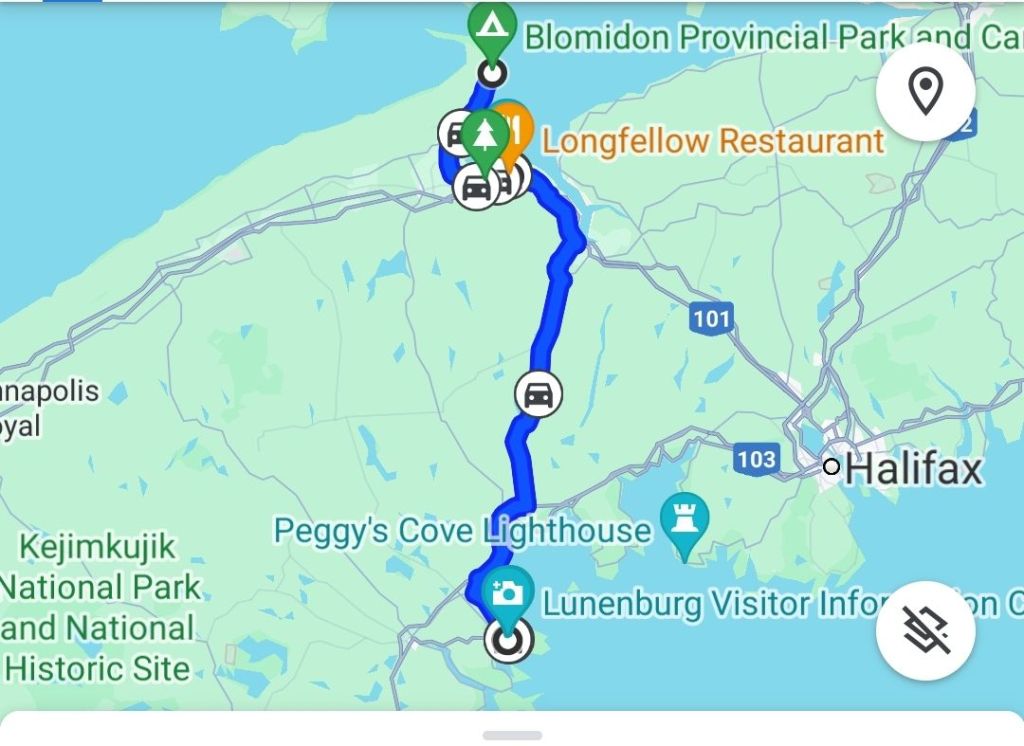
Today we are finishing up our meander through the Annapolis Valley by visiting Grand Pre and Wolfville on our way to Lunenburg. We were here many years ago on a bike tour of this area. I am not a biker so I walked the dykes instead. By day 4 of the bike tour, more people were walking with me on the dykes instead of biking on the roads!
Dykeland System
The dykeland system in Nova Scotia began with Charles de Menou d’Aulnay in the 1630s who applied a technique similar to one long used in France. The concept entailed constructing earthen dykes along a tidal river or bay to prevent salt water from flooding the marshland. At low tide, a system of canals, streams and dykes allowed freshwater to flow through sluices (aboiteaux) in the dykes made from hollowed logs or planks and out to sea. At high tide, a wooden valve at the river end of the sluice closed as the tide rose, preventing the sea water from entering the marshland. Within a few years, rain and melting snow leached out most of the salt, creating a fertile plain where farmers could cultivate crops such as wheat, oat and flax.


Roads in farming areas often led along the tops of dykes. Carts drawn by oxen or horses were used for local travel. The dykeland system has survived throughout the centuries. Today, thousands of hectares of agricultural land along the Bay of Fundy coast in Nova Scotia are maintained as dykelands, based on the concept brought here by d’Aulnay and his settlers.
Wolfville, NS
Wolfville is a charming town located in the Annapolis Valley of Nova Scotia, Canada. Its history dates back to the early 18th century when Acadian farmers settled the area. The town was officially founded in 1837 and was originally known as Mud Creek. In 1861, the name was changed to Wolfville in honor of the surrounding Wolfville Ridge.
Throughout its history, Wolfville has been a hub for education and culture. Acadia University, a prestigious institution founded in 1838, has played a significant role in shaping the town’s identity.
We enjoyed a short walk along the dyke at Wolfville and then headed to the Domaine Grand Pre winery where we had an enjoyable time sitting on the patio and sampling local wines.

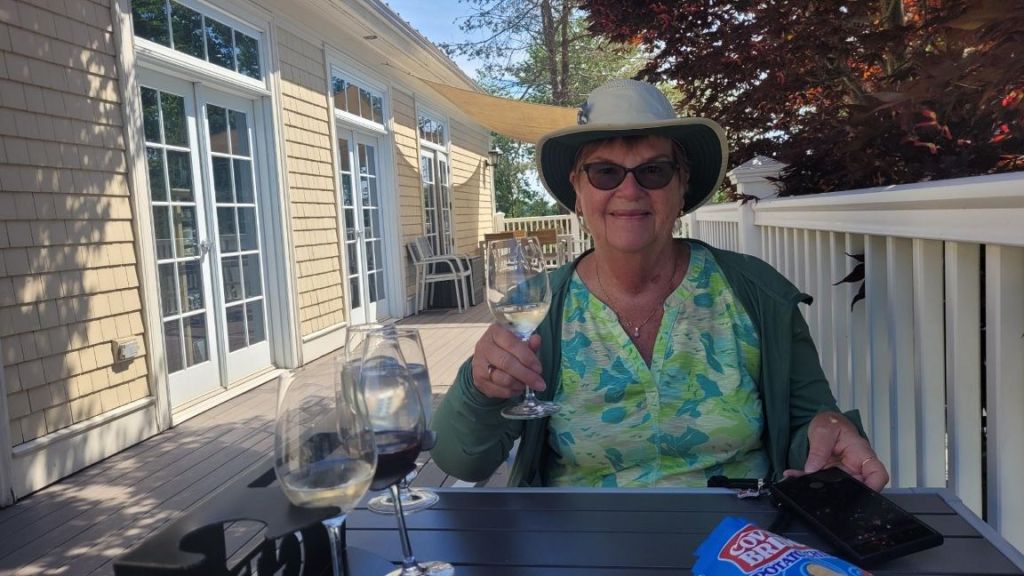
The winery was adjacent to the Parks Canada National monument of Grand Pre honoring the Acadians who were removed by the British in 1757.
Grand Pre, NS
Grand Pré, a Canadian rural community located in the Annapolis Valley of Nova Scotia, was once a thriving Acadian settlement.
The history of Grand Pré dates back to the early 17th century when French settlers, known as the Acadians, established a vibrant farming community in the region. The fertile marshlands of Grand Pré were well-suited for agriculture, and the Acadians became known for their skill in dykeland farming.
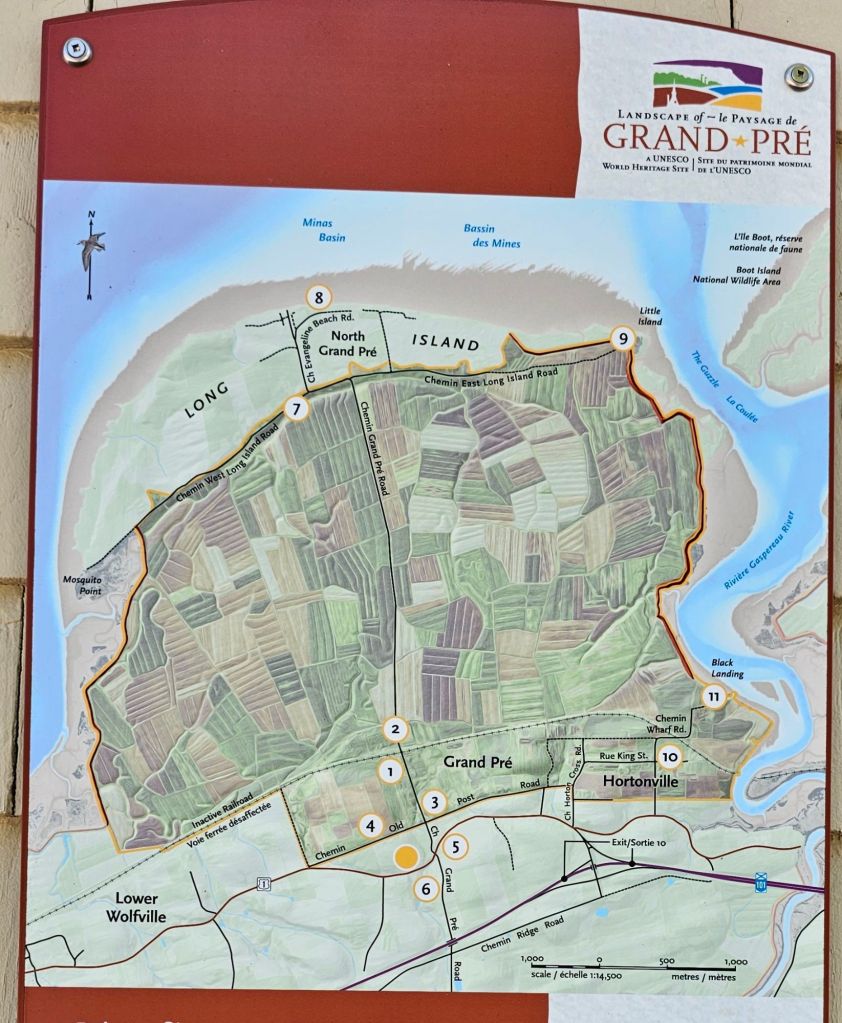
In 1755, during the French and Indian War, the British authorities demanded that the Acadians pledge allegiance to the British Crown. When the Acadians refused, they were forcibly expelled from the region in what became known as the Great Expulsion or the Grand Dérangement. The Acadian population of Grand Pré was rounded up and deported, their homes were burned, and their lands were confiscated. Many of them relocated in Louisiana.
The story of the Acadian expulsion from Grand Pré was immortalized in Henry Wadsworth Longfellow’s epic poem “Evangeline: A Tale of Acadie,” which tells the tale of two lovers, Evangeline and Gabriel, who were separated during the expulsion.
** I wrote about the Acadian expulsion and their resettlement along the Bayou Teche in Louisiana on our recent Louisiana trip that included a discussion about Longfellow’s poem Evangeline. Day 6: Chicot State Park to Parks, La 2024
Today, Grand Pré is a UNESCO World Heritage Site, recognized for its cultural significance and its role in preserving the history of the Acadian people.
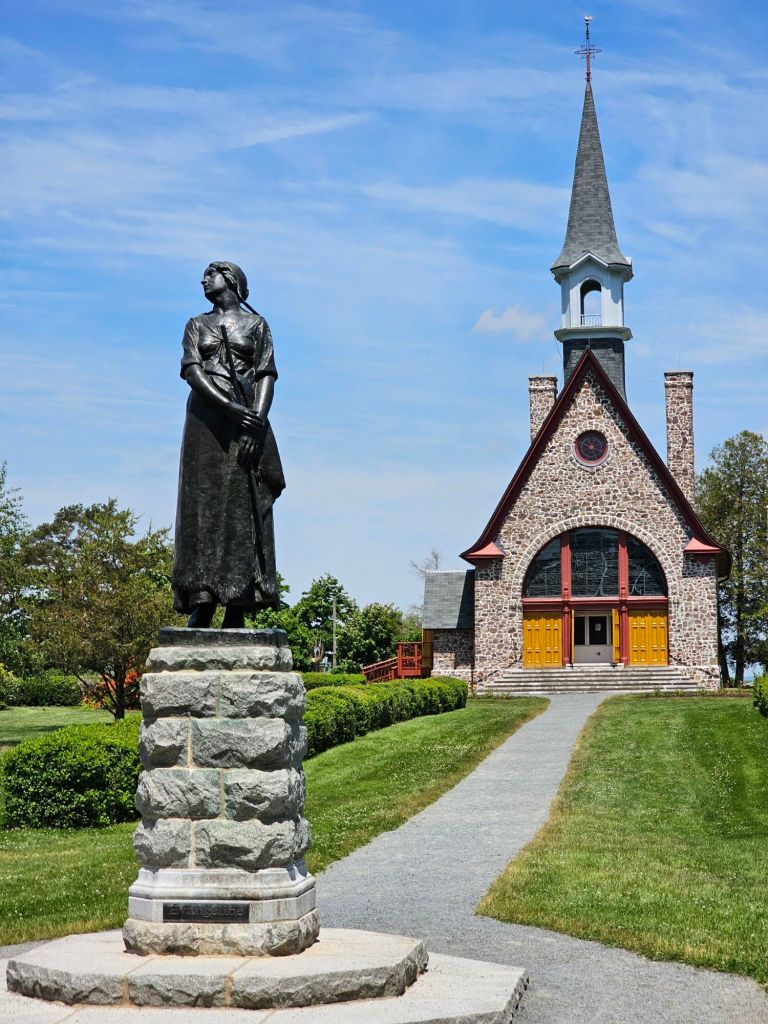

It was lunchtime by the time we left Grand Pre. Both of us were in the mood for seafood chowder. Fortuitous, Longfellow’s Restaurant located at the entrance to the heritage site fit the bill. Lovely little restaurant with the best seafood chowder we’ve ever eaten! Timely and delicious.
We arrived in Lunenburg via Mahone Bay, a scenic fishing town, around 3:30. The campground was at the top of the hill above the town and not much to write home about. Theoretically we booked this so we could walk into town. I wasn’t in the mood for climbing hills today. We decided to drive down into town, see what we could, have a bite to eat and then set up camp later. Turned out to be a good plan.
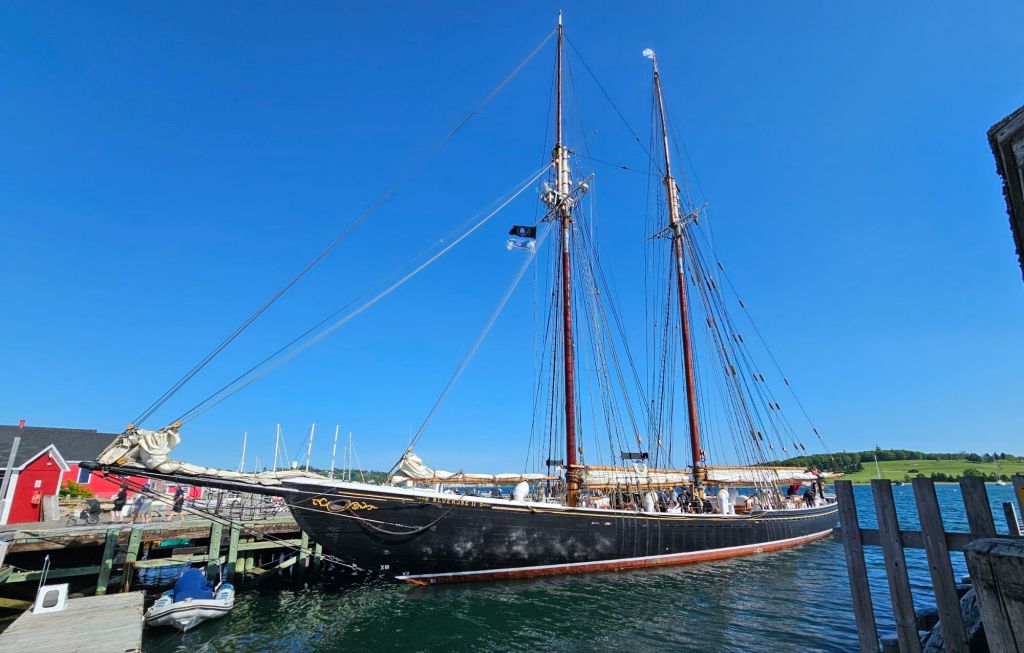
We had time to visit the Fisheries Museum of Atlantic Canada and climb aboard the Bluenose II.
The Bluenose II
The Bluenose II is a replica of the original Bluenose schooner, which was a Canadian fishing and racing vessel. The original Bluenose was built in 1921 in Lunenburg, Nova Scotia and became famous for its speed and success in racing competitions. It was known as the “Queen of the North Atlantic” and featured on the Canadian dime.
The Bluenose II was built in 1963 as a replica of the original Bluenose, with the same iconic design and purpose. It serves as a floating monument to the original vessel and a symbol of Canadian maritime history. The Bluenose II has had a storied history of its own, participating in numerous sailing events and serving as a tourist attraction in Halifax, Nova Scotia.
Over the years, the Bluenose II has undergone several restorations and refurbishments to ensure its seaworthiness and authenticity. Today, it continues to sail in Canadian waters, delighting visitors and carrying on the legacy of the original Bluenose.


We enjoyed a glass of wine on an outside deck overlooking the harbour and had a light snack for dinner before returning to our campsite for the evening.
All in all a beautiful day.
 Louise and Brian McLeod Travel Blog
You must be logged in to post a comment.