Finally have some nice weather, bright sunshine and cool enough to enjoy all the walking necessary.
The girls with us want to visit the English bookstore just opposite Notre Dame, Shakespeare and Company. Little did we know it’s the most popular attraction in Paris after the Eiffel Tower and the Louvre. We came over yesterday afternoon late in the afternoon. The lineup to get in was impossible. We decided to get here early today before it opened a. Success but we were here at least 30 minutes early. The store hasn’t opened yet and the end of the line is not visible.
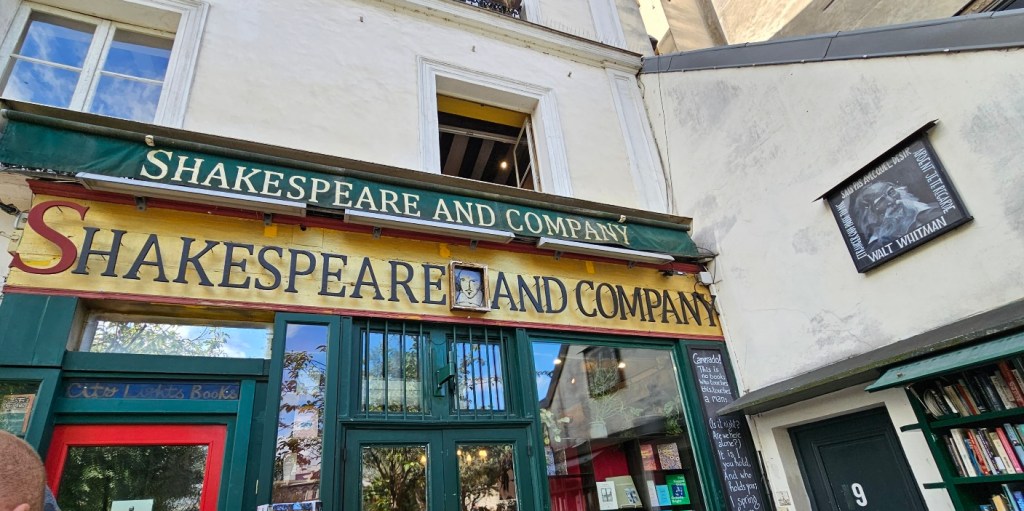
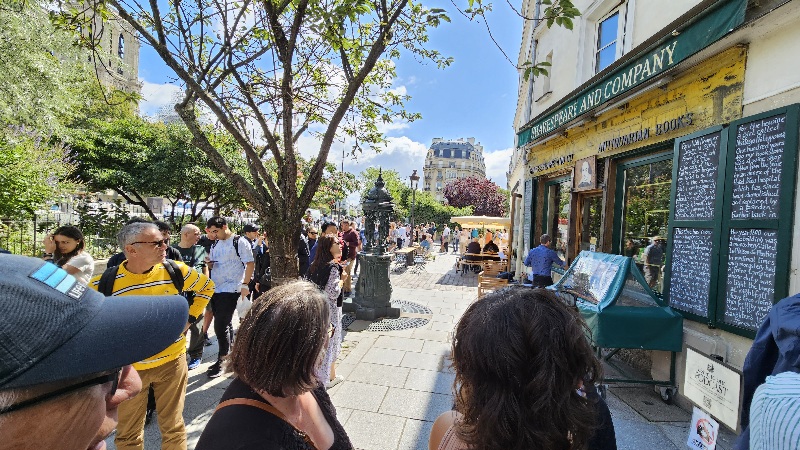
Fascinating place. Well worth the wait. I wasn’t going to go into the history of places we are seeing in Paris as it’s all so well known, but this is different I think so I’m going to talk about it.
History
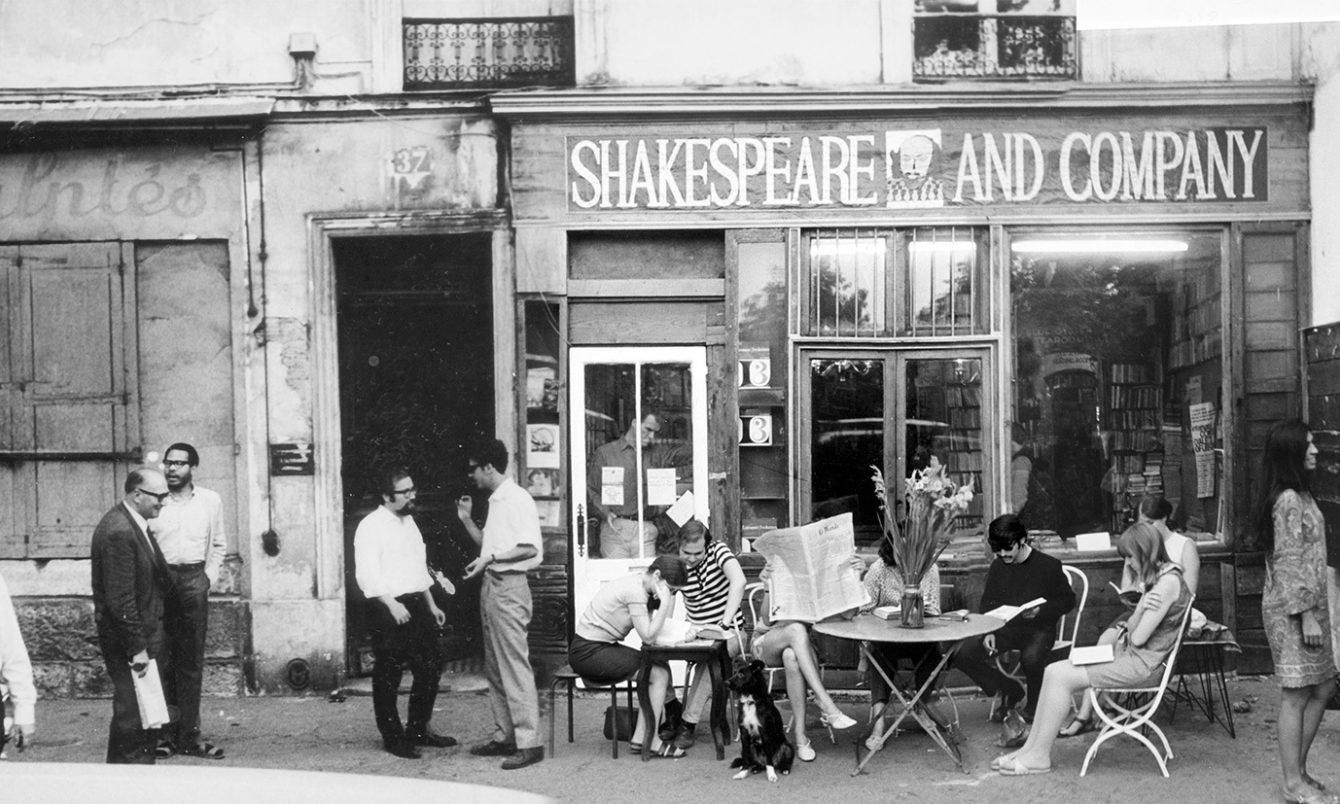
“I created this bookstore like a man would write a novel, building each room like a chapter, and I like people to open the door the way they open a book, a book that leads into a magic world in their imaginations.”
— George Whitman
A Brief History of a Parisian Bookstore
Shakespeare and Company is an English-language bookshop in the heart of Paris, on the banks of the Seine, opposite Notre-Dame. Since opening in 1951, it’s been a meeting place for anglophone writers and readers, becoming a Left Bank literary institution.
The bookshop was founded by American George Whitman at 37 rue de la Bûcherie, Kilometer Zero, the point at which all French roads begin. Constructed in the early 17th century, the building was originally a monastery, La Maison du Mustier. George liked to pretend he was the sole surviving monk, saying, “In the Middle Ages, each monastery had a frère lampier, a monk whose duty was to light the lamps at nightfall. I’m the frère lampier here now. It’s the modest role I play.”
When the store first opened, it was called Le Mistral. George changed it to the present name in April 1964—on the four-hundredth anniversary of William Shakespeare’s birth—in honor of a bookseller he admired, Sylvia Beach, who’d founded the original Shakespeare and Company in 1919. Her store at 12 rue de l’Odéon was a gathering place for the great expat writers of the time—Joyce, Hemingway, Stein, Fitzgerald, Eliot, Pound—as well as for leading French writers.
Through his bookstore, George Whitman endeavored to carry on the spirit of Beach’s shop, and it quickly became a center for expat literary life in Paris. Allen Ginsberg, William Burroughs, Anaïs Nin, Richard Wright, William Styron, Julio Cortázar, Henry Miller, William Saroyan, Lawrence Durrell, James Jones, and James Baldwin were among early visitors to the shop.
Sylvia Beach (14 March 1887 – 5 October 1962), born Nancy Woodbridge Beach, was an American-born bookseller and publisher who lived most of her life in Paris, where she was one of the leading expatriate figures between World War I and II. She is known for her Paris bookstore, Shakespeare and Company, where she published James Joyce‘s book, Ulysses (1922), and encouraged the publication of and sold copies of Hemingway’s first book, Three Stories and Ten Poems (1923). In July 1920, Beach met Irish writer James Joyce at a dinner party hosted by French poet André Spire. Soon after, Joyce joined her lending library. Joyce had been trying, unsuccessfully, to publish his manuscript for his masterpiece, Ulysses, and Beach, seeing his frustration, offered to publish it. Shakespeare and Company gained considerable fame after it published Ulysses in 1922, as a result of Joyce’s inability to get an edition out in English-speaking countries. She was later financially stranded when Joyce signed on with another publisher, leaving her in debt after she had bankrolled, and suffered severe losses from, the publication of Ulysses.
The Pantheon
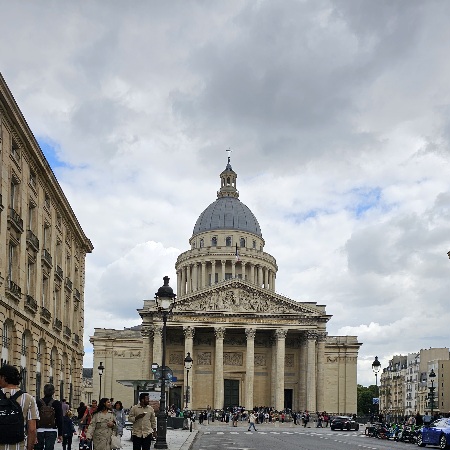
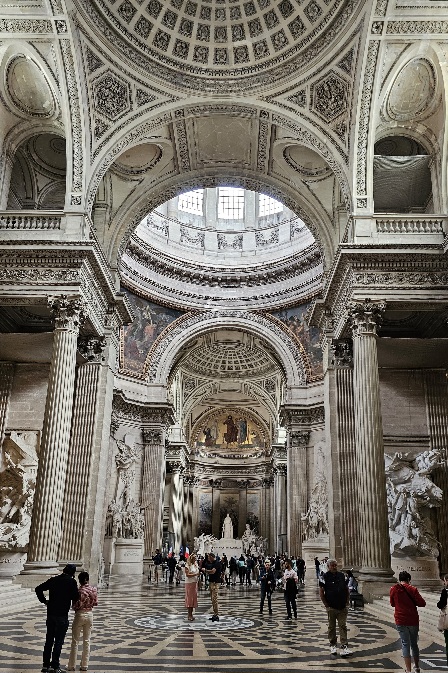
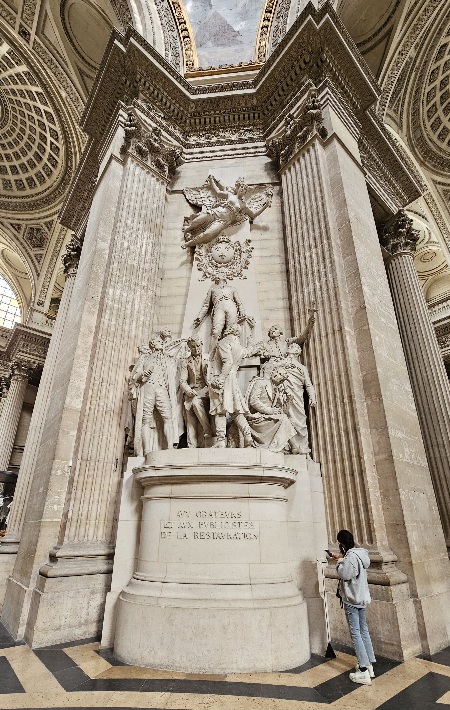
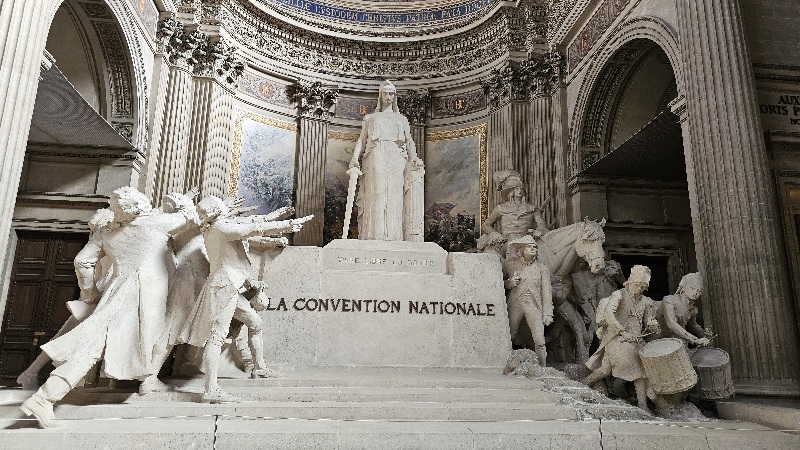
Buried in the Crypt of the Pantheon
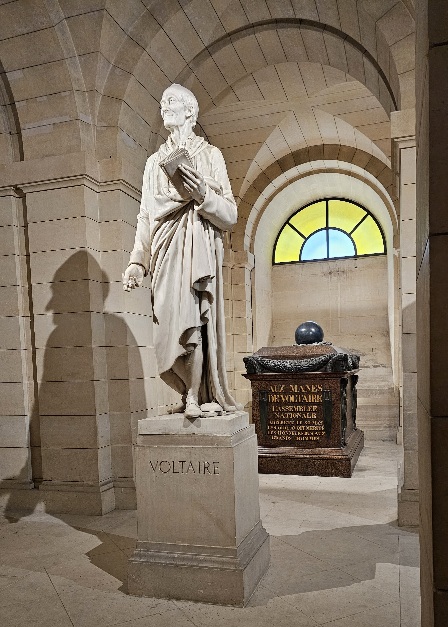
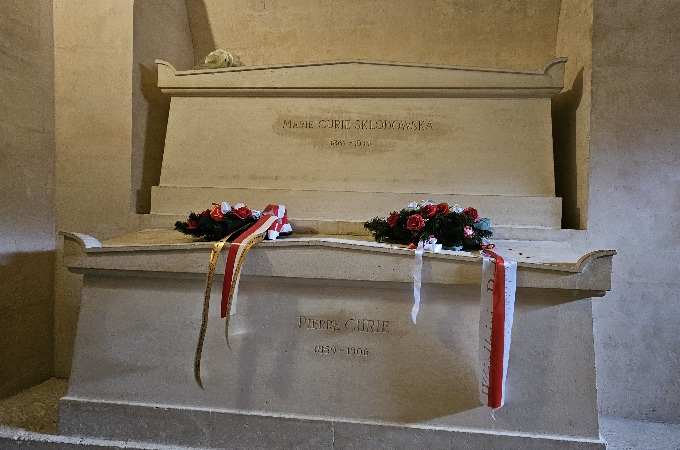
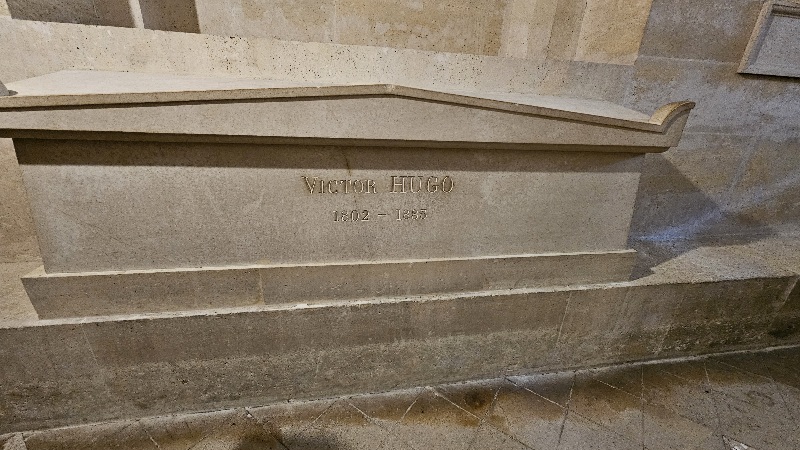
… among others
Foucault’s Pendulum
Foucault explained his results in an 1851 paper entitled Physical demonstration of the Earth’s rotational movement by means of the pendulum, published in the Comptes rendus de l’Académie des Sciences. He wrote that, at the North Pole:
…an oscillatory movement of the pendulum mass follows an arc of a circle whose plane is well known, and to which the inertia of matter ensures an unchanging position in space. If these oscillations continue for a certain time, the movement of the earth, which continues to rotate from west to east, will become sensitive in contrast to the immobility of the oscillation plane whose trace on the ground will seem animated by a movement consistent with the apparent movement of the celestial sphere; and if the oscillations could be perpetuated for twenty-four hours, the trace of their plane would then execute an entire revolution around the vertical projection of the point of suspension.
France’s Prime Meridian
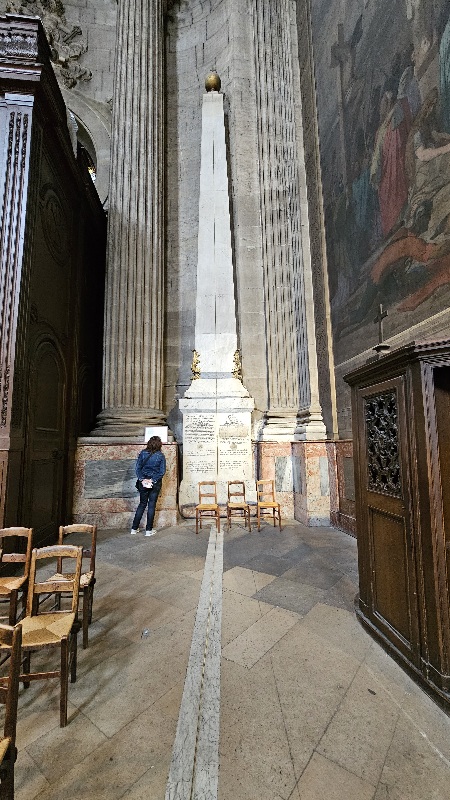
France’s prime meridian, a line of longitude right through the centre of Paris, and essentially a semi-circle around the the world from north to south. It is from these lines that distance and time can be measured. France’s meridian was calculated in the 17th century, and developed more precisely by astronomer François Arago in the 19th century. This line held a long-standing rivalry against other meridian lines, all of which eventually lost out to the Greenwich meridian. The rest of the world accepted London’s prime meridian quite quickly, and the French took a little longer, eventually accepting it in 1911.
 Louise and Brian McLeod Travel Blog
You must be logged in to post a comment.