I think summer just might have decided to make an appearance. Another lovely cloudless warm day although rain is badly needed here.
Short drive of an hour to Regina through the same prairie landscape. We saw a couple of potash plants in the area.
Regina is the provincial capital, a beautiful city with parks and lakes. Our destination here was the Saturday morning open air farmer’s Market and the RCMP Training Center.
We bought some local produce at a Hutterite-operated farm stand. I knew Canada had colonies of Hutterites but didn’t know where they had settled. Now I know. The women are distinctive by their black headscarves with white polka dots and beautiful traditional clothing. Very colorful.
Hutterites
Hutterites (German: Hutterer), also called Hutterian Brethren (German: Hutterische Brüder), are a communal ethnoreligious branch of Anabaptists, who, like the Amish and Mennonites, trace their roots to the Radical Reformation of the early 16th century and have formed intentional communities.
The founder of the Hutterites, Jakob Hutter, “established the Hutterite colonies on the basis of the Schleitheim Confession, a classic Anabaptist statement of faith” of 1527, and the first communes were formed in 1528. The beliefs of the Hutterites, especially those espousing a community of goods and nonresistance, have resulted in hundreds of years of diaspora in many countries. Today, almost all Hutterites live in Western Canada (Alberta, Saskatchewan and Manitoba) and the upper Great Plains of the United States.
Lile Mennonites, they don’t like to be photographed so out of respect I don’t have one to place here.
The RCMP Heritage Center
The RCMP Heritage Centre (French: Le Centre du patrimoine de la GRC) is a law enforcement museum located in Regina, Saskatchewan, Canada. The museum houses a number of exhibits on the Royal Canadian Mounted Police (RCMP) and artifacts relating to the police force.
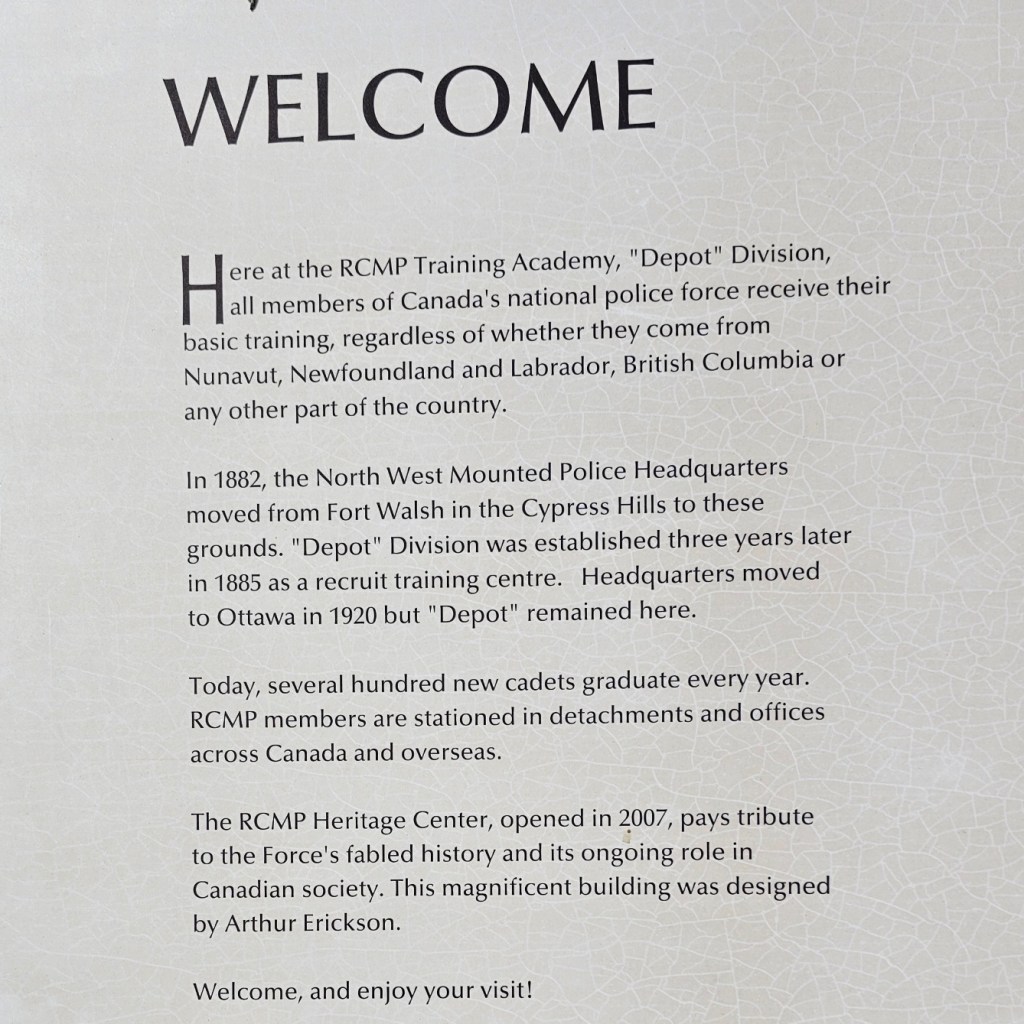
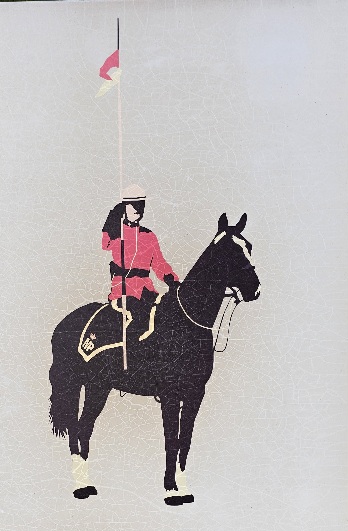
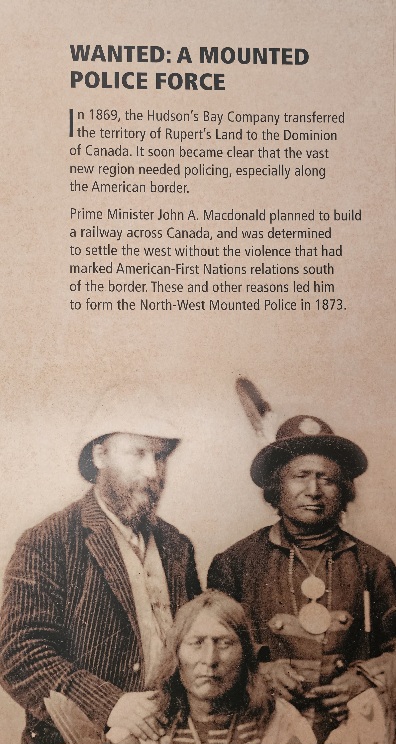
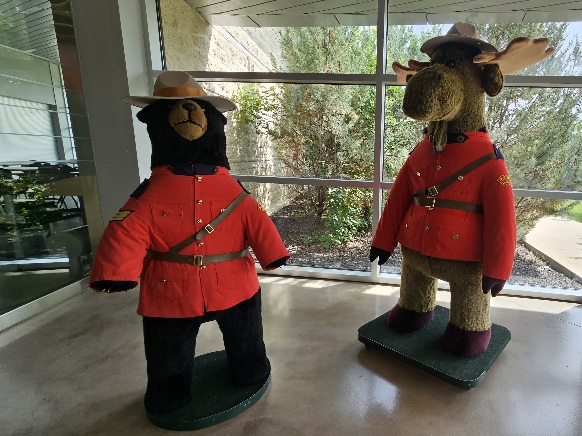
I was so busy reading everything that l didn’t take any other photos! There was also a movie about the RCMP training center, The Depot. All RCMP officers are trained here at the Depot. A new squad arrives every Monday. Rigorous training takes 6 months. Not everybody makes the final cut. About 23% of the students are female.
The Royal Canadian Mounted Police (RCMP; French: Gendarmerie royale du Canada; GRC), commonly known in English as the Mounties (and colloquially in French as la police montée) is the federal and national police service of Canada. As police services are the constitutional responsibility of provinces and territories of Canada, the RCMP’s primary responsibility is the enforcement of federal criminal law, and sworn members of the RCMP have jurisdiction as a peace officer in all provinces and territories of Canada. However, the service also provides police services under contract to eight of Canada’s provinces (all except Ontario and Quebec), all three of Canada’s territories, more than 150 municipalities, and 600 Indigenous communities. In addition to enforcing federal legislation and delivering local police services under contract, the RCMP is responsible for border integrity; overseeing Canadian peacekeeping missions involving police; managing the Canadian Firearms Program, which licenses and registers firearms and their owners; and the Canadian Police College, which provides police training to Canadian and international police services. Despite its name, the Royal Canadian Mounted Police are no longer an actual mounted police service, and horses are only used at ceremonial events.
The Royal Canadian Mounted Police was established in 1920 with the amalgamation of the Royal North-West Mounted Police and the Dominion Police. The RCMP has long enjoyed an international cultural influence, appearing in films, television shows, and books since its formation in the early 20th century. The Government of Canada considers the RCMP to be an unofficial national symbol.
The two most populous provinces, Ontario and Quebec, operate independent provincial police services, which, like the RCMP, are responsible for some provincial law enforcement and providing local police services under contract. The other eight provinces and all three territories contract at least some policing responsibilities to the RCMP, which provides front-line policing in those provinces under the direction of the provincial governments. Municipalities, which are responsible for police services in every province except Newfoundland and Labrador, can contract for RCMP services through their provincial government, or by direct contracts. Thus, the RCMP provides police services at the federal, provincial, and municipal level. In some areas of Canada, it is the only police service.
In 1940, the RCMP schooner St. Roch facilitated the first effective patrol of Canada’s Arctic territory. It was the first vessel to navigate the Northwest Passage from west to east, taking two years, the first to navigate the passage in one season (from Halifax to Vancouver in 1944), the first to sail either way through the passage in one season, and the first to circumnavigate North America (1950).
In June 1953, the RCMP became a full member of the International Criminal Police Organization (Interpol).
There is no direct policing equivalent to the RCMP in the United States, which has no federal front-line policing agency. The biggest difference between American and Canadian police is that Canadian police enact the single Canadian federal criminal code, whereas in the United States different states have their own criminal code, which in some cases differs from the American federal criminal code. In Canada the enforcement of the federal criminal code is the same throughout all provinces and territories. Therefore police training, police practices, and investigative policies are standardized regardless of a police officer’s location in the country. Another difference between U.S. and Canadian police is that police in Canada are public servants, whereas in the U.S. police chiefs can be elected. The use of lethal force in the U.S. far outstrips Canada. Adjusting for population differences, the police in the U.S. use lethal force about six times as often as Canadian officers. (source Wilfred Laurier University).
The van badly needed a wash and it’s been a week since I last did laundry. We found both a laundromat and a car wash fairly close to each other and not far from the RCMP Heritage Center. I did laundry while Brian took the van for a clean up. It worked out rather well. If you want a glimpse into local color, sit in a laundromat for an hour!
Regina is the capital city of the Canadian province of Saskatchewan. The city is the second-largest in the province, after Saskatoon, and is a commercial centre for southern Saskatchewan.
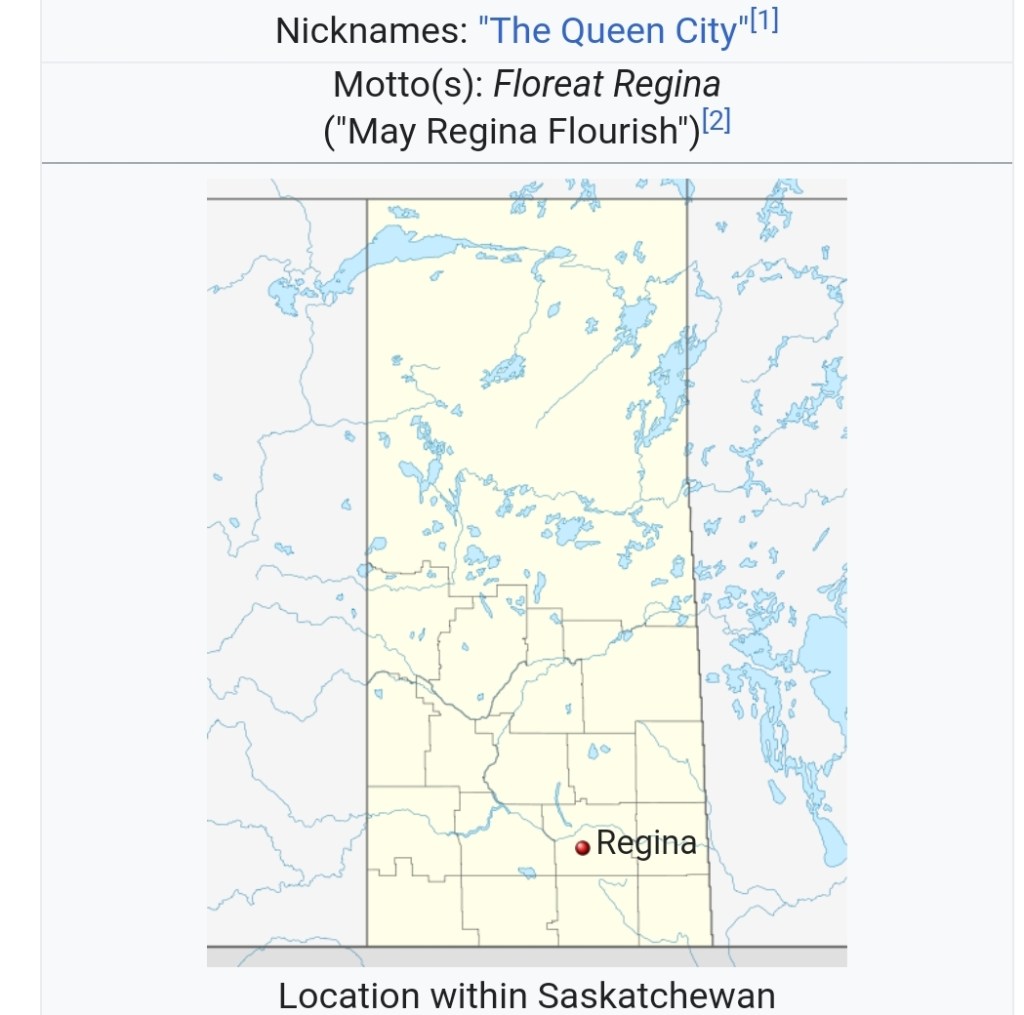
Regina was previously the seat of government of the North-West Territories, of which the current provinces of Saskatchewan and Alberta originally formed part, and of the District of Assiniboia. The site was previously called Wascana (“Buffalo Bones” in Cree), but was renamed to Regina (Latin for “Queen”) in 1882 in honour of Queen Victoria.
The Royal Canadian Mounted Police Academy, “Depot” Division, is on the western perimeter of the city. As capital of the North-West Territories, Regina was the headquarters of the Royal North-West Mounted Police (the RCMP’s predecessor) before “the Force” became a national body with its headquarters in Ottawa in 1920. The city takes great pride in this national institution which is a major visitor attraction and a continuing link with Regina’s past as the headquarters of the Force, together with longstanding substantial enrollment by trainees from across Canada, obtaining entertainment and recreation citywide. It offers sunset ceremonies and parade in the summertime. The national RCMP music and “Depot” Division chapel (the oldest building still standing in the city) are major visitor attractions in Regina.
Oil and natural gas, potash, kaolin, sodium sulphite and bentonite contribute a great part of Regina and area’s economy. The completion of the train link between eastern Canada and the then-District of Assiniboia in 1885, the development of the high-yielding and early-maturing Marquis strain of wheat and the opening of new grain markets in the United Kingdom established the first impetus for economic development and substantial population settlement. The farm and agricultural component is still a significant part of the economy.
Tonight we are in Echo Valley Provincial Park in the Qu’appelle Valley about 40 miles east of Regina.
The Qu’Appelle River and Valley derive their name from a Cree legend of a spirit that travels up and down it. The aboriginal people told the North West Company trader Daniel Harmon in 1804 that they often heard the voice of a human calling, “kâ-têpwêt?“, meaning “What is calling?” (“que + appelle?” in French). They would respond, and the call would echo back (there is a strong echo phenomenon at Lebret). Pauline Johnson, a half-Mohawk poet, learned of the legend and elaborated upon it with Victorian sentiment. In her version, a young Cree swain heard his name while crossing one of the lakes and replied, “Who calls?” Only his echo could be heard (hence Echo Lake), and he realized it had been his bride-to-be calling out his name at the instant of her death.
More about the Qu’Appelle Valley tomorrow when we visit Fort Qu’appelle. My father used to talk about the Qu’appelle Valley when I was young. I always thought it was Apple Valley.
Little bit of rain around dinner time but we hope we can have a campfire tonight.
 Louise and Brian McLeod Travel Blog
You must be logged in to post a comment.