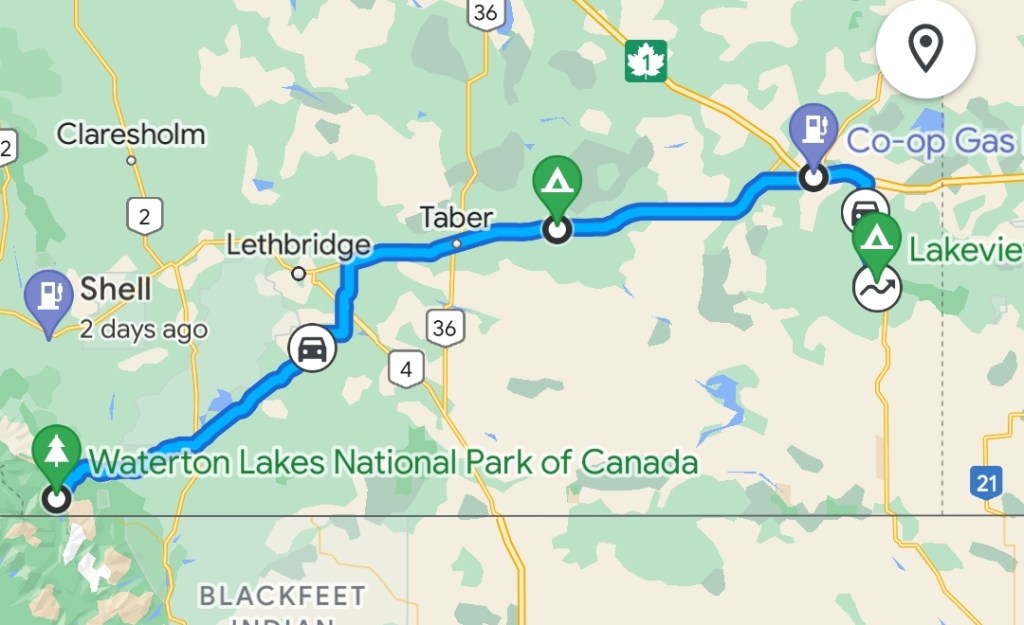
Today started off sunny but not particularly warm and still very windy. That must be normal for this part of the world. We didn’t rush out as our next destination is only 3 hours away.
It’s my turn to drive. Heading east we have the mountains at our backs. Our forward view is the vast rolling southern Alberta prairies. Crops, particularly around Taber are potatoes, canola and other grains.

The fields were just being planted as we travelled west over a month ago. Now they are in full growth.

We started seeing canola fields with orange tent-like things scattered around. We have also seen a lot of trucks carrying bee hives. Is there a relation? It turns out that there is. Canola seed plants have male and female flowers that need a lot of pollination. Honey bees, who’s hives we have seen at the edges of the fields, are not enough to pollinate the canola flowers. The tent-like things are habitats for leaf-cutter bees that are brought in just as the canola starts to flower. Taber, AB is a large producer of leaf- cutter bees for rent.
Canola crops made possible by hard-working leafcutters
Canola is beautiful when it’s in full bloom with bright yellow flowers. It produces rape seed oil much used in cooking etc. Rapeseed oil is one of the oldest known vegetable oils. There are both edible and industrial forms produced from rapeseed. The non-Food variety is called colza oil.
Rapeseed is extensively cultivated in Canada, France, Belgium, Ireland, the United Kingdom, the United States, the Netherlands, Germany, Denmark, and Poland. In France and Denmark, especially, the extraction of the oil is an important industry.Apart from its use for human consumption, rapeseed oil is extensively used as a lubricant for machinery. It was widely used in European domestic lighting before the advent of coal (city) gas or kerosene. It was the preferred oil for train pot lamps, and was used for lighting railway coaches in the United Kingdom before gas lighting, and later electric lighting, were adopted.

Lunch was a shared sandwich in a gas station parking lot as we watched all the trucks go by.
The landscape became progressively drier and less productive as we headed east towards the Saskatchewan border.
Our campground for the next two nights is Cypress Hills Interprovincial Park between Alberta and Saskatchewan. We camp the first night in Alberta and the second in Saskatchewan.
Cypress Hills Interprovincial Park near to Mediecine Hat AB has the highest point in Canada east of the Rocky Mountains. Reaching up to 1,466 metres above sea level, the beautiful Cypress Hills are protected within Canada’s first and only inter-provincial park. It has a diverse geography.
We arrived in camp fairly early. The campsite we are in is treed but sunny… and still cold. I needed an afternoon off from traveling to relax and do some baking. We went for a long walk first and then sat for a bit in the sun trying to keep warm I don’t know where summer is!
While my husband was out finishing his steps, I made some brownies and raisin/nut ‘muffins’. Enough baking now to get us home I think. I had left one cookie in a sealed plastic container (the last of what we brought from home) on the picnic table. The red squirrels here are aggressive. One managed to detect the cookie and tried to abscond with container. That didn’t work. Then he realized there were some good smells coming from inside the vehicle. Fortunately I had the mosquito netting down. He was up and down the screen and I was afraid he would ruin it. I used the only thing I had in my hand to try to chase him away… the hand mixer I was using. Consequently I had batter all over the place trying to convince him to leave!

We can have campfires now and they are needed for warmth. We bought another bundle of firewood yesterday and had a campfire while we ate dinner outside. We have noticed that everyone here is still wearing warm coats, campfires are a must and the portable chairs being used have puffy coverings, like a warm winter coat for a chair.
A walk after dinner and then inside to watch a downloaded series on my laptop.
I didn’t write anything about Alberta yet but will do do now because we leave it tomorrow.
ALBERTA
Alberta’s capital is Edmonton, while Calgary is its largest city. The two are Alberta’s largest census metropolitan areas.More than half of Albertans live in either Edmonton or Calgary, which contributes to continuing the rivalry between the two cities. English is the official language of the province.
Alberta is one of the thirteen provinces and territories of Canada. It is part of Western Canada and is one of the three prairie provinces. Alberta is bordered by British Columbia to the west, Saskatchewan to the east, the Northwest Territories (NWT) to the north, and the U.S. state of Montana to the south. It is one of the only two landlocked provinces in Canada (Saskatchewan being the other). The eastern part of the province is occupied by the Great Plains, while the western part borders the Rocky Mountains. The province has a predominantly continental climate but experiences quick temperature changes due to air aridity. Seasonal temperature swings are less pronounced in western Alberta due to occasional Chinook winds.
Before becoming part of Canada, Alberta was home to several First Nations like Plains Indians and Woodland Cree. It was also a territory used by fur traders of the rival companies Hudson’s Bay Company and North West Company. The Dominion of Canada bought the lands that would become Alberta as part of the NWT in 1870. From the late 1800s to early 1900s, many immigrants arrived to prevent the prairies from being annexed by the US. Growing wheat and cattle ranching also became very profitable. In 1905, the Alberta Act was passed, creating the province of Alberta. Massive oil reserves were discovered in 1947. The exploitation of oil sands began in 1967.
Alberta is renowned for its natural beauty, richness in fossils and for housing important nature reserves. Alberta is home to six UNESCO designated World Heritage Sites: the Canadian Rocky Mountain Parks, Dinosaur Provincial Park, Head-Smashed-In Buffalo Jump, Waterton-Glacier International Peace Park, Wood Buffalo National Park and Writing-on-Stone Provincial Park. Other popular sites include Banff National Park, Elk Island National Park, Jasper National Park, Waterton Lakes National Park, and Drumheller.

Alberta’s economy was one of the strongest in the world, supported by the burgeoning petroleum industry and to a lesser extent, agriculture and technology. In 2013, Alberta’s per capita GDP exceeded that of the United States, Norway, or Switzerland, and was the highest of any province in Canada at CA$84,390. This was 56% higher than the national average of CA$53,870 and more than twice that of some of the Atlantic provinces
Agriculture has a significant position in the province’s economy. The province has over three million head of cattle, and Alberta beef has a healthy worldwide market. Nearly one half of all Canadian beef is produced in Alberta. Alberta is one of the top producers of plains buffalo (bison) for the consumer market. Sheep for wool and mutton are also raised. Wheat and canola are primary farm crops, with Alberta leading the provinces in spring wheat production; other grains are also prominent.
Alberta is the leading beekeeping province of Canada, with some beekeepers wintering hives indoors in specially designed barns in southern Alberta, then migrating north during the summer into the Peace River valley where the season is short but the working days are long for honeybees to produce honey from clover and fireweed. Hybrid canola also requires bee pollination, and some beekeepers service this need.
Alberta is the largest producer of conventional crude oil, synthetic crude, natural gas and gas products in Canada. Alberta is the world’s second-largest exporter of natural gas and the fourth-largest producer. The Athabasca oil sands surrounding Fort McMurray have estimated unconventional oil reserves approximately equal to the conventional oil reserves of the rest of the world, estimated to be 1.6 trillion barrels.
Alberta has been a tourist destination from the early days of the 20th century, with attractions including outdoor locales for skiing, hiking, and camping, shopping locales such as West Edmonton Mall, Calgary Stampede, outdoor festivals, professional athletic events, international sporting competitions such as the Commonwealth Games and Olympic Games, as well as more eclectic attractions. According to Alberta Economic Development, Calgary and Edmonton both host over four million visitors annually. Banff, Jasper and the Rocky Mountains are visited by about three million people per year. Alberta tourism relies heavily on Southern Ontario tourists, as well as tourists from other parts of Canada, the United States, and many other countries.
About 1.2 million people visit the Calgary Stampede, a celebration of Canada’s own Wild West and the cattle ranching industry.
Another tourist destination that draws more than 650,000 visitors each year is the Drumheller Valley, located northeast of Calgary. Drumheller, “Dinosaur Capital of The World”, offers the Royal Tyrrell Museum of Palaeontology. Drumheller also had a rich mining history being one of Western Canada’s largest coal producers during the war years.
As with any Canadian province, the Alberta Legislature has (almost) exclusive authority to make laws respecting education.
Several publicly funded post-secondary institutions are governed under the province’s Post-secondary Learning Act. This includes four comprehensive research universities that provides undergraduate and graduate degrees, Athabasca University, the University of Alberta, the University of Calgary, and the University of Lethbridge; and three undergraduate universities that primarily provide bachelor’s degrees, the Alberta University of the Arts, Grant MacEwan University, and Mount Royal University.
 Louise and Brian McLeod Travel Blog
You must be logged in to post a comment.