We wanted to visit the Doukhabor Discovery Center in Castlegar which doesn’t open until 10 am. We only have a 2 1/5 hour drive to our next campsite and the timing is perfect. Gave us time to shower and do a load of laundry first.
The Doukhabors in Canada
Doukhobors are a sect of Russian dissenters, many of whom now live in western Canada. They are known for a radical pacifism which brought them notoriety during the 20th century. Today, their descendants in Canada number approximately 30,000, with one third still active in their culture.
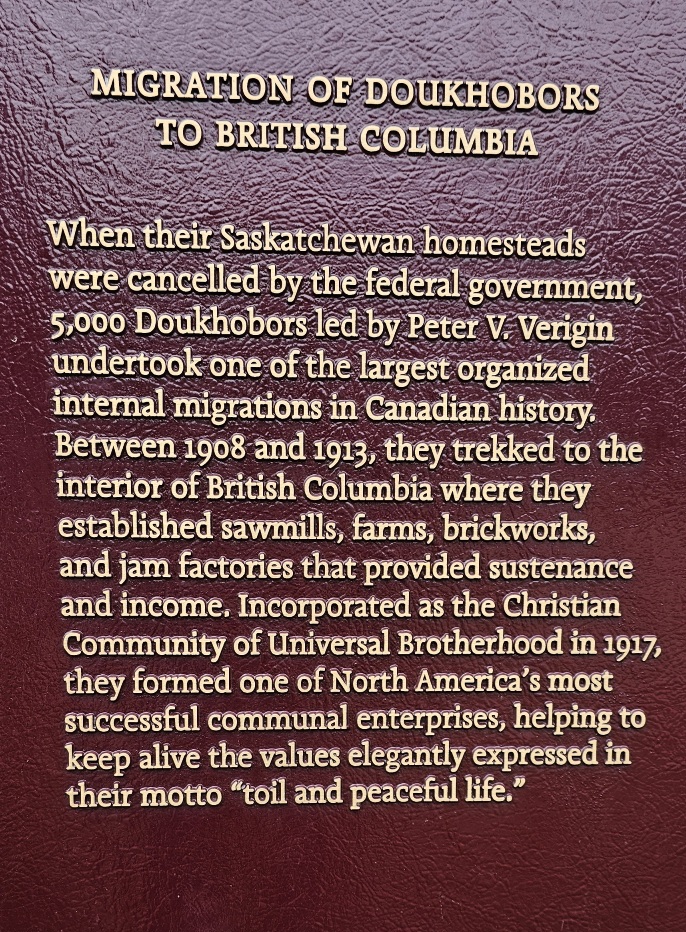
Since they arose as a peasant group in southern Russia with orally transmitted teachings and traditions, their origin is obscure. Their doctrines appear to have been at least partially derived from those of a 17th-century renegade preacher Danilo Filipov, who dissented radically from the Orthodox Church.
The Doukhobors rejected church liturgy, believing that god dwells in each human being and not in a church; they rejected secular governments; and practised pacifism. They replaced the Bible with orally transmitted psalms and hymns, which they called the Living Book. These are sung to this day at the molenie (religious gatherings). Group decisions are made collectively at sobranie (community meetings). Doukhobors do not use any religious symbols at these meetings except for the display of bread, salt and water, which represent the elements that sustain life.
During the late 18th century, the group was persecuted by the tsars and the Russian Orthodox Church for heresy and pacifism. In 1785, an Orthodox archbishop called them Doukhobors, or “Spirit-Wrestlers.” It was intended to mean “Wrestlers against the Holy Spirit,” but the group adopted it, interpreting it as “Wrestlers for and with the Spirit.”
They overcame initial difficulties and eventually prospered, particularly under their female leader, Lukeriia Kalmikova. Kalmikova died in 1886, and the ensuing struggle for leadership split the sect. Her adopted son Peter Verigin, later called Peter Gospodii (the Lordly), emerged as the majority leader. Verigin was able to exhort his followers to reaffirm their ideals and become even more radical, as the Doukhobors added vegetarianism, communal living and abstinence from alcohol to their other practices. In 1895, they publicly burned their weapons in what is now known as The Burning of Arms, which may have been the first pacifist protest in modern times.
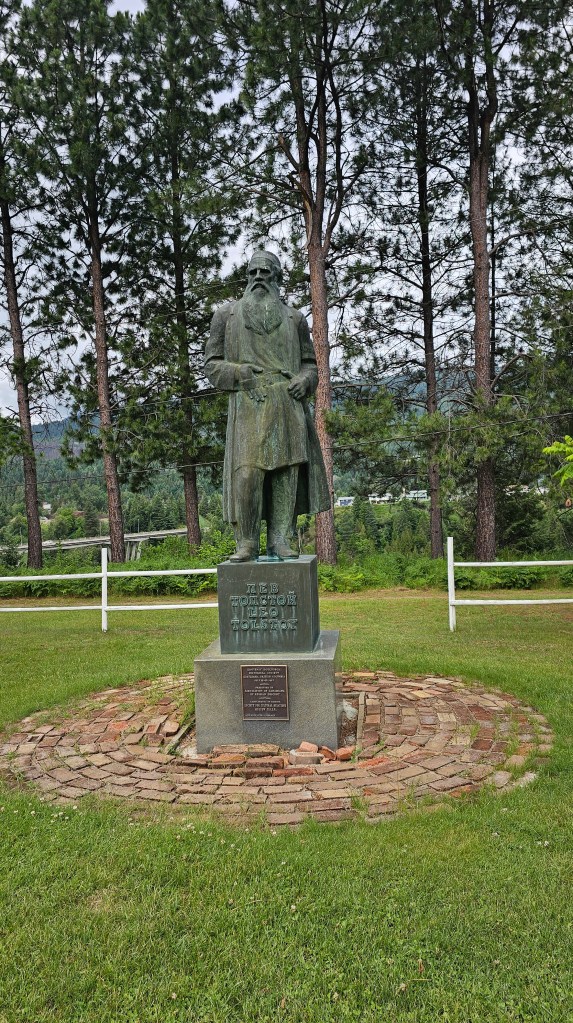
Persecuted again, many of the Doukhobors were allowed to emigrate to Canada, assisted by novelist Leo Tolstoy and his followers in addition to British and American Quakers and Russian anarchists. More than 7,500 sailed to Canada in 1899 and settled in what was to become Saskatchewan, where they lived as a community. With 500 more Doukhobors, Verigin joined them there in 1902, making the migration of the Doukhobors the largest single mass migration in Canadian history.
Initially, Doukhobors were permitted to register for individual homesteads but not to live communally. They received concessions regarding education and military service. Frank Oliver, who succeeded Clifford Sifton as minister of the interior in 1905, interpreted the Dominion Lands Act more strictly. When Doukhobors refused to swear an oath of allegiance — a condition for the final granting of homestead titles — their homestead entries were cancelled.
In 1908, Verigin led most of his followers to southern British Columbia, where he bought land and established a self-contained community of 6,000 members. Some Doukhobors split off to establish their own farms and became independents.
A tiny, radical splinter, called Sons of Freedom, rejected any control by Canadian authorities and saw themselves as “ringing bells” destined to remind other Doukhobors to adhere to traditional values. To show their freedom from material possessions, from the 1920s onward they marched, burned their own homes, the homes of other Doukhobors and torched public buildings, rail lines and schools in disputes with the government of British Columbia over education and other issues. Many in this group were later imprisoned for nude protest parades and had their children taken from them.
During the 1930s, the effects of the Depression, internal disenchantment and mismanagement, combined with the incendiarism of fanatics and the unsympathetic policies of finance companies and government, ruined their communal living system. It had been one of the largest and most complex undertakings in communal living in North American history.
In the 1970s and 1980s, many Doukhobors returned to the Kootenay region and rediscovered their heritage.
The Doukhabor agrarian communal society was a tribute to their slogan “Toil and Peaceful Life”.
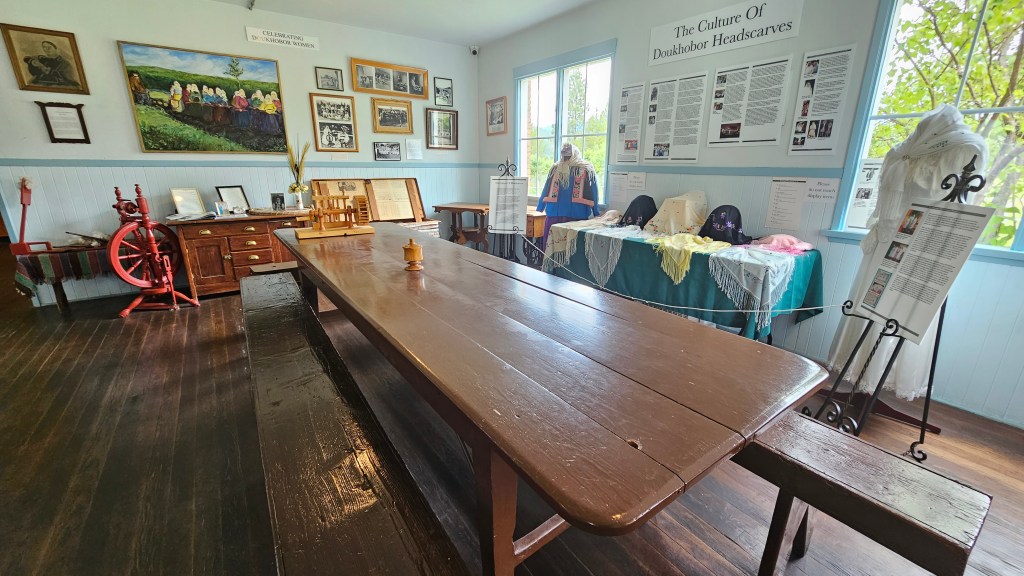
The Doukhabor Discovery Center




Doukhobor Borscht: Doukhobors are vegetarian and unlike most varieties of borsch, Doukhobor borsch is vegetarian, loaded with butter and heavy cream, and always served hot. The beet isn’t a main ingredient, it’s primarily used for colour and then discarded before the soup is served. Many of their dishes are based on Russian and Slavic dishes that have been adapted and influenced by the Doukhobors adoption of vegetarianism and exposure to North American food culture. I picked up a jar of Doukhobor Borscht to have for lunch one day.
Winter Doukhobor Borscht
- 1 lbbutter, do not substitute margarine
- 6 c shredded cabbage
- 2 c shredded carrot
- 2 finely chopped onions
- 4 c good quality canned tomatoes
- 1beet
- 6 russet potatoes
- 2 bay leaves
- 3 qt good quality vegetable stock, preferably home made
- 1/2 lb fresh spinach
- 1 qt whipping cream
- 2 green peppers, chopped
- 1/2 c fresh dill, do not substitute dry
- 2 Tbsp salt
- 2 tsp black pepper
- sour cream
From Castlegar we headed east again on the Crowsnest Highway towards Cranbrook, BC. We have been following the Crowsnest for 3 days now. It meanders up and down through the Selkirk Mountains along the Canada/US border. We crossed 3 states today, Washington, Idaho and we are now slightly northwest of Kalispell, Montana but still in British Columbia.
Between Salmo and Creston BC, we drove the Kootenay Pass, 5800 feet above sea level, stupendous scenery! The road to the summit is very steep, hitting a 13% of maximum gradient through some of the ramps. Starting at Creston, the ascent is 40 km long. Over this distance, the elevation gain is 1154 meters and the average percentage is 2.9 %. The route winds its way at a moderate grade until the last section that kicks up to 7.4%. If you want the details for what we drove today, below is the link. I am so glad we didn’t read this beforehand! And that it wasn’t my turn to drive.
Kootenay Pass is an awe-inspiring route in Canada
https://www.dangerousroads.org/north-america/canada/5100-kootenay-pass.html
Btw, it was an excellent highway.
It had also snowed up there last night and we were almost at the snow line.
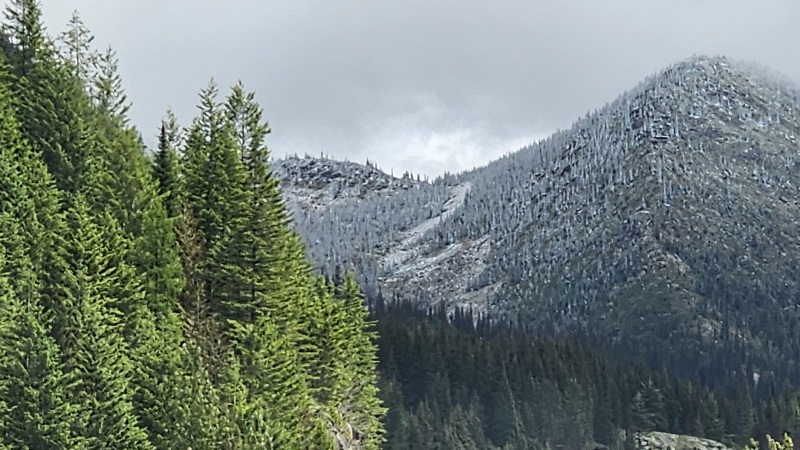
Having held our breath through this awe-inspring drive, we stopped in Creston to replenish the food and drink cupboards and had lunch. We also changed time zones at the top of the pass (Creston doesn’t do daylight savings) and we lost an hour.
The rest of the trip was your average twisty/turny stuff that we have gotten used to. I think the prairies will be a shock to the system after more than 2 weeks in mountainous British Columbia.
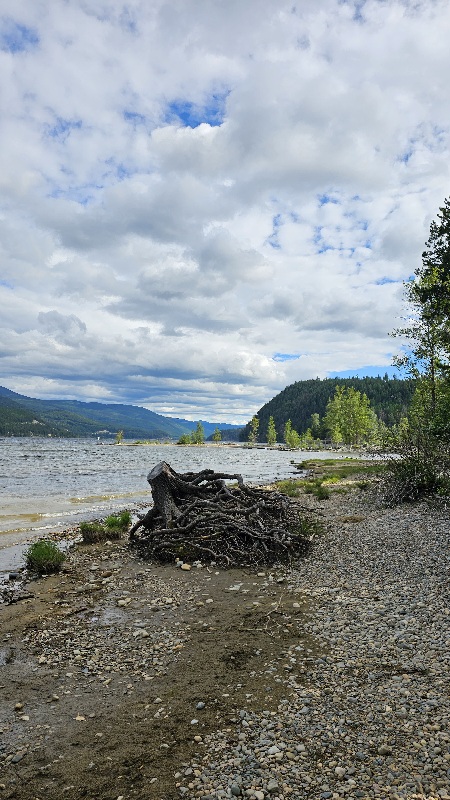
We are camped on Lake Moyie just west of Cranbrook, BC. We have gotten our cold weather clothing out. But we can finally have a campfire again and the host ranger delivered a load of wood before dinner. We are having fireside sundowners tonight.
Alberta tomorrow and hopefully cheaper gas.
British Columbia
I haven’t talked about British Columbia as a province but would like to do so before we say goodbye to it. We have spent almost 3 weeks here exploring it from east to west, south on the inland waterway on its western coast and west across its southernmost highway. In past times we have spent time in Terrace, BC almost 1,000 km north of Vancouver and visited family in Dease Lake in the farther northwest not far from Yukon border and coastal Alaska. We have traveled by boat on the Stikine River from Telegraph Creek to Wrangell Island in Alaska. We are international travelers by nature but British Columbia hosts some of the most spectacular scenery, charming cities and friendly people you can find anywhere on the planet.
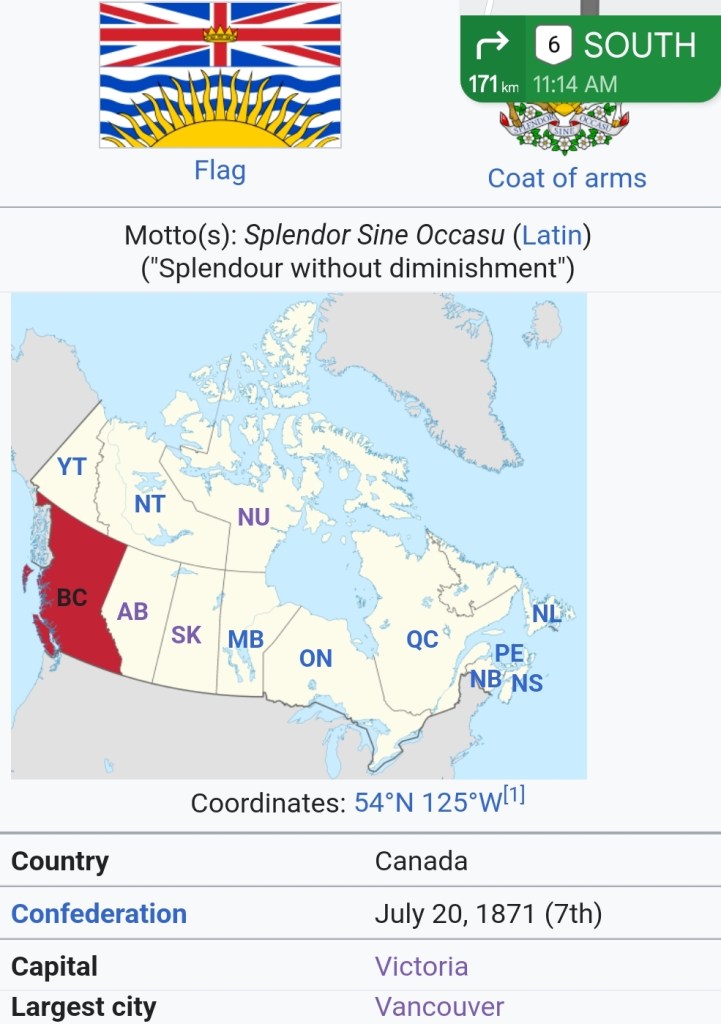
British Columbia has a culture that is in many ways inspired by the natural beauty of the province. B.C. residents are known for their healthy living and outdoor recreational activities, with biking, skiing, snowboarding, kayaking and swimming all proving popular in the province.
B.C.’s geography is so unlike the rest of Canada it’s classified in a distinct category all its own. The province occupies what is known as the country’s Cordillera region, a vast, thickly forested area of enormous mountain ranges, deep valleys and long rivers. Situated between the Pacific Ocean and the Rocky Mountains, the province has a diverse geography, with rugged landscapes that include rocky coastlines, sandy beaches, forests, lakes, mountains, inland deserts and grassy plains.
With an estimated population of over 5.3 million as of 2023, it is Canada’s third-most populous province.
English is the common language of the province, although Punjabi, Mandarin Chinese, and Cantonese also have a large presence in the Metro Vancouver region. The Franco-Columbian community is an officially recognized linguistic minority, and around one percent of British Columbians claim French as their mother tongue. British Columbia is home to at least 34 distinct Indigenous languages.
Major sectors of British Columbia’s economy include forestry, mining, filmmaking and video production, tourism, real estate, construction, wholesale, and retail. Its main exports include lumber and timber, pulp and paper products, copper, coal, and natural gas. British Columbia exhibits high property values and is a significant centre for maritime trade: the Port of Vancouver is the largest port in Canada and the most diversified port in North America. Although less than 5 percent of the province’s territory is arable land, significant agriculture exists in the Fraser Valley and Okanagan due to the warmer climate.
The area now known as British Columbia is home to First Nations groups that have a deep history with a significant number of indigenous languages. There are more than 200 First Nations in BC. Prior to contact (with non-Aboriginal people), human history is known from oral histories of First Nations groups, archaeological investigations, and from early records from explorers encountering societies early in the period.
Lands now known as British Columbia were added to the British Empire during the 19th century. Colonies originally begun with the support of the Hudson’s Bay Company (Vancouver Island, the mainland) were amalgamated, then entered Confederation as British Columbia in 1871 as part of the Dominion of Canada.
During the 1770s, smallpox killed at least 30 percent of the Pacific Northwest First Nations.This devastating epidemic was the first in a series; the 1862 Pacific Northwest smallpox epidemic killed about half to two-thirds of the native population of what became British Columbia.
British Columbia has diverse array of higher educational institutions, ranging from publicly funded universities, colleges, and institutes, to private universities, colleges, seminaries, and career institutes. Public institutions receive approximately half of their funding from grants from the provincial government, with the remaining revenue stemming from tuition charges and philanthropic donations. Each post-secondary institution sets its own admission requirements, although the standard requirement is the completion of high school. British Columbia is also home to 11 private colleges and universities located throughout the province. Two American universities (Fairleigh Dickinson University and Northeastern University) also have degree-granting campuses located in Vancouver.
 Louise and Brian McLeod Travel Blog
You must be logged in to post a comment.