It was still cool, windy and cloudy this morning. We ditched our ‘camp’ clothes for ‘city’ clothes as today is sightseeing in Winnipeg. Our campsite is about half an hour northeast of the city, more or less.
We headed for the area of Winnipeg called ‘The Forks’ and the National Museum of Human Rights. It’s where the Assiniboine River empties into the Red River. We found a good place to park the van for the day as we planned to spend most of it on foot.

Winnipeg is the capital and largest city of the province of Manitoba in Canada. It is centred on the confluence of the Red and Assiniboine rivers, near the longitudinal centre of North America.
The city is named after the nearby Lake Winnipeg; the name comes from the Western Cree words for “muddy water” – winipīhk. The region was a trading centre for Indigenous peoples long before the arrival of Europeans; it is the traditional territory of the Anishinabe (Ojibway), Ininew (Cree), Oji-Cree, Dene, and Dakota, and is the birthplace of the Métis Nation. French traders built the first fort, Fort Rouge, on the site in 1738.
Known as the “Gateway to the West,” Winnipeg is a railway and transportation hub with a diversified economy. Winnipeg lies at the confluence of the Assiniboine and the Red River of the North, a location now known as “The Forks.” This point was at the crossroads of canoe routes travelled by First Nations before European contact. Evidence provided by archaeology, petroglyphs, rock art, and oral history indicates that native peoples used the area in prehistoric times for camping, harvesting, hunting, tool making, fishing, trading and, farther north, for agriculture.
The rivers provided an extensive transportation network linking northern First Peoples with those to the south along the Missouri and Mississippi rivers. The Ojibwe made some of the first maps on birch bark, which helped fur traders navigate the waterways of the area.
Many French men who were trappers married First Nations women; their mixed-race children hunted, traded, and lived in the area. Their descendents are known as the Métis. More about the Métis in a couple of days as we are staying in Métis campground in Alberta.
In 1869–70, present-day Winnipeg was the site of the Red River Rebellion, a conflict between the local provisional government of Métis, led by Métis born Louis Riel, and newcomers from eastern Canada. General Garnet Wolseley was sent to put down the uprising. The result of the uprising led to The Manitoba Act of 1870 which made Manitoba the fifth province of the three-year-old Canadian Confederation.
Winnipeg is a pretty city being situated at the confluence of the two rivers. It faces St.Boniface, which is French speaking, directly across the Red River.

The Canadian Museum for Human Rights (opened in 2014).
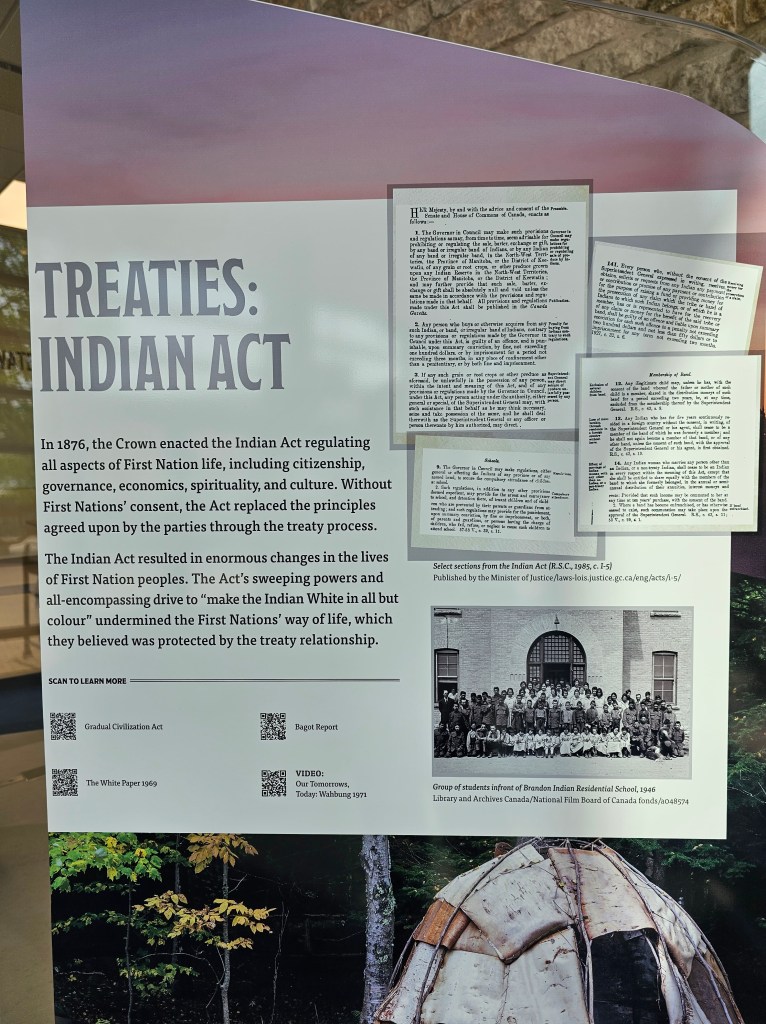
The Canadian Museum for Human Rights is the first museum solely dedicated to the evolution, celebration and future of human rights. Its mandate is to explore the subject of human rights, with special but not exclusive reference to Canada, in order to enhance the public’s understanding of human rights, to promote respect for others, and to encourage reflection and dialogue.
We spent about 2 hours here. The subject matter is compelling. Obviously is has a Canadian orientation but does cover global human rights issues. Those of you that know me, are aware that Human rights are something I work towards in my organization work. This was a good reminder that we aren’t done yet. It also reminded me of things in Canadian history I had forgotten about.
The building itself is worth visiting just for the architecture… maybe a bit overdone as the content gets overshadowed by the building itself which at times is distracting. It almost requires 2 visits, one for the architecture and one for the content. It is a museum of ideas, not things.


We had a light lunch of delicious beef and barley soup in the museum and then headed into the park at The Forks. Normally you can walk right along the Red River to the Assiniboine but the river is still over its banks.
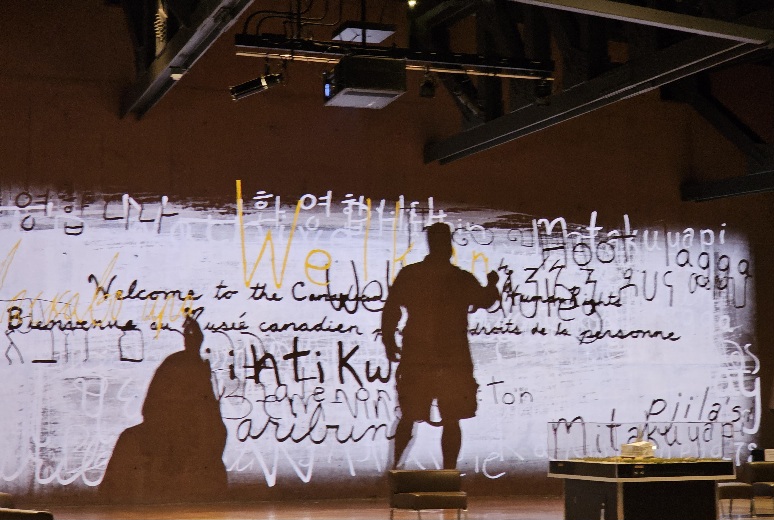

The Meeting Place

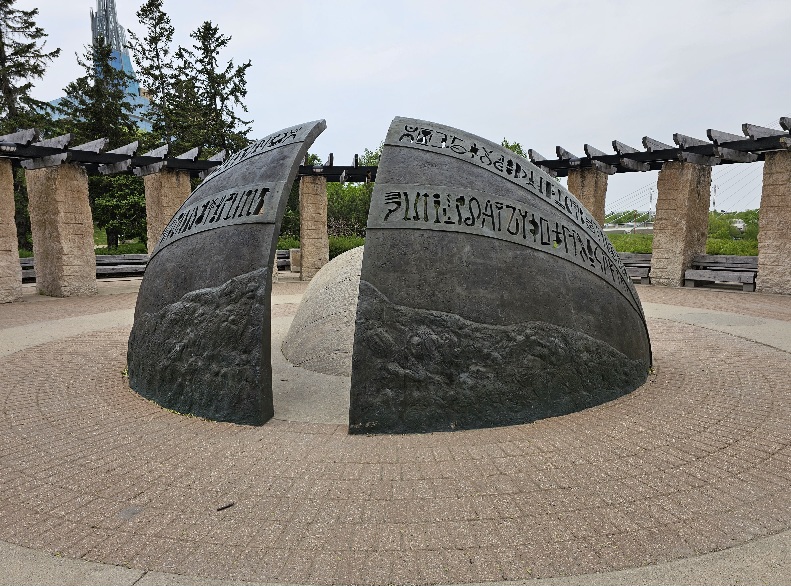
Oodena Celebration Circle, The Forks National Historic Site, Winnipeg, Manitoba, Canada.
Near the convergence of the two rivers is a natural shallow amphitheatre known as the Oodena Celebration Circle. It pays homage to the 6,000 years of Aboriginal peoples in the area. Oodena, Ojibwe for “heart of the community”, features ethereal sculptures, a sundial, interpretive signage, a naked eye observatory and a ceremonial fire pit, making it a desirable venue for cultural celebrations or a place to simply sit and marvel at its beauty.
Now this was really interesting. We spent a lot of time here in the afternoon because something very special, and not for the tourists, was happening here. We are not shy about finding local experiences. We noticed people starting to gather here with food and gifts, and the fire pit had a fire in it. As it turned out, it was a high school awards ceremony by the ‘Children of the Earth’ High school here in Winnipeg. The students being celebrated had taken the Medical Careers Exploratory Program to encourage Indigenous students towards medical careers so they can be medical advocates for their own people. It was amazing. Starting with a pipe ceremony, drumming and singing and then the awards for each student. The pipe ceremony started with the giving of tobacco as tobacco was the ‘first medicine’. Congratulations to all the students for completing this course which was conducted in partnership with local community hospitals and the university.


We decided to take a 30 minute water tour to round out our day at The Forks. I am ever more cognizant of the importance of the fur trade and its role in the discovery and economic development of Canada and our relationships with our first nation’s peoples.



We completed our day at The Forks with a lovely dinner at the Inn at the Forks. We got back to camp about 7 pm. We didn’t even bother setting anything up. The beauty of our little home on wheels.
 Louise and Brian McLeod Travel Blog
You must be logged in to post a comment.