It started into some serious rain early this morning that will continue well into early afternoon. Our only plan for today was to visit Thunder Bay so I took the opportunity to roll over and go back to sleep.
It doesn’t get dark here until after 10 pm which means we will still have a goodly amount of time to explore once it stops raining. It also gives us time to use the wifi here and look to our trip across Saskatchewan. We are closely monitoring the fires in Alberta. They are close to the route we have chosen through Edmonton as our destination is Prince George in Northern British Columbia and family.
My daughter sent me a link to firesmoke.ca that tracks air quality from forest fires and we have other apps including road closures put out by the Canadian government. Last night the sun was not its normal color as it set but was bright red instead of yellow.
This is the start of the May long weekend here in Canada. It usually marks the time to start putting gardens, spring clean up, opening up the cottage etc. All the Ontario Provincial parks will open today… finally… along with the roadside picnic / rest areas. I was surprised that we could get a campsite at Kakabeka Falls for two nights over this weekend. And it IS full because we have to change sites each night.
Terry Fox
An absolute must to visit in Thunder Bay is the Memorial to Terry Fox. The monument marks the spot where Terry Fox, a true Canadian hero, was forced to abandon his cross Canada run for cancer research.
Terrance Stanley Fox CC OD (July 28, 1958 – June 28, 1981) was a Canadian athlete, humanitarian, and cancer research activist. In 1980, with one leg having been amputated due to cancer, he embarked on an east-to-west cross-Canada run to raise money and awareness for cancer research. Although the spread of his cancer eventually forced him to end his quest after 143 days and 5,373 kilometres (3,339 mi), and ultimately cost him his life, his efforts resulted in a lasting, worldwide legacy. The annual Terry Fox Run, first held in 1981, has grown to involve millions of participants in over 60 countries and is now the world’s largest one-day fundraiser for cancer research; over C$850 million has been raised in his name as of September 2022.

The statue was created by sculptor Manfred Pervich to mark the place where Fox was forced to stop his run on August 31, 1980. It is approximately four kilometres (2+1⁄2 miles) west of the exact spot where Fox ended his run, which is marked by a road sign. The monument was dedicated on June 26, 1982, just days before the first anniversary of Terry Fox’s death.


Terry Fox’s quest was completed a few years later by Steve Fonyo, also a cancer survivor and amputee. At age 18, he embarked on a run across Canada entitled Journey for Lives to raise funds for cancer research. Fonyo began his run on March 31, 1984 and completed it 425 days later on May 29, 1985, covering 7,924 km (4,924 mi), and raising $14 million. Unlike Fox, who had to abandon the Marathon of Hope when his cancer returned, Fonyo completed the coast-to-coast run and was the youngest person at the time to be named to the Order of Canada.
Thunder Bay, ON
My husband had an aunt who retired in Thunder Bay, having been a teacher in a tiny little community near Nipigon called Red Rock. My brother-in-law and his wife both attended Lakehead University here. So Thunder Bay has some significant family importance.
Thunder Bay is the second largest city in Northern Ontario after Sudbury, ON and has a population of 100,000+. We will be passing through Sudbury on the return trip so more about that city much later.
European settlement in the region began in the late 17th century with a French fur trading outpost on the banks of the Kaministiquia River. It grew into an important transportation hub with its port forming an important link in the shipping of grain and other products from western Canada, through the Great Lakes and the Saint Lawrence Seaway, to the east coast. Forestry and manufacturing played important roles in the city’s economy. They have declined in recent years, but have been replaced by a “knowledge economy” based on medical research and education. Thunder Bay is the site of the Thunder Bay Regional Health Research Institute. The city takes this name from the immense Thunder Bay at the head of Lake Superior, known on 18th-century French maps as Baie du Tonnerre (Bay of Thunder). The city is often referred to as the “Lakehead”, or “Canadian Lakehead”, because of its location at the end of Great Lakes navigation on the Canadian side of the border.
I grew up calling it ‘the Lakehead’ and still do although Nipigon has also claimed that nickname.
Thunder Bay is an amalgamation of two communities, Port Arthur and Fort William. In the early 1900s, Thunder Bay began a period of extraordinary growth, based on improved access to markets via the transcontinental railway and development of the western wheat boom. The CPR double-tracked its Winnipeg–Thunder Bay line. The Canadian Northern Railway established facilities at Port Arthur. The Grand Trunk Pacific Railway began construction of its facilities at the Fort William Mission in 1905, and the federal government began construction of the National Transcontinental Railway. Grain elevator construction boomed as the volume of grain shipped to Europe increased. Both cities incurred debt to grant bonuses to manufacturing industries.
Thunder Bay was the first city in the world to enact daylight saving time, on 1 July 1908.
The Persian: In Thunder Bay, a “Persian” is an oval-shaped pastry that’s fried and frosted with pink berry icing. It’s a local delicacy with deep roots in this Northern Ontario town. This prized pastry was first created in the 1940s by Art Bennett, the original founder of Bennett’s Bakery (formerly called “Art Bennett’s”). As the story goes, he named the sweet treat after John Joseph “Black Jack” Pershing, an American World War I General who allegedly visited his bakery while he was making the dough. As a result of this memorable meeting, Bennett dubbed his now-famed pastry a “Persian.”

Ir rained off and on until about 2 pm. We found a wonderful restaurant for lunch at Marina Bay. By the time we finished lunch it had stopped raining. We went for an hour long walk around the marina park followed by a trip to Canadian Tire to buy a new mat and then food shopping. We move tomorrow to a provincial park ( now that they are finally open) for the rest of this holiday weekend.


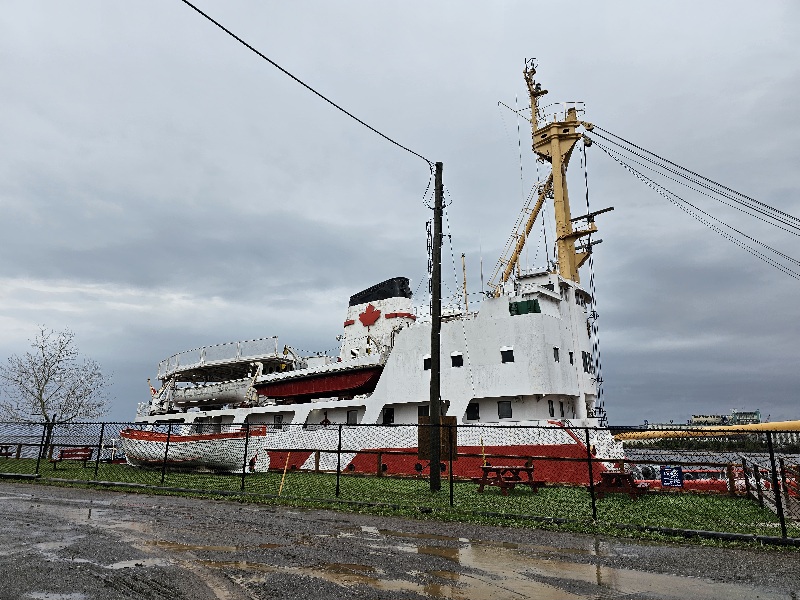
The CCGS Alexander Henry was named in honor of the fur trader, who from about 1803 lead summer expeditions to the Thunder Bay area. Alexander Henry was built by the Port Arthur Ship Building Company in 1959 for the Federal Department of Transport. The Alexander Henry was replaced by the Icebreaker Samuel Risley in 1985 and was then given to the Marine Museum of the Great Lakes at Kingston. In June of 2017, the ship was purchased by the Lakehead Transportation Museum Society of Thunder Bay and returned to its home port.
We tried to visit it today but it’s still closed for the season. It seems to be the norm these days, being closed I mean.


We got back to our campsite about 4:30 to find that our outdoor mat, our hose and our electrical hookups were gone!! This has never happened to us before. It took about half an hour for the camp host to locate them. Apparently the young man who cleans the sites in the morning thought we had checked out.
We have driven through a lot of mud. The camper was a mess tonight. We spent a bit of time cleaning up the retractable steps etc. So glad we have a neutral colored van.
The sun is out now at almost 7 pm. It’s the warmer it’s been all day. We have both showered and sitting in the sun having our camp cocktails. I am also trying to make some ‘sun tea’. After the great lunch we had, dinner tonight is left over salad and sushi we bought earlier and of course those Persians we bought.
 Louise and Brian McLeod Travel Blog
You must be logged in to post a comment.