These days have been all family visits including celebrating another 21st birthday. We also did a few personal things like a bit of shopping and getting the van washed, did some laundry. You know, daily life things.
There are a few things to do in Timmins although its mainly a northern Ontario mining town
Friday night we went out to dinner at Cedar Meadows. Cedar Meadows is a spa hotel that also has very nice cabins. What makes this place unusual is their wild animal enclosure where they have heard of Bison, elk and fallow deer in addition to swans all of which are viewable by the public via a wagon ride. Their next expansion is an area where they are building cabins with a plexiglass enclosure that will hold wolves for a sleeping with wolves experience.
In between family gatherings on Saturday we walked around Gillies Lake conservation area, a 1.4 mile walk around a body of pond size water. It was developed by the Conservation Authority as part of its lake rejuvenation project in 1986.
The weather has been amazing. It was 78F when we arrived on Thursday and in the high 60s low 70s Friday and Saturday.
That will change tonight as a below normal cold front comes in for the next couple of days. We will have to get some antifreeze today and winterize the van as we are leaving it stationary for 2 days Monday and Tuesday while we do a side trip.
We leave for Cochrane ON this afternoon where we catch the train early tomorrow morning for Moosonee, ON at the southern tip of James Bay.
Some mining facts for Timmins:
The Kidd Concentrator mine located in Timmins, ON is the world’s deepest base-metal mine below sea level, mining at 9800 feet with shaft bottom at 9889 feet.
The Gold Rush: We always hear about the Yukon and California gold rush but never about the ones in northern Ontario that saw unprecedented gold production in the 1930s and 40s.
Rumors of gold in the Porcupine area (just east of Timmins) had been circulating since 1905. In June 1909, a group of prospectors found a rich vein that would eventually become the Dome Mine. The news was out and prospectors started flowing into the area, resulting in the Porcupine Gold Rush.
The Hollinger Gold Mine was discovered on October 9, 1909, by Benny Hollinger, who found the gold-bearing quartz dike that later became known as Hollinger Mines.
By the end of the 1920s, the Hollinger was the largest gold mine in the British Empire and paid annual dividends of more than $5 million. By 1927, a 3.5 mile aerial tramway was in operation. By 1945, the mine had 350 miles of underground railway, used by 36 electric locomotives, and 1,500 ore cars, and by the 1960s, 600 miles of tunnels.
The mine shut down in 1968, but was reactivated in the seventies as an open-pit mine. The mine was scheduled for closure in 2019 with plans for the site to include a new public park featuring Hollinger Lake, a sandy beach, picnic areas, and wilderness trails. However that seems to be on hold and mining continues for now.
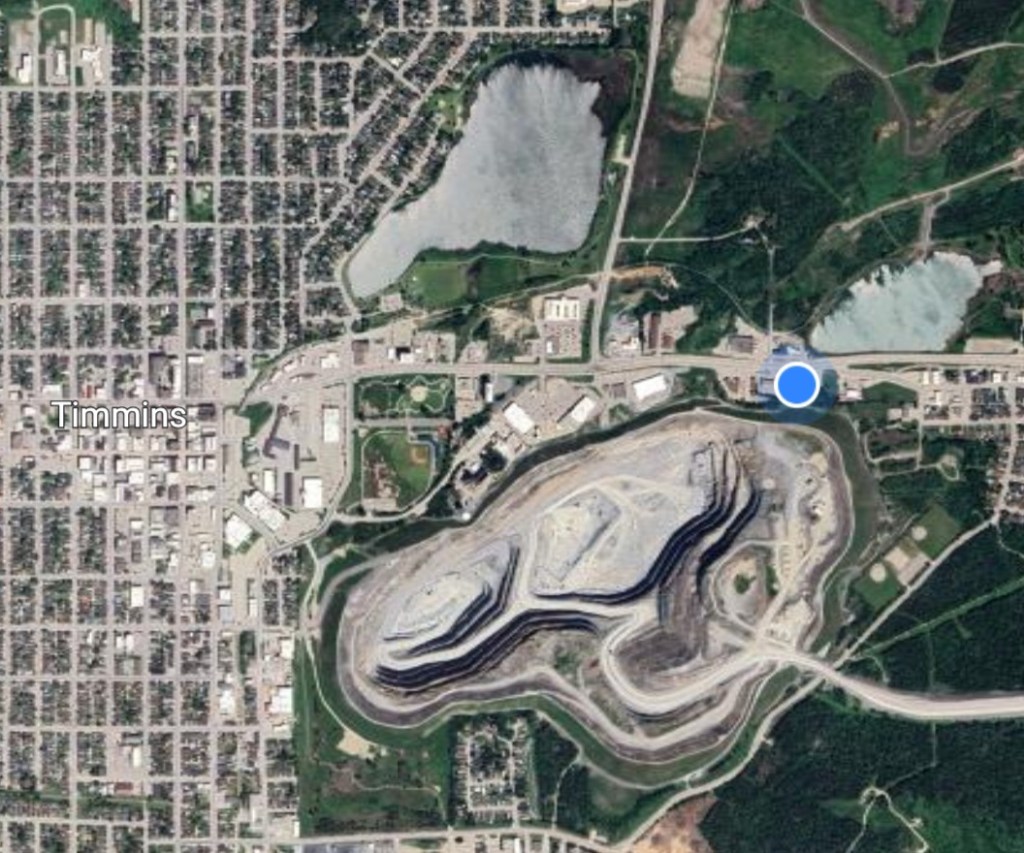
Throughout its history, Timmins has been known globally as one of the richest mineral producing areas in the world. The community lies at thepm heart of the Abitibi Greenstone Belt, which contains some of the world’s largest deposits of gold, silver, copper and zinc.
 Louise and Brian McLeod Travel Blog
You must be logged in to post a comment.