We leave Waterloo today and drive eastward through the top of Toronto and tomorrow’s destination of the nation’s capital, Ottawa. It’s a nice warm morning, in the upper 50s, and overcast. Much better than the temperatures we had been waking up to so far. It promises to be a nice day.
Since most of this past week (and half of the next) has been spent in the region of Southern Ontario, I want to spend a little bit of today’s blog on this area.
Southern Ontario
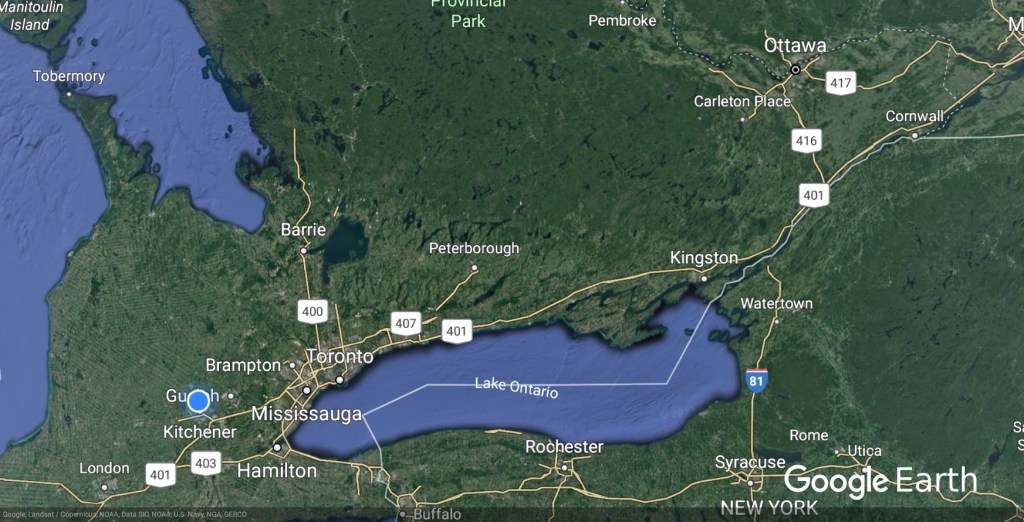
Southern Ontario is a primary region of the Canadian province of Ontario. It is the most densely populated and southernmost region in Canada, with approximately 13.5 million people, approximately 36% of Canada’s population of 37 million.
Southern Ontario differs greatly from Northern Ontario (we will get there next week), having a much higher population density, a different climate, and a different culture than its northern counterpart. It is broken into smaller subregions, including Central Ontario, Eastern Ontario, the Golden Horseshoe, and Southwestern Ontario. The core area of Southern Ontario is part of the Quebec City–Windsor Corridor, which extends northeast into southern Quebec.
Following the Seven Years’ War, the British wrested control of Southern Ontario, and more significant colonization efforts were spurred on by the arrival of United Empire Loyalists brought on by the American Revolution. Southern Ontario was where a large portion of the battles took place during the War of 1812, and was a major destination for escaping slaves using the underground railroad. Following the enactment of Prohibition in the United States in 1919, Southern Ontario immediately became a hotbed of smuggling alcohol (spirit) across the border.
Southern Ontario has a very different climate from the rest of the country. It is the only area of Canada that has Carolinian forest. Many trees, plants, and wildlife in Southern Ontario are not found anywhere else in Canada. Some rare trees in this region include the tulip tree, pawpaw fruit tree, and the cucumber tree. The Carolinian forests of Southern Ontario have in large part been destroyed by development sprawl. Very few original growth areas remain.
The Golden Horseshoe
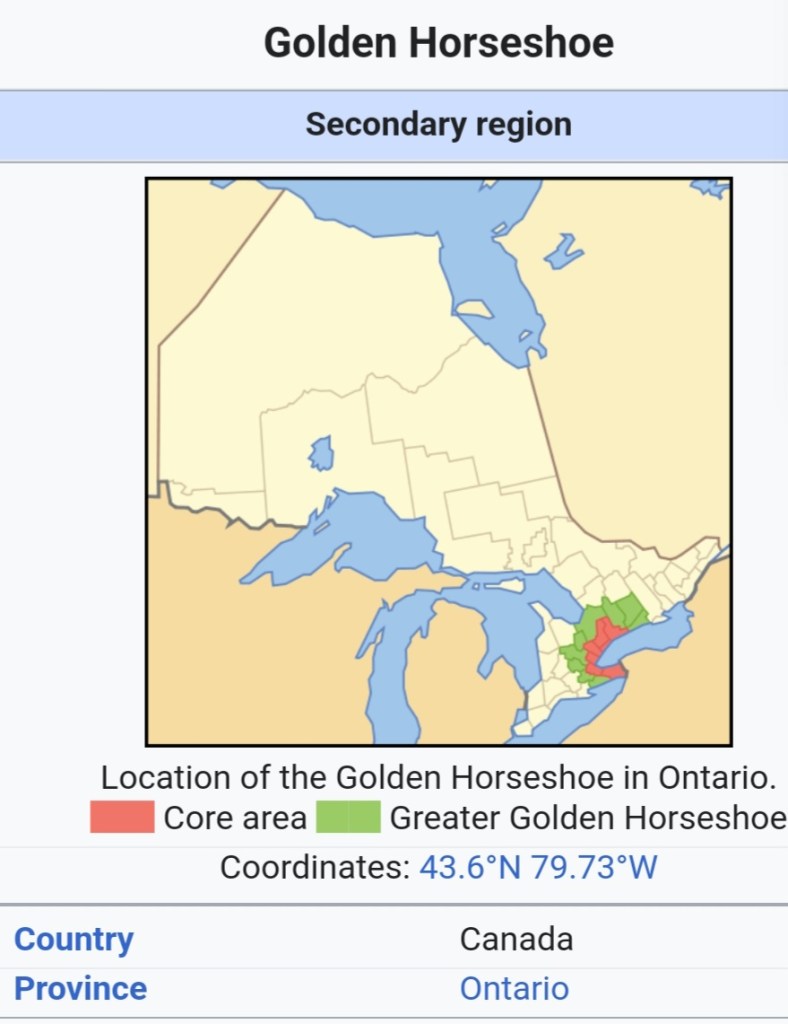
The Golden Horseshoe, where I lived as a child and spent part of my early adulthood, is a secondary region of Southern Ontario, Canada, which lies at the western end of Lake Ontario, with outer boundaries stretching south to Lake Erie and north to Lake Scugog, Lake Simcoe and Georgian Bay of Lake Huron. The region is the most densely populated and industrialized in Canada. Based on the 2021 census, with a population of 7,759,635 people in its core and 9,765,188 in its greater area, the Golden Horseshoe accounts for over 20 percent of the population of Canada and more than 54 percent of Ontario’s population. It is part of the Quebec City–Windsor Corridor, itself part of the Great Lakes megalopolis. It encompasses the Greater Toronto Area (the GTA).
The Greenbelt is a protected area of green space, farmland, forests, wetlands, and watersheds, located in Southern Ontario, Canada. It surrounds a significant portion of the Golden Horseshoe.Ontario’s Greenbelt. Created by legislation passed by the Government of Ontario in 2005, the Greenbelt is considered a prevention of urban development and sprawl on environmentally sensitive land in the province
The Greater Toronto Area (GTA)
The Greater Toronto Area covers an area bordered by Lake Ontario to the south, Kawartha Lakes to the east, the Niagara Escarpment to the west, and Lake Simcoe to the north. The region creates a natural ecosystem known as the Greater Toronto Bioregion. The Greater Toronto Area forms part of the neck of the Ontario Peninsula. Vast parts of the region remain farmland and forests, making it one of the distinctive features of the geography of the GTA. Most of the urban areas in the GTA hold large urban forest. For the most part designated as parkland, the ravines are largely undeveloped.
Extrapolating the data for all 25 communities in the Greater Toronto Area from the 2021 Census, the total population for the economic region included 6,711,985 people.
Toronto is the capital city of the Province of Ontario while Ottawa is the capital of Canada.
Toronto is the 4th largest city in North America: Mexico City, New York, Los Angeles followed by Toronto. It is larger in population than Chicago but smaller in area. Toronto is an international centre of business, finance, arts, sports and culture, and is recognized as one of the most multicultural and cosmopolitan cities in the world. The diverse population of Toronto reflects its current and historical role as an important destination for immigrants to Canada. More than half of residents were born outside of Canada, more than half of residents belong to a visible minority group, and over 200 distinct ethnic origins are represented among its inhabitants. While the majority of Torontonians speak English as their primary language, over 160 languages are spoken in the city.
Five public universities are based in Toronto. OCAD University, Toronto Metropolitan University, the Université de l’Ontario français, the University of Toronto and York University.
Fact: Canada is the most educated country in the world ie with the highest percentage of its population that has completed post-secondary education according to the Organization for Economic Cooperation and Development (OECD). The U.S. comes 6th and almost 15 % lower.
My husband and I are University of Toronto graduates and my husband earned his Masters Degree at York University.
Peterborough and the Trent-Severn Waterway
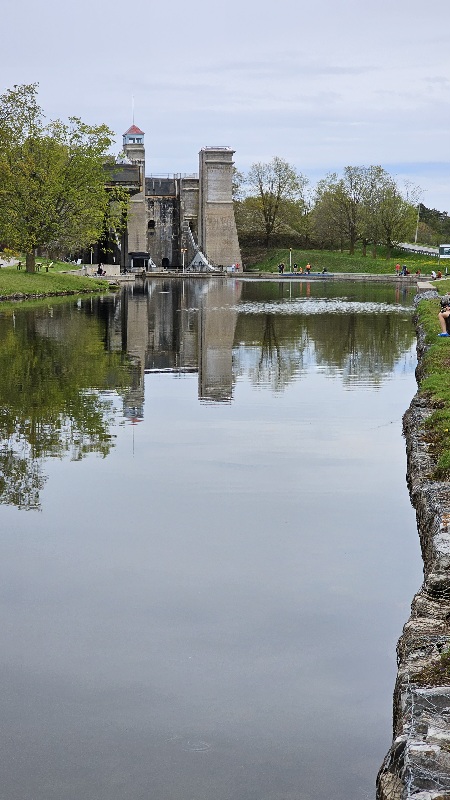
We stopped in Peterborough along the way and walked along the canal to photograph the famous Peterborough Lift Lock on the Trent-Severn Waterway.
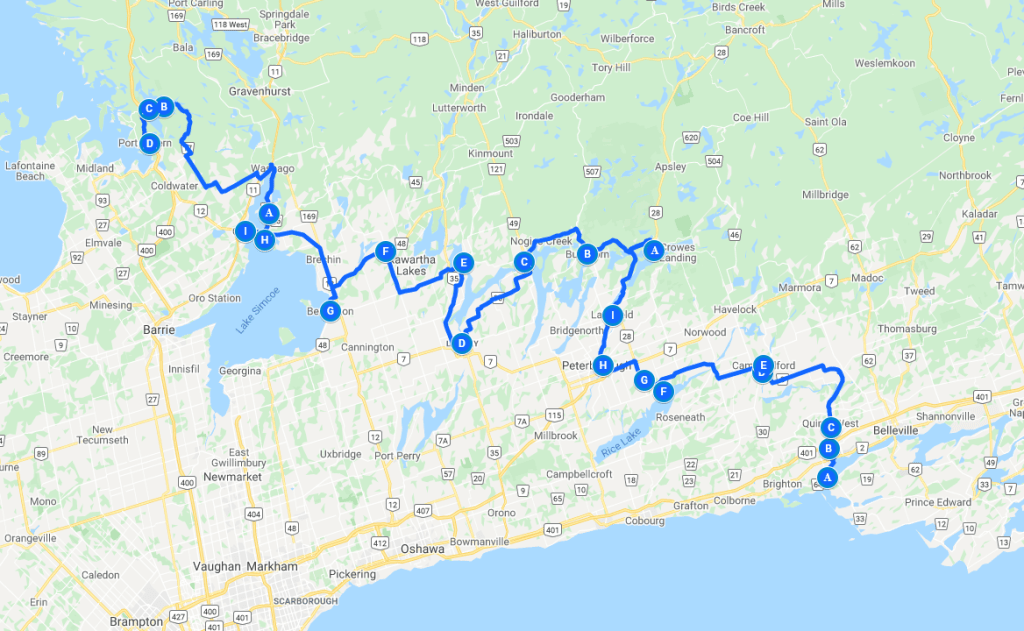
The Trent–Severn Waterway is a 386-kilometre-long (240 mi) canal route connecting Lake Ontario at Trenton to Georgian Bay, Lake Huron, at Port Severn. Its major natural waterways include the Trent River, Otonabee River, Kawartha Lakes, Lake Simcoe, Lake Couchiching and Severn River. Its scenic, meandering route has been called “one of the finest interconnected systems of navigation in the world”.
The Trent-Severn Waterway was intended for commercial usage to join Lake Ontario to Lake Huron via the many lakes a ruvers between the two. The total length of the waterway is 386 kilometres (240 mi), beginning at Trenton, Ontario, with roughly 32 kilometres (20 mi) of man-made channels. There are 44 locks, including 37 conventional locks, two sets of flight locks, hydraulic lift locks at Peterborough and Kirkfield, and a marine railway at Big Chute which transports boats between the upper and lower sections of the Severn. The system also includes 39 swing bridges and 160 dams and control structures that manage the water levels for flood control and navigation on lakes and rivers that drain approximately 18,600 square kilometres (7,182 sq mi) of central Ontario’s cottage country region (where our daughter has hers), across four counties and three single-tier cities, an area that is home to more than a million Canadians.
Meant to be used for commercial purposes when construction began in the 1880s, by the time the waterway was completed, its usefulness as a commercial waterway was over; ships plying the Great Lakes had grown much larger than the canal could handle, and the railways that had connected to the canal now took most of its freight. But the introduction of motor boats found the Trent–Severn perfectly positioned as a pleasure boating route, and today it is one of Ontario’s major tourist attractions.
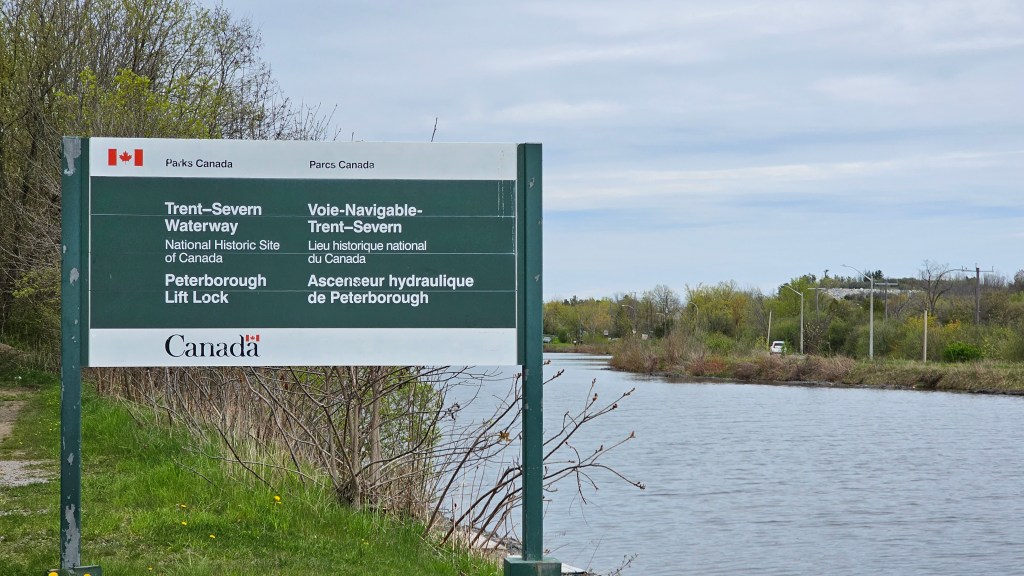
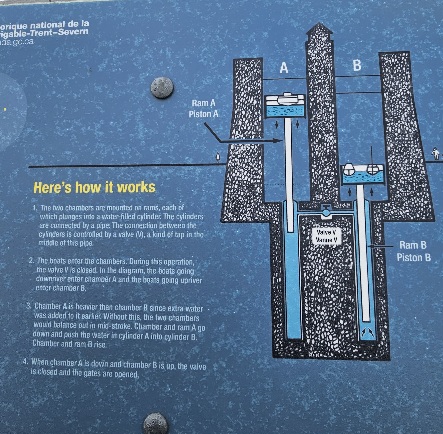
The Peterborough Lift Lock is a boat lift located on the Trent Canal in the city of Peterborough, Ontario, Canada, and is Lock 21 on the Trent-Severn Waterway. For many years, the lock’s dual lifts were the highest hydraulic boat lifts in the world, raising boats 65 ft (20 m). This was a considerable accomplishment in the first years of the 20th century, when conventional locks usually only had a 7 ft (2.1 m) rise. The Peterborough Lift Lock was designated a National Historic Site in 1979, and was named an Historic Mechanical Engineering Landmark by the American Society of Mechanical Engineers in 1987.


We are not carrying much food yet as we still have people to visit and only camping as needed so far (like tonight). We had a decent Sunday brunch today with leftovers for breakfast tomorrow. Dinner can be light.
After leaving Peterborough it was my turn to drive. We followed Hwy 7 eastward through cottage country and many of the towns we recognized from when we lived in Kingston, ON (see map below) where 2 of our daughters were born. It was slow going in places since it’s only 2 lanes and decently hilly but beautiful country with Laurentian Shield Lakes and rivers and pine trees. Not much in the way of farming until you get to the Ottawa River Valley further east.
Our campsite for tonight is a private campground on McGowan Lake about 1 1/2 hours west of Ottawa. We were greeted by a pair of loons on the lake. I do hope we hear them in the morning. There is nothing more beautiful than the sound of loons first thing in the morning.
For the second time this week, I backed into the campsite to park the van. I think I can do this now! Success!!

Google has a mapping/tracking ‘service’ I’ve just been made aware of. It’s called Timeline. Once activated, it keeps track of where you’ve been even if you are not using the App. I was looking for a way to map where we’ve been so hopefully this does the trick. It’s also a little perturbing/scary as it keeps track of EVERYWHERE you’ve been.
It’s spitting rain again so no outside sitting or eating. Also the mosquitoes are put. Dinner is some ham we have with us and fresh asparagus from our local farm stand at home.
 Louise and Brian McLeod Travel Blog
You must be logged in to post a comment.