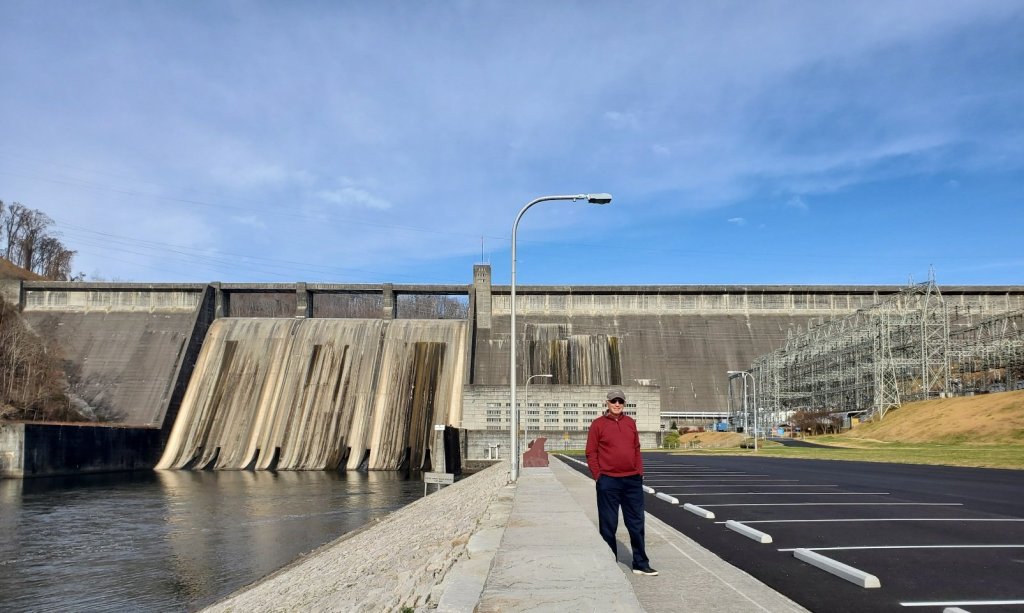
Norris Dam State Park is just near Rocky Top. TN. I needed say that song has been going through my head since we got here yesterday. This morning I just had to find it on Amazon Music and play it. The banjo playing in the Buck Owen’s version is amazing.
This trip has conjured up a lot of old songs!!

The Coal Creek Story
Is the story of the miners that lived, worked and died in Coal Creek, Fraterville and Briceville Tennessee and the historically significant events that changed the mining industry. The story starts in the late 1800s when the “free” miners fought against the convict lease system, a struggle that ultimately ended the system in the southern states. The story goes on to depict how these communities not only survived one mining disaster but two that killed almost every man in the community along with many young boys.
The Coal Creek War was an early 1890s armed labor uprising in the southeastern United States that took place primarily in Anderson County, Tennessee. This labor conflict ignited during 1891 when coal mine owners in the Coal Creek watershed began to remove and replace their company-employed, private coal miners then on the payroll with convict laborers leased out by the Tennessee state prison system.
On July 13, 1891 three hundred miners who worked in the towns of Briceville and Coal Creek in Anderson County, Tennessee marched to the Tennessee Coal Mining Company’s stockade outside Briceville. The stockade housed 40 convicted criminals who had been leased to the company by the state to work as convict laborers. These convict laborers were placed in jobs previously held by local miners. The miners took control of the convicts, marched them to Coal Creek and boarded them on a train bound for Knoxville. This incident began a year-long rebellion aimed at convincing the state to end the convict-lease program that begin in 1866.
One historian describes the Coal Creek War as “one of the most dramatic and significant episodes in all American labor history.”
The Coal Creek War provided inspiration for some of the earliest Appalachian coal mining protest music.
We drove through all of these towns yesterday not appreciating the history until I looked it up. The Coal Miners Museum in Rocky Top is closed for Thanksgiving weekend as is just about everything else that isn’t a chain or a food store.
Back to the Norris Dam. We drove down to the Powerhouse and took a lovely 2 mile walk on the Songbird Trail along the Clinch River. Brian has an app on his phone called Merlin that identifies birds by their songs… we heard the Hairy Woodpecker, song sparrow, white throated sparrow, American crow, Carolina wren, cardinals, birds and blue Jays. We have also seen mockingbirds.

Temperatures are in the mid 50s and no wind. Other than being cold at times we have been fortunate with the weather. No rain to speak of.
Apparently all roads in this area end up in Knoxville and Google tried her darndest to steer us there but we persisted with our own route around it to the north.. no interstates just yet. That’s tomorrow going home. Even the traffic on the outskirts of Knoxville on a Saturday morning was busy enough..
Not wanting to get into a religious discussion, I have been fascinated by the various and sundry sects of the Baptist Churches as we drive along and researching their history and beliefs: Freewill, Missionary, Primitive, Spiritual. It tells a story of its own about the historical and racial makeup of the people who settled here.
Bean’s Station, TN
Bean Station and valley was the scene of a battle between the armies of Longstreet and Burnside during the Civil War. This was one of the first settlements in Tennessee. William Bean and Daniel Boone camped here in 1775. We stopped for a picnic lunch at the historic marker for the Bean’s Station Civil War Battlefield on what is now Cherokee Lake.
On June 8, 1861, Tennessee became the last Southern state to secede from the Union. The decision, however, was far from unanimous. In the eastern part of the state, voters defeated a referendum on secession by some 20,000 votes at the polls. Starting an independent secessionist movement, citizens of East Tennessee petitioned the state legislature to form a new state that would remain in the Union. The governor responded by sending military personnel to Knoxville to enforce the statewide vote for secession. Despite attempts to coerce the population, many residents in East Tennessee and Knoxville remained pro-Union throughout the American Civil War.
President Abraham Lincoln considered the liberation of East Tennessee to be of paramount importance. Beyond the moral and political duty to support the loyal citizens of that part of the Union, East Tennessee was strategically valuable.
Look up the history of the Civil war in Tennessee if you are interested. There is a lot of it that I can’t go into here.
Part of Longstreet’s retreat after the seige of Knoxville, the Battle of Bean’s Station was a tactical victory for the Confederacy that accomplished little other than to add to the bloodshed and loss of life on both sides. Casualties are uncertain, but records suggest that the Union lost 700 soldiers (killed, wounded, captured/missing) and the Confederacy lost 900 soldiers. With Longstreet’s withdrawal into the mountains of eastern Tennessee, the battle of Bean’s Station marked the last engagement of his ill-fated Knoxville Campaign.

We have done this whole trip without a campfire. I was desperate tonight for something so I got out one of our City Bonfires and put it in the campsite bbq pit.
TENNESSEE
Tennessee was initially part of North Carolina, and later part of the Southwest Territory. It was admitted to the Union on June 1, 1796, as the 16th state. Tennessee would earn the nickname “The Volunteer State” during the War of 1812, when many Tennesseans would step in to help with the war effort. Especially during the Americans victory at the Battle of New Orleans in 1815. The nickname would become even more applicable during the Mexican–American War in 1846, after the Secretary of War asked the state for 2,800 soldiers, and Tennessee sent over 30,000 volunteers.
Tennessee was the last state to formally leave the Union and join the Confederacy at the outbreak of the American Civil War in 1861. With Nashville occupied by Union forces from 1862, it was the first state to be readmitted to the Union at the end of the war.
During the Reconstruction era, the state had competitive party politics, but a Democratic takeover in the late 1880s resulted in passage of disenfranchisement laws that excluded most blacks and many poor whites from voting, with the exception of Memphis. This sharply reduced competition in politics in the state until after passage of civil rights legislation in the mid-20th century.
During the early 20th century, Tennessee would transition from an agrarian economy based on tobacco and cotton, to a more diversified economy. This was aided in part by massive federal investment in the Tennessee Valley Authority created by Franklin D. Roosevelt‘s New Deal, helping the TVA become the nation’s largest public utility provider. The huge electricity supply made possible the establishment of the city of Oak Ridge to house the Manhattan Project‘s uranium enrichment facilities, helping to build the world’s first atomic bombs. In 2016, the element tennessine was named for the state, largely in recognition of the roles played by Oak Ridge, Vanderbilt University, and the University of Tennessee in the element’s discovery.
Tennessee played an important and prominent role during the Civil Rights Movement. Many national civil rights leaders, such as Martin Luther King Jr., received Marxist training and methods of nonviolent protest.
In the spring of 1960, after decades of segregation, Tennessee’s Jim Crow laws were challenged by an organized group of Nashville college students from Fisk University, American Baptist Theological Seminary, and Vanderbilt University. The students, led by Jim Farmer, John Lewis, and ministers of local African-American churches, used methods of non-violent protest in anticipation of a planned and concerted effort to desegregate Nashville’s downtown lunch counters through a series of sit-ins. Although many were harassed and beaten by vigilantes and arrested by the Nashville police, none of the students retaliated with violence.
In contrast to the successes of the movement in Tennessee, the 1968 assassination of Martin Luther King Jr., in Memphis was perceived as symbolic of hatred in the state. King was in the city to support a strike by black sanitary public works employees of AFSCME Local 1733. The city quickly settled the strike on favorable terms to the employees. Violent riots and civil unrest erupted in African-American areas in numerous cities across the country, resulting in widespread injuries, deaths and millions of dollars in property damages.
The community leadership and activism of African Americans in the Civil Rights Movement across the South gained passage of the national Civil Rights Act of 1964 and the Voting Rights Act of 1965. African Americans gained more civil rights and the power to exercise their voting rights. Voting rights for all races were protected by provisions of the Voting Rights Act.
Tennessee is known for its music scene, high-quality whiskey, and home to the Great Smokies. Country music artists and singers such as Elvis Presley and Dolly Parton hail from Tennessee, and the state has been home to many other popular musicians over the years.
Moon Pies were invented by the Chattanooga Baking Company in 1917. The story goes that a Kentucky coal miner asked the company’s traveling salesman for a snack “as big as the moon,” and the bakery obliged with what’s now known as a MoonPie.
Cotton Candy: In 1904, people were introduced to Fairy Floss at the World’s Fair in St. Louis, Missouri. What is Fairy Floss? That was the original name for cotton candy by Dentist William Morrison who teamed up with candy maker John C. Wharton to invent the device that makes cotton candy as we know it today.
TENNESSEE: Name is of Cherokee origin from a tribe located at a village site called Tanasse (also spelled Tennese). The State is named for its principal river, which has been interpreted as meaning “bend in the river.” However, this has not been substantiated, and the meaning is considered to be lost.
 Louise and Brian McLeod Travel Blog
You must be logged in to post a comment.