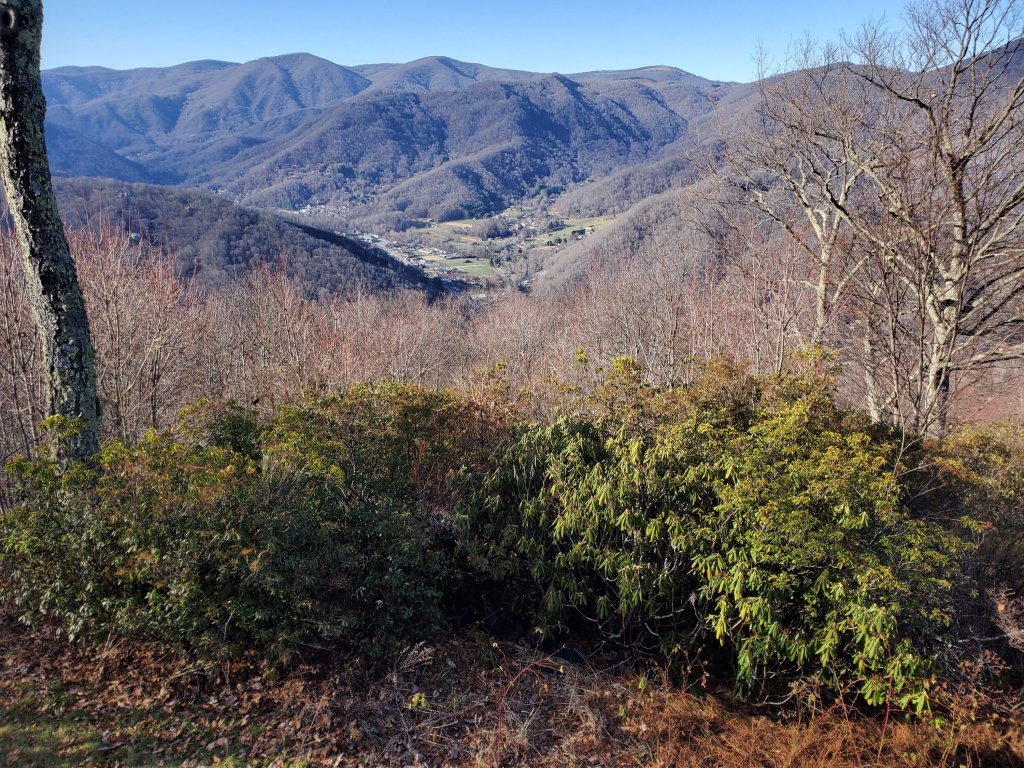
Cheroke, NC is the Indian Reservation at the NC entrance to the Great Smoky Mountains National Park.
This morning we visited the Museum of the Cherokee Nation to learn more about this population that was ‘removed’ by US President Andrew Jackson from their home territories in the US south east to Indian territory west of the Mississippi River.
The Cherokee are one of the indigenous peoples of the Southeastern Woodlands of the United States. Prior to the 18th century, they were concentrated in their homelands, in towns along river valleys of what is now southwestern North Carolina, southeastern Tennessee, edges of western South Carolina, northern Georgia, and northeastern Alabama. By the 19th century, White American settlers had classified the Cherokee of the Southeast as one of the “Five Civilized Tribes” in the region. They were agrarian, lived in permanent villages, and had begun to adopt some cultural and technological practices of the white settlers. They also developed their own writing system.
Around 1809 Sequoyah began developing a written form of the Cherokee language. He spoke no English. In 1821, he introduced Cherokee syllabary, the first written syllabic form of an American Indian language outside of Central America. Initially, his innovation was opposed by both Cherokee traditionalists and white missionaries, who sought to encourage the use of English. When Sequoyah taught children to read and write with the syllabary, he reached the adults. By the 1820s, the Cherokee had a higher rate of literacy than the whites around them in Georgia.
In 1830 Congress passed the Indian Removal Act, authorizing the forcible relocation of American Indians east of the Mississippi to a new Indian Territory. US President Andrew Jackson claimed the removal policy was an effort to prevent the Cherokee from facing extinction as a people, which he considered the fate that “…the Mohegan, the Narragansett, and the Delaware” had suffered. There is, however, ample evidence that the Cherokee were adapting to modern farming techniques. A modern analysis shows that the area was in general in a state of economic surplus and could have accommodated both the Cherokee and new settlers.
A small group known as the “Ridge Party” or the “Treaty Party” saw relocation as inevitable and believed the Cherokee Nation needed to make the best deal to preserve their rights in Indian Territory. Led by Major Ridge, John Ridge and Elias Boudinot, they represented the Cherokee elite, whose homes, plantations and businesses were confiscated, or under threat of being taken by white squatters with Georgia land-titles. With capital to acquire new lands, they were more inclined to accept relocation. On December 29, 1835, the “Ridge Party” signed the Treaty of New Echota, stipulating terms and conditions for the removal of the Cherokee Nation. In return for their lands, the Cherokee were promised a large tract in the Indian Territory, $5 million, and $300,000 for improvements on their new lands.
President Martin Van Buren ordered 7,000 Federal troops and state militia under General Winfield Scott into Cherokee lands to evict the tribe. Over 16,000 Cherokee were forcibly relocated westward to Indian Territory in 1838–1839, a migration known as the Trail of Tears. Marched over 800 miles across Tennessee, Kentucky, Illinois, Missouri and Arkansas, the people suffered from disease, exposure and starvation, and as many as 4,000 died, nearly a fifth of the population. As some Cherokees were slaveholders, they took enslaved African Americans with them west of the Mississippi. Intermarried European Americans and missionaries also walked the Trail of Tears.
The Cherokee living along the Oconaluftee River in the Great Smoky Mountains were the most conservative and isolated from European–American settlements. They rejected the reforms of the Cherokee Nation. When the Cherokee government ceded all territory east of the Little Tennessee River to North Carolina in 1819, they withdrew from the Nation. Over 400 Cherokee either hid from Federal troops in the remote Snowbird Mountains, under the leadership of Tsali (ᏣᎵ), or belonged to the former Valley Towns area around the Cheoah River who negotiated with the state government to stay in North Carolina. An additional 400 Cherokee stayed on reserves in Southeast Tennessee, North Georgia, and Northeast Alabama, as citizens of their respective states. They were mostly mixed-race and Cherokee women married to white men. Together, these groups were the ancestors of the federally recognized Eastern Band of Cherokee Indians, and some of the state-recognized tribes in surrounding states.
Today, there are three federally recognized Cherokee tribes: the Eastern Band of Cherokee Indians in Cherokee, North Carolina; the United Keetoowah Band of Cherokee Indians in Tahlequah, Oklahoma; and Cherokee Nation, the largest tribal government in the United States, with more than 360,000 citizens.
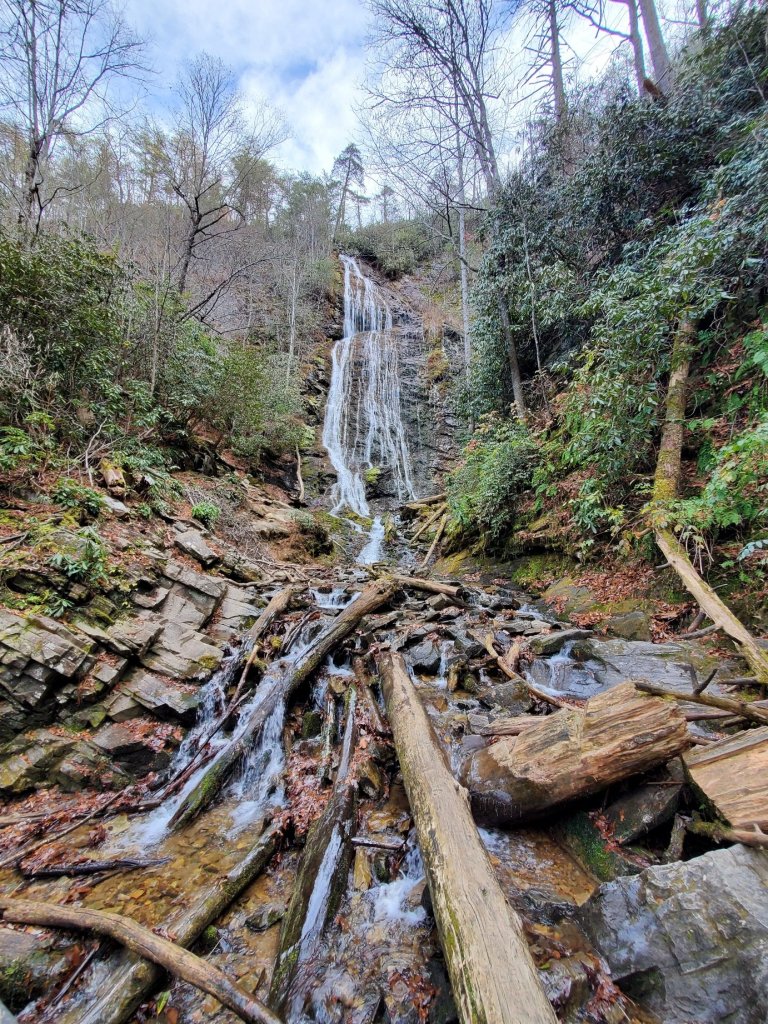
We hiked up to Mingo’s Falls, just outside of the park. Lots of steps. The perspective doesn’t show its true height.
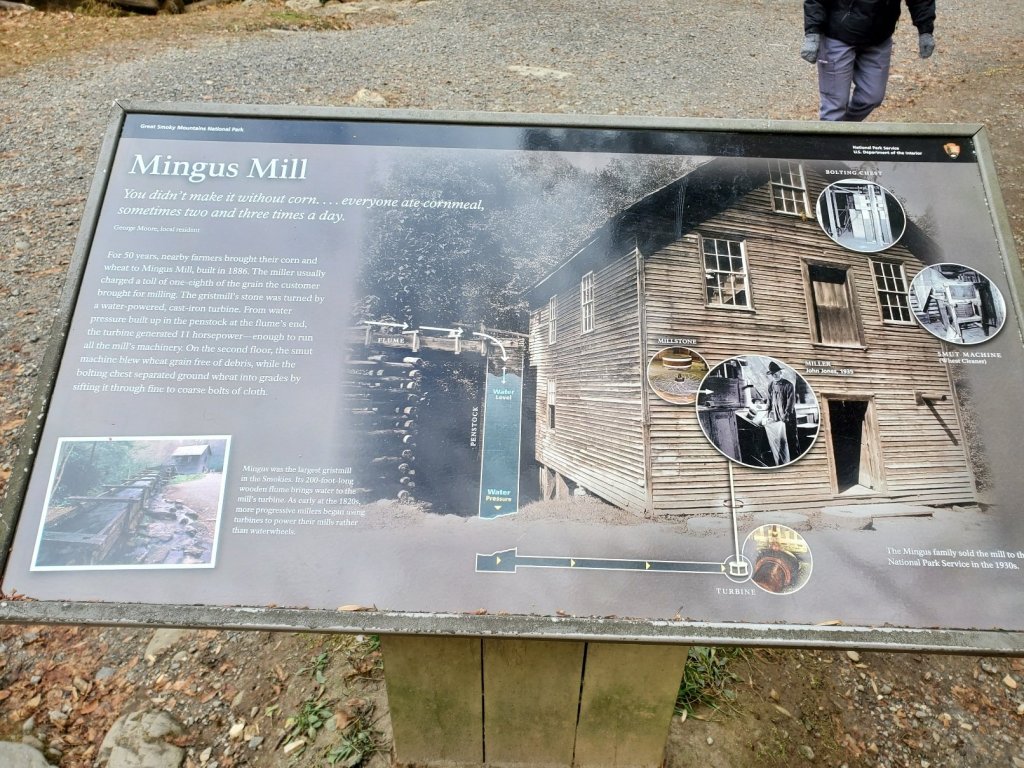
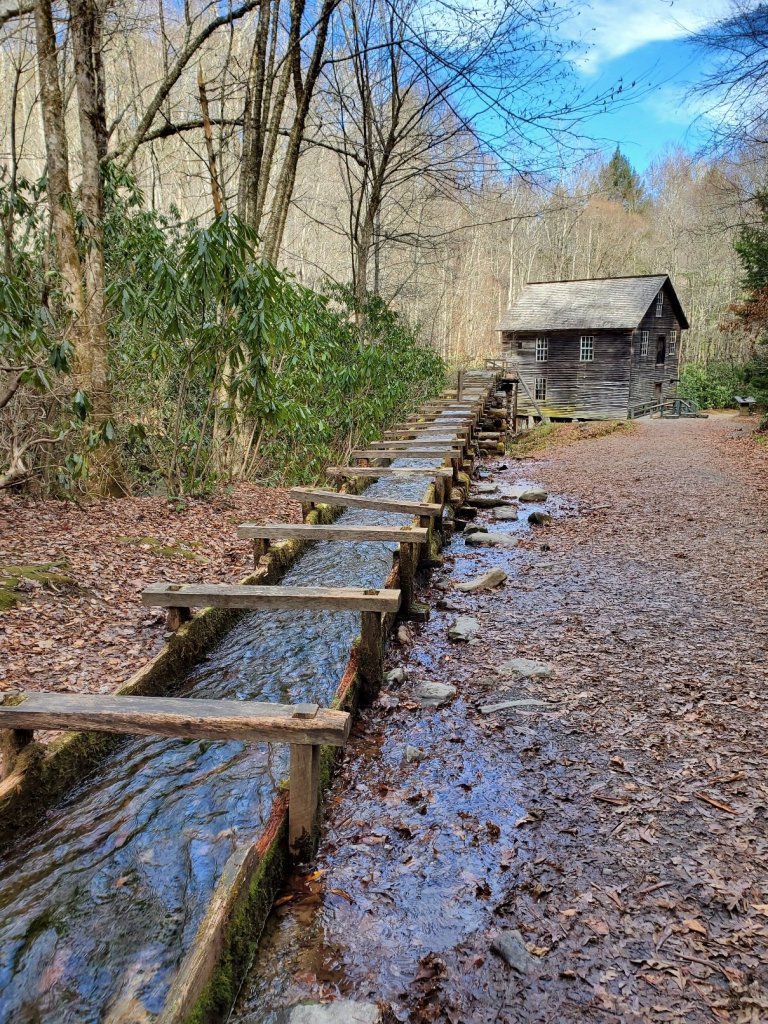
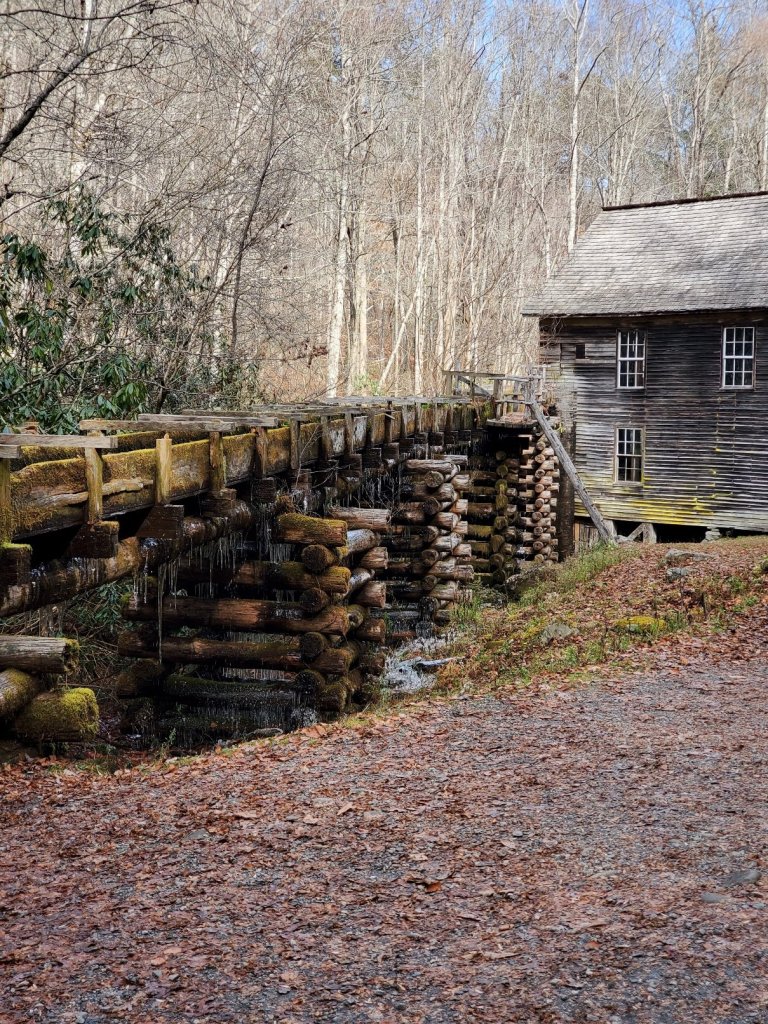
We drove back into the park looking for elk but they had already moved on. We visited Mingus MIll instead, an 1800s grist mill that was turbine driven instead of a water wheel. Great for photographing.
After lunch at the local brewery, we settled back into our Air BnB for a quiet afternoon of laundry and packing up. I was able to participate in our family zoom / online Sunday afternoon gaming with 2 daughters in another country. This weekend online family gaming activity was something we started during COVID-19 that we still continue.
This was our last day with our friends. We separate tomorrow. We will continue on to Tennessee and Alabama while they head north to celebrate Thanksgiving with family.
 Louise and Brian McLeod Travel Blog
You must be logged in to post a comment.