Friday noon we met our friends for lunch in Ashville, NC, home of the famed Biltmore Estate, for lunch. It was sunny and cold.


Our Air BnB in Maggie Valley for the weekend is literally at the top of a mountain up a tortuous twisty road. Fortunately we don’t have to drive the van back down until we leave on Monday morning. The view is spectacular. The house is aptly named Heavens Balcony.
Saturday in the Great Smoky Mountains
The Great Smoky Mountains are a mountain range rising along the Tennessee–North Carolina border in the southeastern United States. They are a subrange of the Appalachian Mountains, and form part of the Blue Ridge Physiographic Province. The range is sometimes called the Smoky Mountains and the name is commonly shortened to the Smokies. The Great Smokies are best known as the home of the Great Smoky Mountains National Park, which protects most of the range.
The range is home to an estimated 187,000 acres (76,000 ha) of old growth forest, constituting the largest such stand east of the Mississippi River. The cove hardwood forests in the range’s lower elevations are among the most diverse ecosystems in North America, and the Southern Appalachian spruce-fir forest that coats the range’s upper elevations is the largest of its kind. The Great Smokies are also home to the densest black bear population in the Eastern United States and the most diverse salamander population outside of the tropics.
We are using the southern entrance into the park from the North Carolina side. It’s a beautiful but very cold day. Even at this time of year the park is a popular place for hikers. The Appalacian Trail goes through here. We met a couple of hikers who had started the trail in Maine, 1900+ miles away, in June. They have 200 miles to go before the finish in Georgia on December 1. This part of the trail is the some of the most difficult.
We had a lovely day driving through the park, getting out occasionally for spectacular views and a walk.
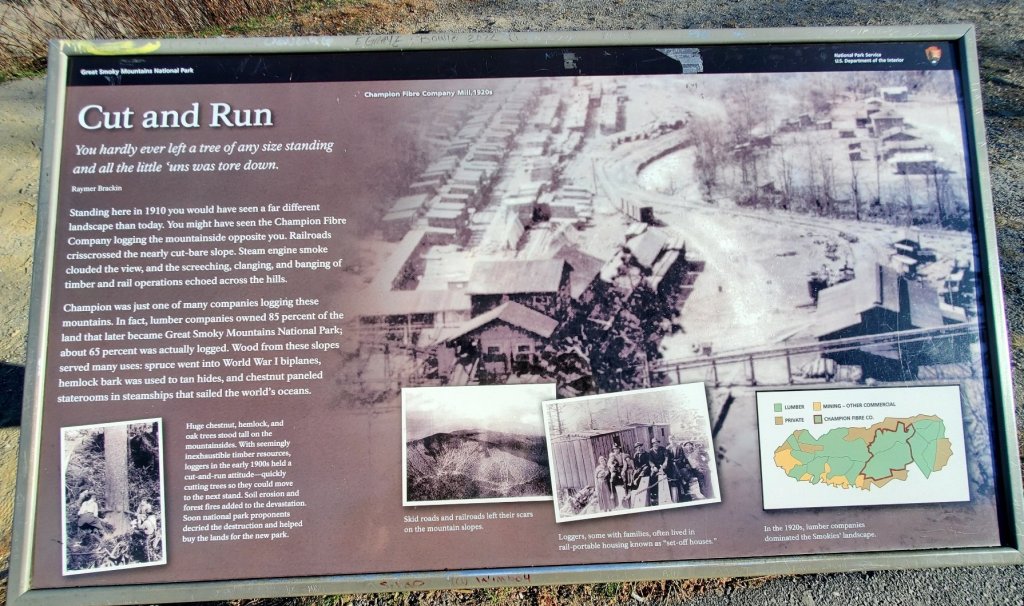
The mountainsides, in the early history of the area, had been completely denuded by logging.


The subspecies of elk that once roamed in Tennessee (Cervus elaphus canadensis) are extinct but a closely related subspecies of elk (Cervus elaphus manitobensis) were released into Tennessee in December of 2000. The initial elk released came from Elk Island National Park (EINP) in Alberta, Canada.
Really? Elk are native to Tennessee?
Source: Mark Johnson’s 2007 article “Native son” published in the Tennessee Cooperator.)
Elk are not only native to Tennessee but were hugely important to the way of life of early residents of the state, even helping to shape its landscape. Much of the land that is now forested in Tennessee was prairie and grassland as recently as 200 years ago.
The last wild elk was killed in Obion County in 1865. For centuries, native American Indians in what is now Tennessee used fire not only as a tool for cooking but also as a means for clearing land, moving wild game to desirable hunting grounds, and renewing the forages so important to large grazing species — namely, bison and elk. Controlled “burns” destroyed woody vegetation that, left unchecked, would become forest. At the same time, the fires stimulated the growth of native warm-season grasses like switchgrass, big bluestem, and Indiangrass, creating a perfect habitat for the grazing wildlife.
There were large prairies all across Tennessee. This ecological pattern of controlled burns and grazing continued until white settlers overtook Native Americans in numbers. Most of these pioneers were agriculturalists who converted the prairies into farms and allowed woody vegetation to overtake native grasses — which don’t hold up well to competition — and the Tennessee landscape as we know it today began to take shape. This loss of habitat, along with extensive hunting, eventually wiped out bison and elk populations east of the Mississippi.
The Appalachian Trail
The Appalachian Trail is a 2,180+ mile long public footpath that traverses the scenic, wooded, pastoral, wild, and culturally resonant lands of the Appalachian Mountains. Conceived in 1921, built by private citizens, and completed in 1937, today the trail is managed by the National Park Service, US Forest Service, Appalachian Trail Conservancy, numerous state agencies and thousands of volunteers.
The Appalachian Trail (also called the A.T.), is a hiking trail in the Eastern United States, extending almost 2,200 miles (3,540 km) between Springer Mountain in Georgia and Mount Katahdin in Maine, and passing through 14 states. The Appalachian Trail Conservancy claims the Appalachian Trail to be the longest hiking-only trail in the world. More than three million people hike segments of the trail each year.
 Louise and Brian McLeod Travel Blog
You must be logged in to post a comment.