We had to get up early for the 9 am ferry to Cumberland Island. The only access is by ferry and it is walk on only. We packed food and water for the day.

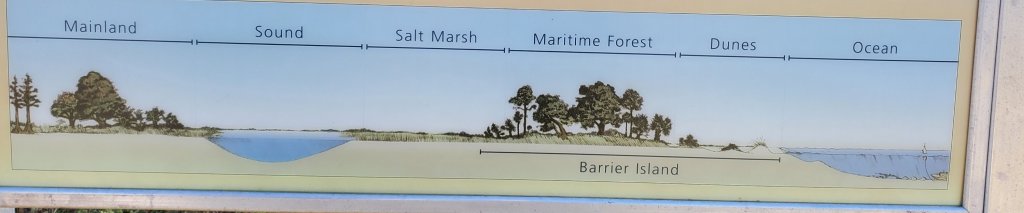
St Marys is the gateway to Cumberland Island, Georgia’s largest and southernmost barrier island. Here pristine maritime forests, undeveloped beaches and wide marshes whisper the stories of both man and nature. Natives, missionaries, enslaved African Americans and Wealthy Industrialists all walked here. Cumberland Island is also home to over 9,800 acres of Congressionally designated Wilderness.
The National Park Service protects almost 36,000 acres of the island, including miles of unspoiled beaches.
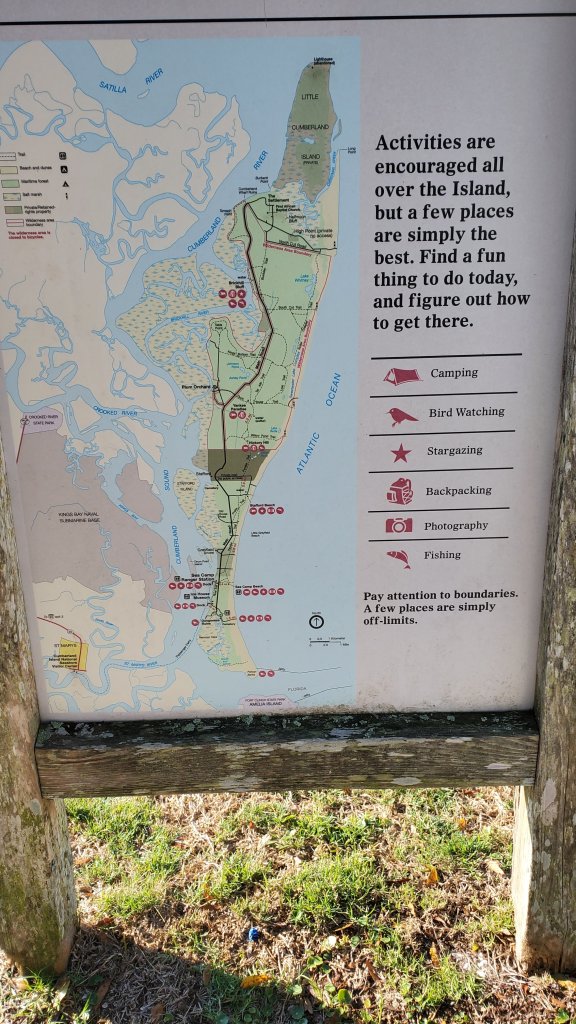
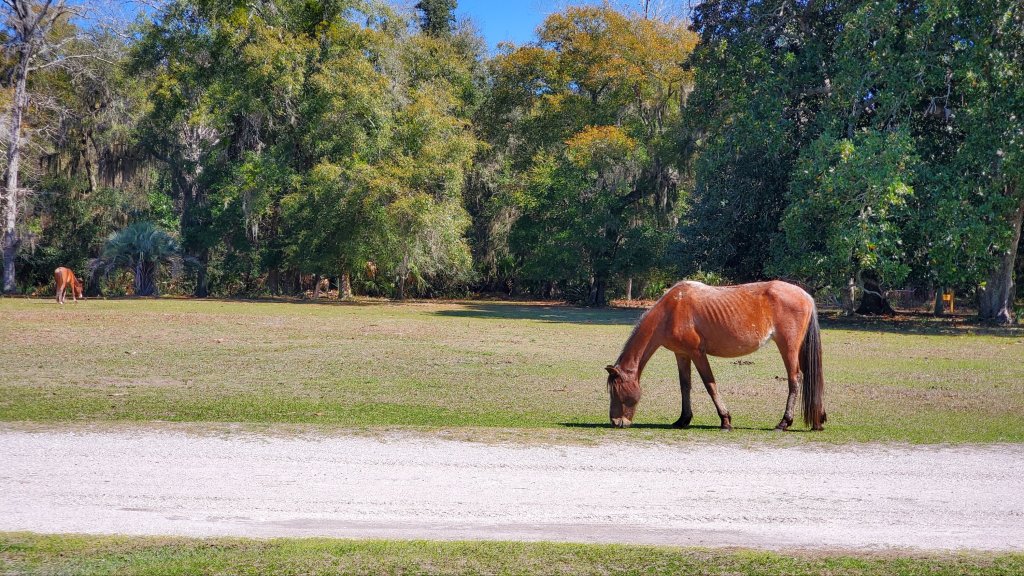
The most intriguing part about Cumberland is its history. Once a working plantation, followed by a winter retreat for the wealthy Carnegie family, Cumberland Island is now home to the descendants of slaves and aristocrats, as well as wild horses with bloodlines that trace to the royal stables of the King of Arabia.
History that has a more specific record starts with the early Spanish missions in the 16th century. In the 1730s, James Edward Oglethorpe laid out two forts, one on each end of the Island. In the 1750s, aspiring planters came to the Island once slavery was allowed on its shores. After the American Revolution, prestigious families, such as that of Nathaniel Greene, became interested in Cumberland’s natural resources; the first mansion was built on the site we now know as Dungeness.
The British were present at Cumberland early in the nineteenth century. The Civil War had a profound effect on the Island’s human history, and Reconstruction saw both speculators and freed slaves trying to wrest a living out of the chaotic devastation the war had caused.
In the early 1880s, Thomas Morrison Carnegie and his wife, Lucy Coleman Carnegie, came to the Island and established the family’s presence, which exists to the present day. In the 1960s the human population began to diversify somewhat as the land started to leave the exclusive holdings of individual families, and the evolution of the National Seashore began.

The horses which roam freely on Cumberland are feral, meaning that their ancestors were once domesticated. Legend has it that they were originally brought to the Island by the Spanish
Feral hogs also may be seen on Cumberland. They are much more destructive than the armadillos on the undergrowth of the Island, and compete with the deer and other large animals for foliage
Native Americans
The Mocama were a Native American people who lived in the coastal areas of what are now northern Florida and southeastern Georgia. A Timucua group, they spoke the dialect known as Mocama, the best-attested dialect of the Timucua language. Their territory extended from about the Altamaha River in Georgia to south of St. Augustine, Florida, covering the Sea Islands and the inland waterways, including the mouth of the St. Johns River in present-day Jacksonville and the Intracoastal.
The Spanish came to refer to the entire area as the Mocama Province, and incorporated it into their mission system. The Mocama Province was severely depopulated in the 17th century by infectious disease and warfare with other Indian tribes and the English colonies to the north. By 1733, it had become too depopulated and helpless to resist James Oglethorpe‘s founding of the English colony of Georgia.
The area has yielded some of the oldest known pottery from what is now the United States.
 Louise and Brian McLeod Travel Blog
You must be logged in to post a comment.