I don’t know if I can take any more of these beautiful mornings. They are almost too good to be true. We had a leisurely get up since we don’t have to beat the crowds into the park and we don’t have far to go today.
Breakfast was half of the egg bites I baked on Thursday night. Every recipe is different since I use whatever I have that needs to be eaten up. This time I added the leftover baked potato. They were delicious, a cross between a hash brown and a tortilla Español with cheese. I will have to remember that. Combined with my homemade Spelt bread and our lattes it was a great way to start the day.
I found a quilt shop in Livingston where we just happen to be stopping for gas this morning. My husband thinks I should make a quilt for the van with all the fabric I have been purchasing as a memory of this trip. Now we HAVE to find fabric stores on the return trip to complete the loop. I love it when I have a new project to look forward to. Fabric store mission successful along with food shopping at Albertsons just down the road.

Today’s route follows the Yellowstone River with railroad between the river and the highway aka Paradiso Valley. We are back into hay bales and cattle country and sheep along with corn. There appears to be a fair amount of beekeeping as well judging by the number of beehives. Are they for honey, pollination or both?
The Yellowstone River
Rivers radiate in every direction from America’s first national park. But only one merits the name Yellowstone. Although its headwaters lie just outside the declared park border in Wyoming’s southern Absaroka Range, the Yellowstone River knows no bounds.
Cutting a diagonal northeast channel across Montana for nearly 700 miles to its confluence with the Missouri River in North Dakota, the Yellowstone River is the longest free-flowing river in the lower 48 states. Within and around Yellowstone National Park, its prestige is punctuated by picturesque waypoints including aptly named Inspiration Point overlooking the thunderous Upper and Lower Falls of the Yellowstone, plummeting 109 feet and 308 feet, respectively, into the near mythical Grand Canyon of the Yellowstone and Black Canyon of the Yellowstone beyond.
North of Yellowstone Park, the river passes through the sublime Paradise Valley, which offers more than 100 miles of Montana’s most popular floating and fishing as it flows casually between the Gallatin and northern Absaroka mountains. The Blue Ribbon trout fishery gradually transitions to cool water habitat along the Great Plains near Billings, where endangered Pallid sturgeon and similarly prehistoric-looking paddlefish join the system.
Throughout the Yellowstone River corridor, wildlife ranges from bald eagles to elk, whitetail deer, black and grizzly bears, native Yellowstone cutthroat trout, and so much more. Recreational activities including fishing, hunting, rafting, wildlife watching and even agate-hunting are incredibly popular along the Yellowstone and are a vital part of the local economy.
To this day, the defeat of the massive dam proposal that would have flooded Paradise Valley remains one of the greatest environmental victories in Montana’s history. Recreation-minded conservationists joined together in the 1970s to thwart the dam proposed in Allenspur Canyon that would have forever altered the landscape, ecology and economy of the region.
Yellowstone River – American Rivers
https://www.americanrivers.org/river/yellowstone-river/
Pictograph Cave State Park
We stopped for lunch at Pictograph Cave State Park. It is 93F again.


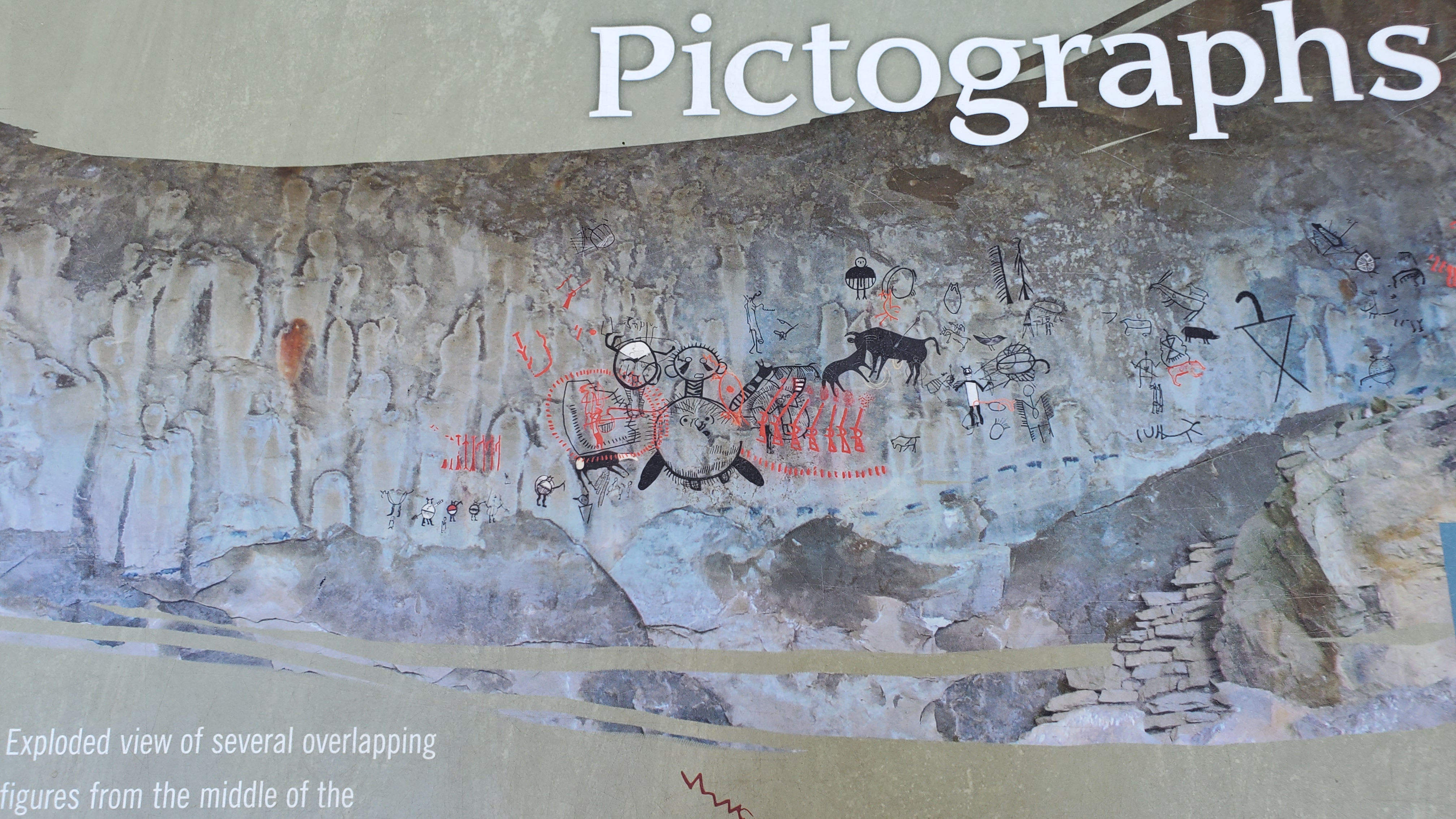
Prehistoric hunters who camped in Pictograph Cave left behind artifacts and over 100 pictographs, or rock paintings. The oldest rock art in the cave is over 2,000 years old. Their interpretations are still subject to debate. The images of animals, warriors and even rifles tell a story that has lasted 9 thousand years.
The park’s three main caves – Pictograph, Middle, and Ghost cave – were carved from the Eagle sandstone cliff by the forces of water and wind. The first recorded discovery of artifacts and paintings in the caves was made in 1936. Approximately 30,000 artifacts, ranging from stone tools, weapons, paintings and the instruments used, were excavated from the site.
We walked the 3/4 loop trail to the caves. It reminded me of Mesa Verde but of course much smaller and probably older… and no ladders to climb.


I don’t need to go looking for deer. They just show up. Our campsite is next to a grassy field. As I was sitting at the picnic table preparing a salad, a herd of about 7 or 8 came into the field for a sunset graze. We have whitetails at home in our backyard. I am constantly chasing them away as they use my garden for a bedtime buffet or an early morning breakfast. These are on someone else’s property so they are acceptable. They are lovely though.
It is a beautiful evening.
 Louise and Brian McLeod Travel Blog
You must be logged in to post a comment.